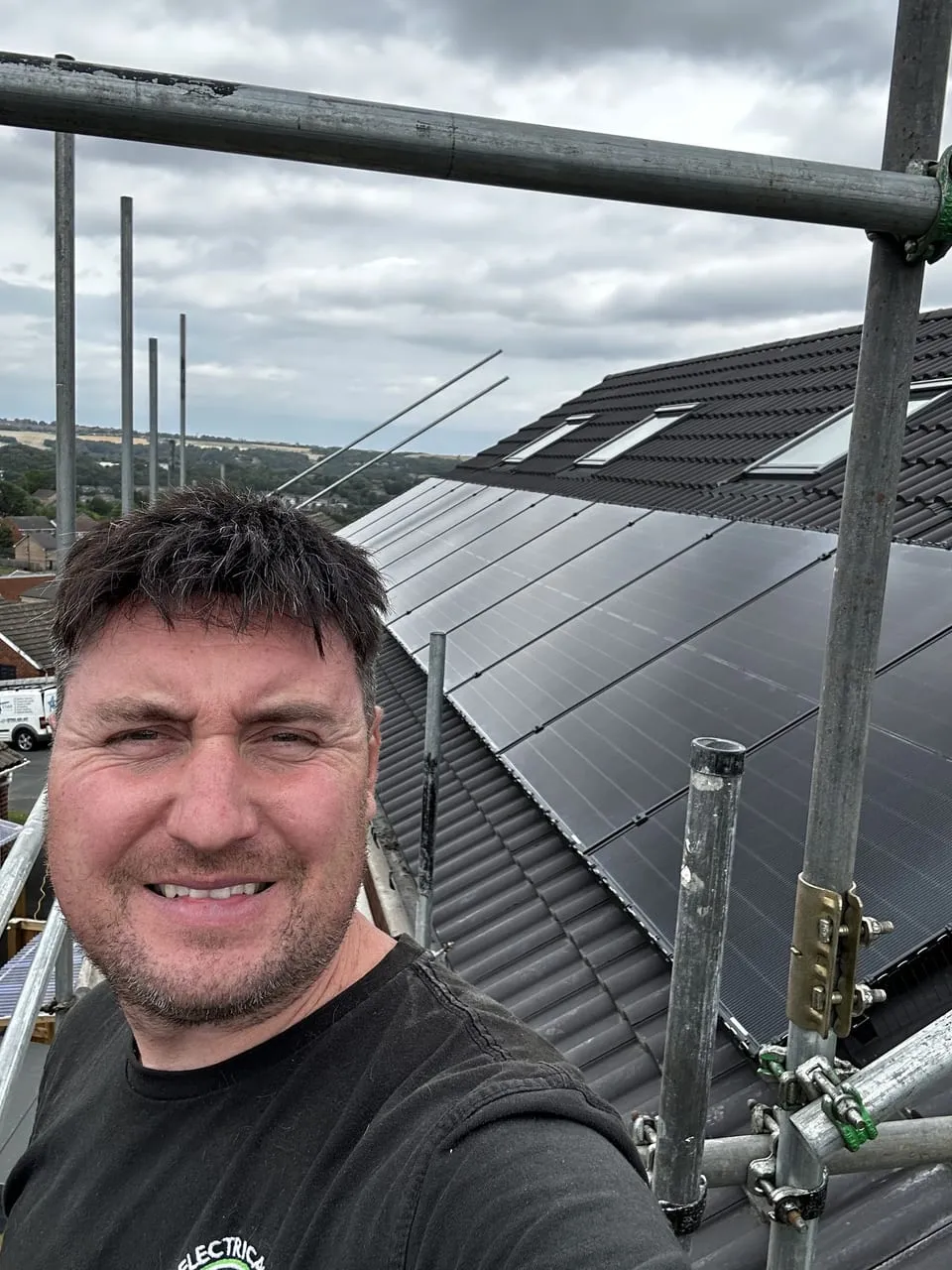
A 100kW solar array sits in an odd spot in the market: too big for most domestic installers, too small to interest the utility-scale developers. That gap is exactly where a lot of UK businesses — a mid-size distribution shed, a farm with three barn roofs, a hotel or a manufacturing unit — actually live. If you’ve been quoted anything from £70,000 to £120,000 and you’re not sure what’s reasonable, here’s the real number, the real output, and the real payback maths for 2026.
What a 100kW system actually costs installed
For commercial-scale solar, pricing is quoted per kWp (kilowatt-peak), not per panel. In 2026, expect £900–£1,200 per kWp for a straightforward commercial rooftop install, which puts a 100kW system at roughly £80,000–£110,000 fully installed, including scaffolding or access equipment, mounting structure, string or hybrid inverters, DC/AC cabling, G99 grid application, and commissioning.
Where you land in that range depends on:
- Roof type — a standing-seam metal roof on a warehouse is quicker and cheaper to fix panels to than an older asbestos-cement roof needing over-cladding or a flat felt roof needing ballasted trays.
- Grid connection — a straightforward G99 application with spare capacity on the local substation is far cheaper than one needing reinforcement work from the DNO, which can add weeks and thousands of pounds.
- Access — single-storey sheds with good vehicle access are simpler than multi-level or listed buildings.
- Inverter choice — string inverters are the cheaper, more common choice at this scale; some installers now offer optimised or hybrid setups if you’re planning battery storage later.
- Battery storage — this figure is solar-only. Adding commercial battery storage is a separate cost layer entirely (more on that below).
For context on how this scales, it’s worth comparing against commercialsolarcostuk.co.uk, which tracks per-kWp pricing across the full commercial range from 20kW up to multi-megawatt ground-mount, and against commercialsolarpanelsinstallation.co.uk for a broader breakdown of what’s included in a typical commercial install spec.
VAT: the 0% window matters here
Residential solar and battery storage in Great Britain currently sits at 0% VAT until 31 March 2027, after which it’s scheduled to revert to 5%. Whether a 100kW commercial install qualifies for the relief depends on the nature of the building and the relevant use — this relief was designed around residential and certain qualifying installations, not blanket commercial premises, so get this confirmed in writing from your installer or accountant before you assume it applies to your quote. Don’t take a verbal assurance at face value on a six-figure spend.
How much power does 100kW actually generate?
UK solar yield varies by location, roof pitch, orientation and shading, but a reasonable planning figure is 850 kWh per kWp per year for an average UK site, rising to 1,000–1,050+ kWh/kWp in the sunniest parts of the south coast and East Anglia with a well-oriented roof.
That means a 100kW system will typically produce:
| Location profile | Annual yield estimate |
|---|---|
| Northern England / Scotland, average orientation | ~78,000–85,000 kWh/yr |
| Midlands / average UK site | ~85,000 kWh/yr |
| Southern England, good orientation, low shading | ~95,000–105,000 kWh/yr |
So the 85–90 MWh/yr figure often quoted for a 100kW system is a fair mid-range planning number for most of the UK, not an outlier — but always ask your installer for a site-specific PVsyst or similar yield estimate rather than relying on a generic rule of thumb, since roof pitch and any shading from plant, trees or neighbouring buildings can move the number materially.
The payback maths
Payback on commercial solar comes down to how much of that generation you actually use on-site versus how much you export. This is the single biggest variable in any commercial solar calculation, and it’s where a lot of quotes get too optimistic.
The two extremes:
- If a business uses most of its generation directly (a business running daytime shifts, refrigeration, HVAC, or continuous processes) and pays close to the ~25p/kWh Ofgem-cap-adjacent import rate, the value of every self-consumed unit is high.
- If a business exports a large share of what it generates (weekend-closed offices, seasonal operations), it’s paid at whatever its supplier’s Smart Export Guarantee (SEG) rate is — and SEG rates vary significantly by supplier, from a few pence up to around 12–20p/kWh at the top end. There’s no fixed national export tariff, so it pays to shop the SEG market rather than accept whatever your existing supplier offers by default.
Worked example (100kW system, 87,000 kWh/yr generation, £95,000 installed):
- Assume 65% self-consumption (56,550 kWh) valued at 25p/kWh = £14,138
- Assume 35% exported (30,450 kWh) valued at 15p/kWh SEG = £4,568
- Total annual value: ~£18,700
- Simple payback: ~5.1 years
Push self-consumption up to 80% (a business with strong daytime demand) and the annual value rises to roughly £21,500, pulling payback closer to 4.4 years. Businesses with very high daytime self-consumption and good export rates can get into the 3-year range quoted in some marketing material — but that’s the favourable end of the range, not the average case. A realistic planning window for most commercial 100kW installs is 3–5 years pre-tax-relief, with 4–5 years being the more common outcome once you account for typical self-consumption profiles.
After payback, with panels degrading at roughly 0.4%/year on modern N-type modules and rated for 25–30+ years of service, you’re looking at two decades-plus of near-free generation, with the main ongoing costs being inverter replacement (typically once, at 10–15 years, £500–£1,000+ at this scale multiplied across however many string inverters are fitted) and periodic panel cleaning/inspection.
Tax relief accelerates payback further
The figures above are pre-tax-relief, as specified, but it’s worth knowing that capital allowances can meaningfully shorten the real payback period for a limited company. Solar PV can qualify for the Annual Investment Allowance (AIA), letting you offset the full cost against taxable profit in the year of purchase up to the AIA threshold, which for many mid-size commercial installs like this can cover the full spend. That doesn’t change the cashflow-break-even point in the table above, but it does change the effective net cost and the tax-adjusted payback — a conversation worth having with your accountant before committing, particularly if the deal is time-sensitive around your company’s financial year end.
What this looks like by sector
A 100kW system suits a specific band of buildings — roughly 800–1,200m² of usable, largely unshaded roof space, depending on panel efficiency and layout constraints. That’s typically:
- Farms and agricultural buildings — a couple of large barn roofs or a modern grain store roof, where solarpanelsforfarms.uk and solarpanelsforagriculture.co.uk both cover the specific considerations around Improving Farm Productivity grant eligibility (England, roughly 25% of eligible cost — rates differ by nation, so check the current scheme for Wales, Scotland or Northern Ireland) and standing-seam vs box-profile roof fixings.
- Warehouses and distribution units — a very common fit for this system size; see solarpanelsforwarehouses.co.uk and solarpanelsforindustrialunits.co.uk for load-bearing and roof-condition guidance specific to steel-portal-frame sheds.
- Hotels and hospitality — daytime and evening demand patterns that suit high self-consumption; solarpanelsforhotels.co.uk covers the occupancy-driven load profile angle in more depth.
- Care homes and continuous-occupancy buildings — 24/7 demand is about as good as it gets for self-consumption economics; solarpanelsforcarehomes.co.uk is worth a read if this is your sector.
If your roof or land can’t quite reach 100kW on its own but you’ve got car park space, it’s also worth looking at solarcarparks.co.uk for canopy structures that add generation capacity without needing more roof.
Should you add battery storage?
At 100kW scale, battery storage isn’t cheap, but it can materially improve the self-consumption percentage that drives the payback maths above — shifting exported daytime generation into evening or early-morning use instead of selling it at SEG rates. batterystorageforbusiness.co.uk breaks down commercial battery sizing and cost per kWh at this scale, which sits well above domestic Powerwall-class pricing once you’re specifying industrial battery cabinets.
Financing routes if £95,000 upfront isn’t realistic
Not every business wants to find six figures in cash. Asset finance, PPAs (power purchase agreements where a third party owns and maintains the system and you buy the power at a discount to grid rates) and commercial solar loans are all live options at this scale. commercialsolarfinance.co.uk and solarpowerpurchaseagreements.co.uk both cover how these structures change the payback calculation — a PPA removes the capex entirely but also removes the long-term ownership upside, so it’s a trade-off worth modelling properly rather than defaulting to.
Getting a proper quote
Because self-consumption profile is the single biggest lever on payback, any quote worth taking seriously should include a site-specific yield estimate and a load-profile-matched self-consumption estimate, not just a generic “average” figure lifted from a spreadsheet. For a wider sense of how commercial pricing compares across system sizes before you commit to 100kW specifically, thecostofsolar.co.uk’s commercial solar panel costs page is a useful cross-check, and our solar panel payback period guide walks through the self-consumption-versus-export maths in more detail for smaller systems, where the same principles apply at a different scale.
Regional installers who work regularly at commercial scale are worth talking to directly for a site survey — among others, Premier Electrical Renewables and EC Eco Energy both handle commercial-scale solar installs and can give you a roof-specific yield estimate rather than a generic one, which is the only way to turn this article’s ranges into a number you can actually plan around.
The bottom line
A 100kW commercial solar system costs roughly £80,000–£110,000 installed in 2026, generates somewhere around 78,000–105,000 kWh a year depending on location and roof orientation, and pays back in 3–5 years pre-tax-relief — with the exact figure driven almost entirely by how much of that generation you use on-site versus export. Get a site-specific survey, shop your SEG rate properly rather than accepting your supplier’s default, and talk to your accountant about capital allowances before you sign anything. The maths on commercial solar at this scale is genuinely strong in 2026 — but only if the self-consumption assumption behind your quote reflects how your building actually uses power.