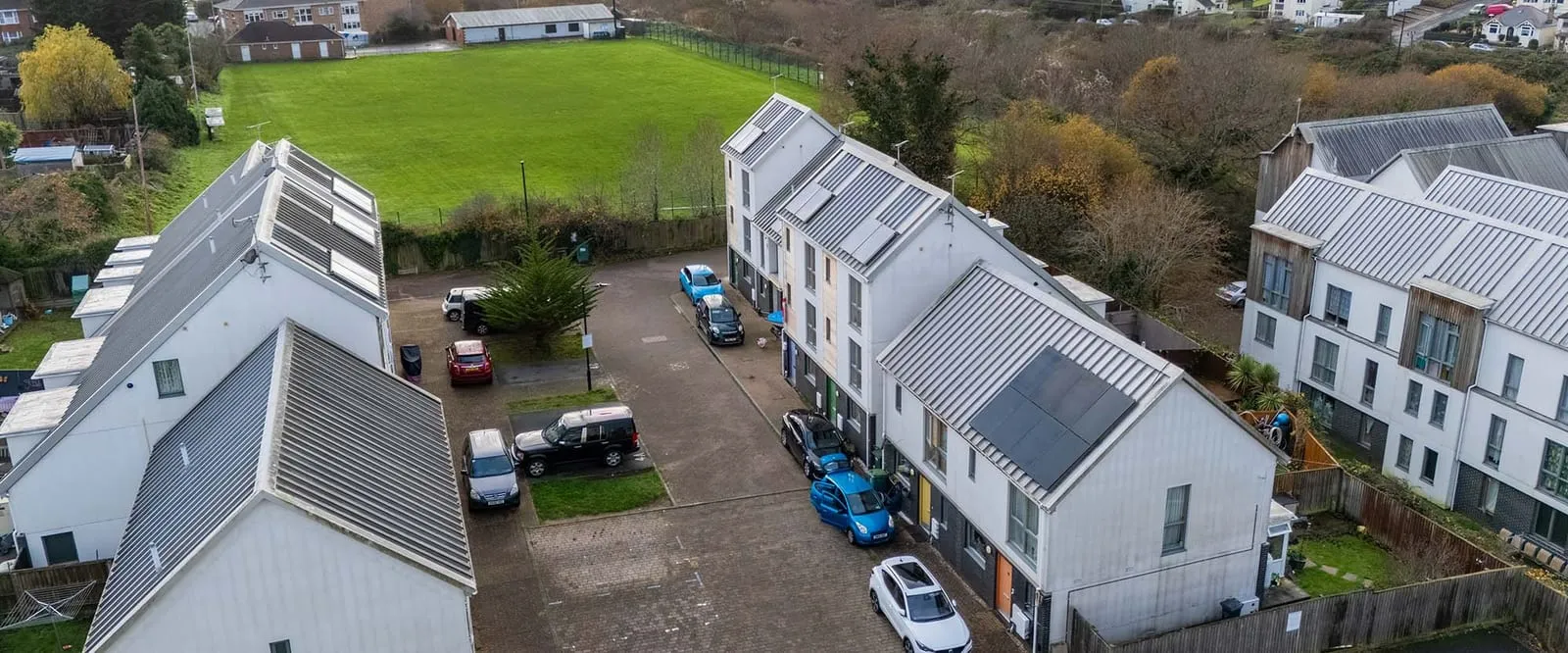
A 50kW solar array sits in an odd but valuable gap: too big to be a “domestic-plus” system, too small to need the drawn-out grid reinforcement studies that trip up multi-megawatt commercial arrays. For UK businesses working out what to spend and what to expect, that middle ground is worth understanding properly rather than lumping it in with either residential or industrial-scale pricing.
What a 50kW system actually costs installed
Based on current UK commercial installer rates of roughly £900–£1,200 per kWp for arrays in this size band, a 50kW system typically lands between £42,000 and £60,000 installed, before any battery storage. Where you sit in that range depends on:
- Roof type and access — a straightforward standing-seam metal roof on a single-storey warehouse costs less to mount on than a complex multi-pitch slate roof or a ground-mount requiring civil works and fencing.
- Panel and inverter spec — Tier-1 N-type modules (TOPCon or HJT, degrading around 0.4% a year with 25–30+ year lifespans) sit at the upper end; commodity panels bring the number down but usually with weaker warranties.
- String vs. hybrid inverter setup — string inverters typically last 10–15 years and cost £500–£1,000 each to replace when the time comes; a hybrid setup ready for future battery integration costs more upfront.
- Distance from the grid connection point and scaffolding/access complexity.
- VAT — currently 0% on qualifying residential installations until 31 March 2027, but most 50kW commercial installations sit outside that relief and attract standard-rate VAT, which is usually reclaimable for VAT-registered businesses anyway.
For a clean like-for-like breakdown of where the money goes at this scale, commercialsolarcostuk.co.uk is worth cross-referencing — it’s built specifically around commercial cost benchmarking rather than domestic pricing dressed up for business readers.
Why 50kW is the sweet spot, not just a round number
The appeal of 50kW isn’t arbitrary — it’s largely a function of UK grid connection rules.
G98 vs G99. Systems up to 16A per phase (roughly 3.68kW single-phase, or around 11kW three-phase) qualify for the simplified G98 “connect and notify” process. Anything larger — including every 50kW system — falls under G99, which requires formal application to the local Distribution Network Operator (DNO) before connection. That’s a genuine extra step, but at 50kW it’s usually a routine, fast-tracked application rather than the kind of detailed network impact study that gets triggered for arrays in the hundreds of kW or low-MW range, where reinforcement costs and multi-month queue times become real risks.
In practice, that means a 50kW system typically clears G99 approval in weeks, not the many months (or years, in constrained parts of the network) that larger commercial or ground-mount solar farms can face. You still need a DNO application and, depending on your local substation capacity, there’s a small chance of needing reinforcement works — but for most sites with reasonable existing three-phase supply, 50kW rarely triggers anything drastic.
Physical footprint. At roughly 4–5 panels per kWp of roof space with modern high-efficiency modules, 50kW needs somewhere in the region of 2,000–2,500m² of usable roof or ground — achievable on a mid-sized industrial unit, a large retail shed, a farm building, or a business park roof without needing an entire estate.
Financial proportionality. A £42k–£60k outlay is a serious but board-approvable capital decision for an SME, rather than requiring the kind of project financing structure a £500k+ multi-hundred-kW array often needs. It also sits comfortably within many businesses’ annual capital allowances planning, and can increasingly be financed through commercial solar loans or asset finance rather than paid outright — worth exploring via specialists like solarassetfinance.co.uk if cashflow, not just payback period, is the constraint.
Who actually suits a 50kW system
Small-to-medium manufacturers and workshops. Businesses running machinery, compressors, or continuous processes during daylight hours get the best match between generation and consumption — self-consumption rates well above 50% are realistic, which is where the real savings sit rather than in export income.
Farms with substantial daytime electrical loads. Grain drying, refrigeration, milking parlours and irrigation pumps all draw power during exactly the hours a 50kW array is producing. solarpanelsforfarms.uk and solarpanelsforagriculture.co.uk both cover the sector-specific considerations — including that England’s farm solar support currently runs through the Improving Farm Productivity grant at roughly 25% of eligible cost (not the old FETF 40% figure some sites still quote), with different schemes and rates across Scotland, Wales and Northern Ireland.
Retail units, care homes and small hotels. Daytime footfall and near-constant HVAC/refrigeration loads make 50kW a good structural fit — see the sector detail at solarpanelsforcarehomes.co.uk and solarpanelsforhotels.co.uk for load-profile specifics that affect sizing decisions.
Warehouses and distribution units with large, unshaded roofs but moderate energy demand — where 50kW is a sensible first phase rather than maxing out the whole roof in one go. solarpanelsforwarehouses.co.uk and solarpanelsforlogistics.co.uk both discuss phased approaches for exactly this scenario.
Who it doesn’t suit: businesses with genuinely low daytime demand (a 50kW array exporting most of its output to the grid at 12–20p/kWh makes for a much longer payback than one offsetting import at ~25p/kWh), and very large sites where 50kW simply won’t scratch the surface of the energy bill and a proper feasibility study for 100kW+ makes more commercial sense — that’s the territory covered by commercialsolarpanelsinstallation.co.uk, which is the better starting point once you’re planning meaningfully above this band.
Payback and the numbers that matter
With UK yields averaging around 850 kWh per installed kWp per year (rising toward 1,050+ kWh/kWp in the sunniest parts of the south), a well-sited 50kW system should generate somewhere in the region of 42,500–52,500 kWh annually.
At a rough blend of self-consumption (offsetting import at ~25p/kWh) and export (via the Smart Export Guarantee, which is supplier-set and typically 12–20p/kWh at the better end, not a fixed national rate), annual savings and export income commonly fall in the £8,000–£13,000 range for a business with decent daytime demand — though this varies significantly with actual consumption pattern. That puts simple payback for many commercial 50kW installations somewhere between 4 and 7 years, with 20+ years of further production after that on modern panel warranties. For the detailed maths and a general framework you can apply to your own consumption data, our own commercial solar panel cost breakdown and payback period guide walk through the calculation step by step, and the solar panel calculator lets you run rough numbers against your own roof size and usage.
MCS certification matters here too — it’s the precondition for SEG eligibility, and any installer quoting for a 50kW system should be MCS-certified as standard (this is now near-universal across serious UK commercial installers, part of why 2025 saw a record 257,397 MCS-certified installs nationally).
Installers actually working at this scale
Several SEO Dons network installers regularly quote and deliver commercial arrays in the 50kW band, alongside larger commercial-scale work:
- Ecoaim in Livingston covers Central Scotland commercial and battery installations, relevant given Scotland’s different grant landscape via Home Energy Scotland.
- EC Eco Energy in Essex specialises in commercial solar and battery work across East Anglia, a good fit for the warehouse/logistics profile common in that region.
- D&R Energy handles commercial solar around Bristol and the South West.
- Green Linc Renewables in Lincolnshire is MCS-certified and well placed for the agricultural and rural commercial market that suits this system size.
Getting two or three comparative quotes at this scale is worth the time — the spread between a competent installer and a cut-price one shows up not in the panels (which are broadly commoditised at Tier-1 level) but in the DNO application handling, the inverter and mounting spec, and the aftercare. For ongoing performance monitoring once a system’s live, solarmaintenancesolutions.com covers the O&M side that a lot of commercial buyers forget to budget for until year three or four, when string inverter replacement or panel-level fault-finding starts to matter.
The practical checklist
Before committing to a 50kW quote, confirm: three-phase supply capacity at the site, roof condition and remaining lifespan (re-roofing under an existing array is expensive and disruptive), whether the DNO’s G99 application is being handled by the installer or falls to you, and whether battery storage is worth adding now versus retrofitting later — a hybrid inverter specified upfront avoids paying twice for inverter capacity if a battery follows in year two or three.
50kW won’t suit every commercial site, but for the daytime-load-heavy SME sector — workshops, farms, care homes, retail units and mid-sized warehouses — it remains one of the cleanest capital-to-payback propositions in UK commercial solar, precisely because it sits just below the regulatory and financial complexity that larger systems bring.