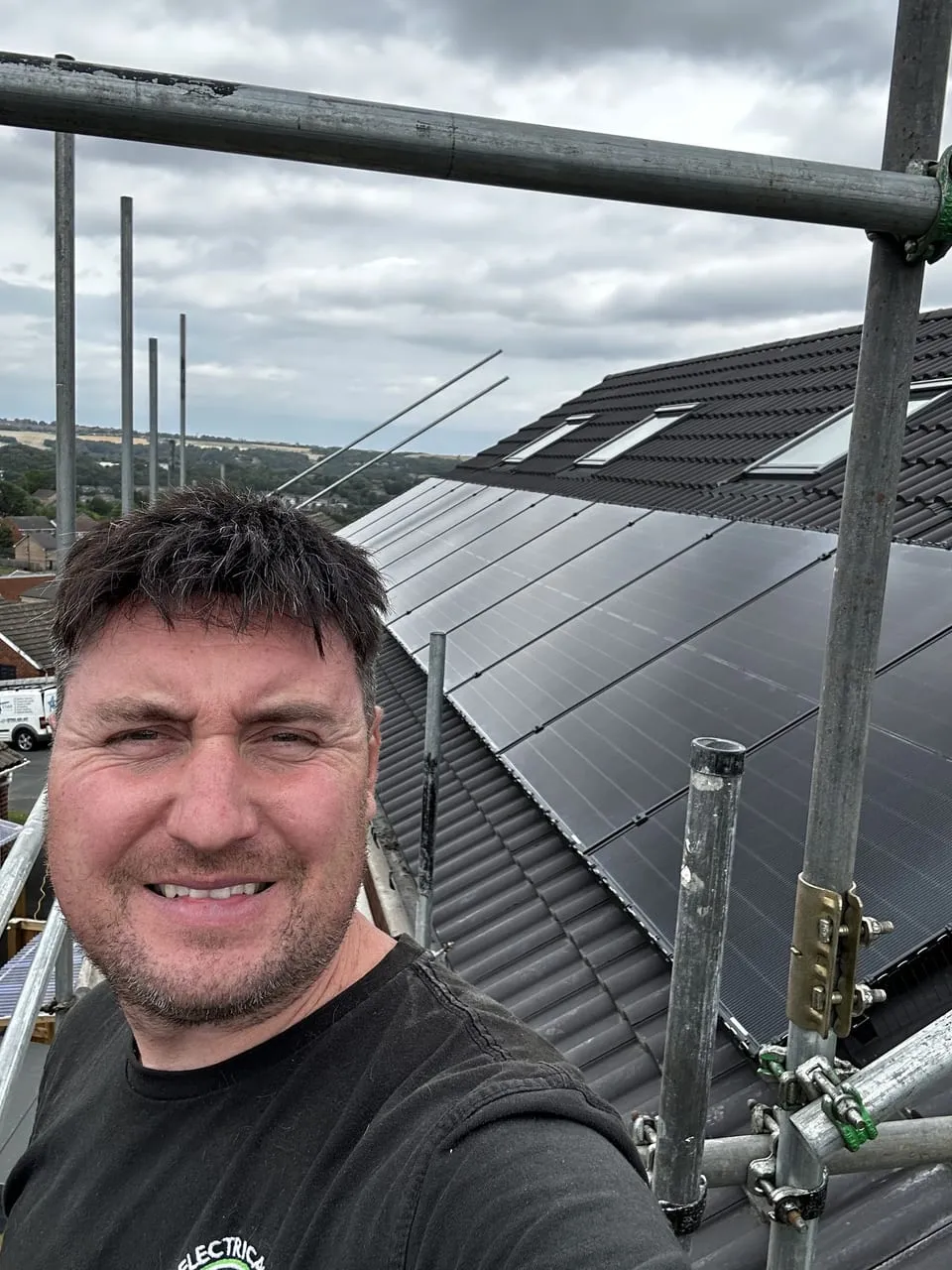
Bradford’s commercial roof stock is a different animal to the terraced streets that made the district famous for wool and worsted. Along the M606 corridor and the industrial estates ringing the city, factory units, warehouses and distribution sheds carry acres of south-facing roof that mostly sit empty. With energy costs still the single biggest controllable overhead for most local firms, the question isn’t really “should we look at solar” any more — it’s “what does it actually cost here, and how fast does it pay back.”
This piece works through the real numbers: what Bradford businesses pay per kWp against the national £900–£1,200/kWp benchmark, how that stacks up against a typical local commercial energy bill, where the best roof stock sits, and what Bradford Council’s climate commitments mean for firms weighing up the investment.
Bradford’s commercial solar market in context
Bradford District — population 546,412 — sits within the Yorkshire and the Humber region, where solar yield averages around 860 kWh per installed kWp per year. That’s a shade below the sunnier south of England (where 1,000+ kWh/kWp is achievable) but entirely workable for commercial payback, especially on the large, unshaded, well-oriented roofs typical of industrial units rather than the compromised roof pitches of domestic streets.
The district’s average house price of around £155,000 — below the England average — is a useful proxy for the wider economic profile: this is a region where controlling fixed costs matters more than in higher-margin southern markets, and where a multi-year payback on a capital asset needs to genuinely stack up rather than be a nice-to-have sustainability gesture.
Bradford Council has set a district-wide net-zero target of 2038, ahead of the UK’s national 2050 goal, set out through the Bradford District Sustainable Development Action Plan. Commercial and industrial decarbonisation is a core plank of that plan — the West Yorkshire Combined Authority’s Net Zero Toolkit is explicitly applicable to Bradford businesses assessing on-site generation, giving firms a framework (rather than a mandate) for building the business case for rooftop solar into wider capital planning. None of this forces a business to install anything, but it does mean solar sits inside a live regional policy conversation rather than outside it — useful context if you’re bidding for supply-chain contracts where scope 1–3 emissions reporting is increasingly a tender requirement.
What commercial solar actually costs in Bradford
There’s no verified Bradford-specific per-kWp rate published anywhere, and treat any site that quotes one with suspicion — installers price against roof access, scaffolding, structural surveys, distribution network operator (DNO) grid connection costs and inverter/battery specification, not postcode. What you can rely on is the national commercial benchmark, and Bradford’s roof stock generally sits at the favourable end of it.
| System size | National cost band (£900–£1,200/kWp) | Typical Bradford application |
|---|---|---|
| 20 kWp | £18,000–£24,000 | Small industrial unit, single-tenant workshop |
| 50 kWp | £45,000–£60,000 | Mid-size factory or warehouse roof |
| 100 kWp | £90,000–£120,000 | Larger distribution shed, full roof array |
| 250 kWp+ | £225,000–£300,000+ | Multi-let estate roof, major logistics unit |
Bradford’s industrial estates tend to favour the lower-cost end of that band. Sites like Euroway, Buck Lane and Tong Park are dominated by single-storey, steel-portal-frame sheds with large uninterrupted roof plates, minimal shading from neighbouring structures, and straightforward crane/scaffold access — exactly the roof profile that keeps installation costs down relative to a cluttered multi-storey city-centre building. Roof condition (particularly on older 1970s–90s asbestos-cement sheeting, common on estates of that era) is usually the biggest cost variable — a structural and roof-condition survey before quoting is essential, and can add cost if reinforcement or overlay sheeting is needed before panels go up. For a genuinely comparable cost breakdown against the national picture, commercialsolarcostuk.co.uk is a useful benchmark to check any quote against before signing.
Modelling the payback against a real Bradford energy bill
Average commercial energy spend for a Bradford business sits around £35,000 a year — a useful anchor for working out what solar actually displaces, rather than working from a hypothetical “typical UK business” figure that may bear no relation to a real Euroway unit’s meter readings.
Take a 50 kWp system, roughly the size that fits a mid-range factory or warehouse roof on one of Bradford’s industrial estates. At the region’s ~860 kWh/kWp/yr yield, that system generates around 43,000 kWh annually. Assuming a realistic commercial self-consumption rate of 65–75% (daytime-heavy operations like manufacturing and warehousing self-consume more than office-only sites), roughly 28,000–32,000 kWh offsets grid import at something close to the current ~25p/kWh commercial rate, saving in the region of £7,000–£8,000 a year. The remaining exported surplus, sold under the Smart Export Guarantee at rates that vary considerably by supplier — typically 12–20p/kWh at the better end, and only available to MCS-certified installations — adds a further £1,500–£2,000.
Put together, a 50 kWp system costing £45,000–£60,000 installed against roughly £35,000/yr of energy spend can realistically save £9,000–£10,000 a year, putting simple payback in the five-to-seven-year range — squarely in line with what commercial solar typically returns nationally. That’s before accounting for capital allowances: solar PV generally qualifies for Annual Investment Allowance, letting VAT-registered businesses offset the full cost against taxable profit in the year of purchase, which meaningfully improves the after-tax return. Note that the 0% VAT relief introduced for residential solar and battery storage does not extend to commercial installations — standard-rated VAT normally applies to a business installation, though it’s usually reclaimable for VAT-registered firms in the normal way. These are illustrative figures, not a quote: shading, roof pitch, tenancy structure (single-let vs multi-let estate) and your actual half-hourly consumption profile all move the number meaningfully, which is exactly why a site survey matters more than a spreadsheet. For the underlying methodology on how commercial payback periods are actually calculated, thecostofsolar’s payback period guide and commercial solar panel cost breakdown walk through the maths in more depth, and the solar panel calculator is a reasonable starting point for sizing before you get a site-specific quote.
Where the roof stock is: Bradford’s industrial estates
Bradford’s commercial solar opportunity is concentrated on its industrial estates rather than its historic core. Euroway, close to the M606, hosts a mix of logistics, light manufacturing and trade counter units with the kind of large flat and shallow-pitch roofs that suit array design well. Buck Lane and Tong Park carry similar stock — established industrial units, many dating from the district’s post-textile industrial diversification, now housing everything from engineering firms to distribution operations. These aren’t heritage buildings requiring planning sensitivity; they’re working sheds where the only real constraints are roof condition, structural loading capacity and DNO grid capacity for larger arrays.
That last point matters more than most quotes acknowledge. Bradford’s grid capacity varies estate by estate, and a 250 kWp+ array on an older industrial estate may need a DNO application and reinforcement works that add months to the timeline — worth raising with an installer at the enquiry stage, not after a contract is signed.
The wider decarbonisation of this stock connects directly to Bradford’s textile heritage: a district that built its economy on power-intensive mills is now looking at the same industrial roof space as a genuine generation asset rather than a legacy liability, which is precisely the kind of transition the Bradford District Sustainable Development Action Plan and WYCA’s Net Zero Toolkit are designed to support.
Choosing an installer for a Bradford commercial project
MCS certification isn’t optional if you want SEG export payments, and it’s also the baseline credential worth checking before any commercial roof survey. YEERS across Yorkshire covers commercial solar, battery storage, heat pump and EV charging installs regionally and is a sensible starting point for a Bradford quote given the geographic fit. For firms closer to the South Yorkshire side of the region, ElectriFusion Solutions — based in Doncaster — handles commercial solar and electrical work across South Yorkshire and is worth a comparison quote, particularly for sites nearer the M18/M62 corridor. Get at least two structural surveys before committing; roof condition on older industrial sheds is the single biggest source of quote variance, and a proper survey (not a desktop estimate) is the only way to know whether you’re looking at £900/kWp or £1,200/kWp for your specific building.
For the wider commercial context — market growth, MCS install volumes, and how commercial solar demand is shifting nationally — SolarWeekly’s 2026 UK solar industry data is a useful trade-side companion to the pricing picture here, and if your Bradford site is a warehouse or distribution shed specifically rather than a mixed-use factory unit, solarpanelsforwarehouses.co.uk and solarpanelsforindustrialunits.co.uk both go deeper on roof-type-specific specification than a general commercial guide can. For finance structuring — leasing vs outright purchase vs a power purchase agreement — commercialsolarfinance.co.uk lays out the options without pushing you toward any one route.
If you want a Bradford-specific starting point that goes beyond this piece — local case studies, grid connection notes and a quote process tailored to the district’s industrial estates — the dedicated page for commercial solar installation in Bradford is the natural next step.
The bottom line
Bradford’s commercial solar economics aren’t exotic — they follow the national £900–£1,200/kWp band closely, and the district’s flat, unshaded industrial-estate roof stock at Euroway, Buck Lane and Tong Park sits at the more favourable end of that range. Against an average £35,000 annual commercial energy bill, a mid-size system realistically pays back in five to seven years once Annual Investment Allowance is factored in — a genuinely investable return, not a marginal one. The variable that actually moves the number for any specific Bradford building is roof condition and self-consumption profile, not the postcode, which is exactly why a proper structural survey and a comparison quote from an MCS-certified installer beats any spreadsheet estimate, including this one.