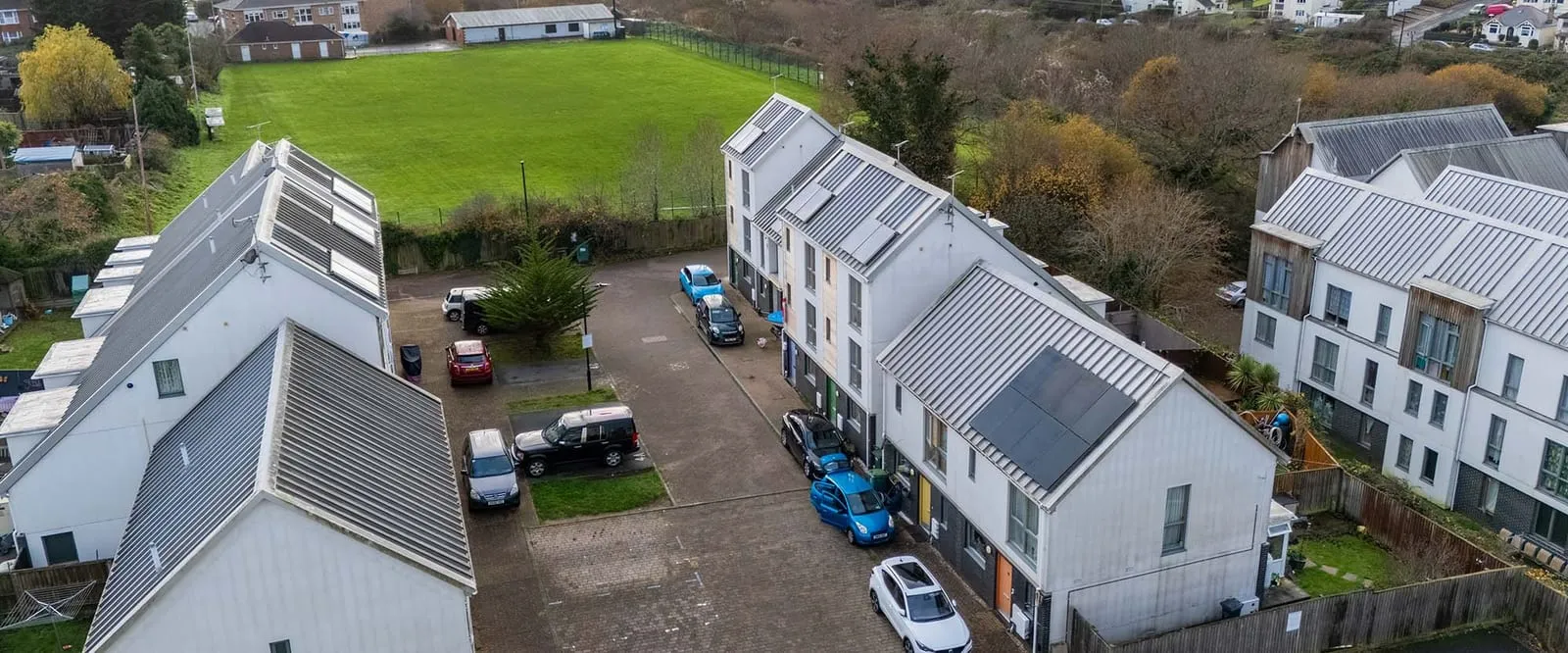
Cardiff businesses are asking a more specific question than they were three years ago. It’s no longer “should we go solar?” but “what will it actually cost us, on our roof, against our bill?” With commercial electricity still sitting well above pre-2021 levels and Cardiff Council pushing a public-sector net-zero target, the arithmetic on a warehouse or office roof in the Welsh capital has shifted from nice-to-have to genuinely worth costing out properly.
This piece works through what commercial solar actually costs in Cardiff, how that compares with the wider UK £/kWp band, what payback looks like against a typical local business energy bill, and which parts of the city have the roof stock to make the numbers work.
Why Cardiff’s commercial energy bills are under the microscope
Cardiff Council has committed the city to net zero by 2030, framed within the Cardiff One Planet Strategy, which sets out how the council intends to cut emissions across its own estate and encourage the wider city to follow. That target sits inside a bigger push: the Welsh Government has set its own public sector net zero by 2030 goal, which is already driving demand for on-site generation among schools, health boards, housing associations and the contractors who service them. When a public body needs a supply chain that can demonstrate lower-carbon operations, commercial solar on a supplier’s own roof becomes a differentiator, not just a cost saving.
For private business, the driver is blunter: energy spend. A typical Cardiff commercial premises — a mid-sized office, workshop or light industrial unit — is spending in the region of £38,000 a year on electricity. That’s not a marginal cost. It’s a fixed, recurring line that a well-specified solar array can cut into permanently, in a way that hedging or switching supplier rarely achieves. Against a backdrop where the average Cardiff house price sits around £270,000 and the city’s population has grown past 372,000, commercial and industrial floorspace across the city is under the same pressure to decarbonise and control costs as the domestic stock is.
What Cardiff businesses actually pay for commercial solar
The UK-wide benchmark for commercial rooftop solar currently sits at roughly £900–£1,200 per kWp installed, and Cardiff isn’t an outlier from that range. South Wales doesn’t carry the scaffolding and labour cost premiums seen in London and the South East, but it also isn’t the cheapest region in the UK — expect quotes to land in the middle-to-lower half of the national band for straightforward flat-roof commercial installs, with the top end reserved for smaller systems, complex roof structures, or jobs needing significant electrical upgrade work alongside the array.
| System size | Typical installed cost (Cardiff, commercial) | Approx. annual generation at ~900 kWh/kWp |
|---|---|---|
| 30 kWp (small office/workshop) | £27,000 – £36,000 | ~27,000 kWh |
| 50 kWp (light industrial unit) | £45,000 – £60,000 | ~45,000 kWh |
| 100 kWp (mid-size warehouse) | £90,000 – £120,000 | ~90,000 kWh |
| 250 kWp (large distribution unit) | £225,000 – £300,000 | ~225,000 kWh |
Two things worth being clear about before those numbers get quoted around a boardroom table. First, this is capital cost only — inverters (typically a 10–15 year component, £500–£1,000 or more to replace on a commercial string setup) and ongoing maintenance sit on top over the system’s life. Second, the 0% VAT relief that’s been widely reported for residential solar and battery storage in Great Britain (running until 31 March 2027) applies to domestic installations, not commercial ones — standard-rate VAT normally applies to a business installation, so don’t build a rate assumption into your business case that doesn’t hold for your premises. It’s worth cross-checking any quote against the wider commercial solar cost benchmarks for the UK before signing anything, particularly if a quote is coming in noticeably outside the range above.
Payback: running the numbers against a typical Cardiff energy bill
Take that £38,000-a-year average commercial energy spend as the starting point. At a blended commercial rate in the region of 25–28p/kWh, that implies annual consumption somewhere around 135,000–150,000 kWh — a reasonable working figure for a business of that scale, though actual consumption obviously depends on what the premises does (an office with modest daytime load looks very different from a refrigerated warehouse running plant around the clock).
A 100 kWp array on a Cardiff roof, generating roughly 90,000 kWh a year at the region’s typical yield of around 900 kWh per kWp, won’t cover that whole load — but commercial solar rarely needs to. The value comes from self-consumption during business hours, when generation and demand overlap most closely. A logistics or light-industrial operator running shifts through the working day might realistically self-consume 65–75% of what the array produces, offsetting somewhere in the region of 60,000–68,000 kWh of grid electricity annually. At 25–28p/kWh, that’s a saving in the rough range of £15,000–£19,000 a year, before any income from exporting surplus generation via the Smart Export Guarantee (export rates vary by supplier, typically 12–20p/kWh at the better end). On a £90,000–£120,000 installed cost, that points to a payback window in the region of 5–8 years — comfortably inside the 25–30 year working life of modern panels, and well within the 10–15 year life of the inverter before its one scheduled replacement.
Battery storage changes that equation further by shifting self-consumption later into the day or across weekends when a business is closed but still needs to run baseline loads — commercial battery costs and sizing are covered in more depth by batterystorageforbusiness.co.uk, and it’s worth running that alongside a pure-generation quote before deciding whether storage earns its place on this particular roof. For businesses wanting to sense-check their own numbers against a bill rather than the averages above, thecostofsolar.co.uk’s solar panel calculator and the dedicated commercial solar panel cost breakdown are a faster way in than working from national averages alone, and the general solar panel payback period explainer is useful background on how payback is actually calculated rather than estimated.
The roof stock: Cardiff Bay, Wentloog and Capital Business Park
Cardiff’s commercial solar opportunity is concentrated on a specific type of building, and the city has a good supply of it. Cardiff Bay Business Park, Wentloog Industrial Estate and Capital Business Park between them account for a large share of the city’s flat-roofed warehouse, logistics and light-industrial floorspace — exactly the roof profile that makes commercial solar economics work. Large, uninterrupted roof areas with minimal shading, structures built to carry reasonable additional load, and — critically — daytime operating hours that line up with solar generation, make these estates a stronger fit for solar than, say, a residential-adjacent retail unit with a fragmented roofline.
Wentloog in particular has the kind of large-format distribution and logistics sheds where a 100–250 kWp array is a realistic single-roof install, and where the business case is strengthened by daytime shift patterns that consume power exactly when the panels are producing it. Capital Business Park and Cardiff Bay Business Park carry a more mixed stock of offices and smaller industrial units, which tends to favour the 30–100 kWp end of the table above rather than the largest arrays — still a meaningful dent in a £38,000 annual bill, just scaled to a smaller roof and a lighter daytime load. Any business on one of these estates weighing up a quote should start from a proper site survey rather than a desktop estimate — commercial solar installation in Cardiff is the right starting point for scoping what a specific roof on one of these parks can actually carry, before a design gets costed.
For anyone weighing solar against surface parking rather than roof space — a live option on some of Cardiff’s larger business park sites — solar carports over car parks are a separate but related route worth a look via solarcarparks.co.uk, and where the building in question is closer to a distribution shed than an office, the sector-specific numbers at solarpanelsforwarehouses.co.uk and solarpanelsforfactories.co.uk go into more depth on the load profiles typical of those building types.
Grants, finance and the VAT question
Wales has its own funding channel worth checking before assuming a project is self-funded capital only: the Business Wales scheme provides SME grants that can apply to energy efficiency and renewable generation projects, and eligibility and current allocation are worth confirming directly with Business Wales rather than assuming a fixed percentage — funding schemes of this kind are reviewed and re-budgeted periodically, and it would be wrong to quote a specific grant rate here without checking it against the live scheme terms at the time of application. What’s more durable is the finance route: commercial solar increasingly gets funded through asset finance or a power purchase agreement rather than outright capital purchase, which matters for a business that would rather preserve cash than tie it up in a rooftop asset. The mechanics of both are covered by solarassetfinance.co.uk and solarpowerpurchaseagreements.co.uk respectively, and commercialsolarfinance.co.uk is a reasonable starting point for comparing structures side by side. If the premises is leased rather than owned, it’s also worth checking MEES/EPC compliance obligations before committing capital to a building the business doesn’t hold the freehold on — commercialepcassessors.co.uk covers what that assessment actually involves.
On installation itself, MCS certification is a non-negotiable if the business wants access to the Smart Export Guarantee, and it’s worth checking any Cardiff-based quote holds current MCS accreditation before signing. FLD Electrical in South Wales covers commercial and domestic solar and electrical work across the Swansea and South Wales region and is a sensible point of comparison for a Cardiff-area quote, given the shared regional labour and logistics costs. Once an array is commissioned, ongoing performance monitoring and cleaning matter more on a commercial roof than most businesses expect — a poorly maintained array can lose meaningful output over a few years, which is where a dedicated O&M contract, such as the national coverage offered by Solar Maintenance Solutions, earns its keep; thebritishsolarblog.co.uk’s guide to solar panel maintenance is a useful primer on what that upkeep should actually cover.
The bottom line for Cardiff businesses
A Cardiff business weighing commercial solar in 2026 is looking at roughly £900–£1,200 per kWp installed, a payback window typically in the 5–8 year range against a bill in the region of £38,000 a year, and a roof stock across Cardiff Bay Business Park, Wentloog and Capital Business Park that’s genuinely well suited to it — large flat roofs, daytime operating hours, and a council and Welsh Government policy backdrop that’s pushing rather than pulling on demand. The wider state of the UK solar industry in 2026 gives useful context on where that demand is heading nationally, but the decision itself comes down to a proper site survey against a real bill, not a national average. Start with an accurate baseline of current spend, get a survey from an installer who knows the regional roof stock, and cost the finance route alongside the capital one before deciding what a Cardiff roof is actually worth.