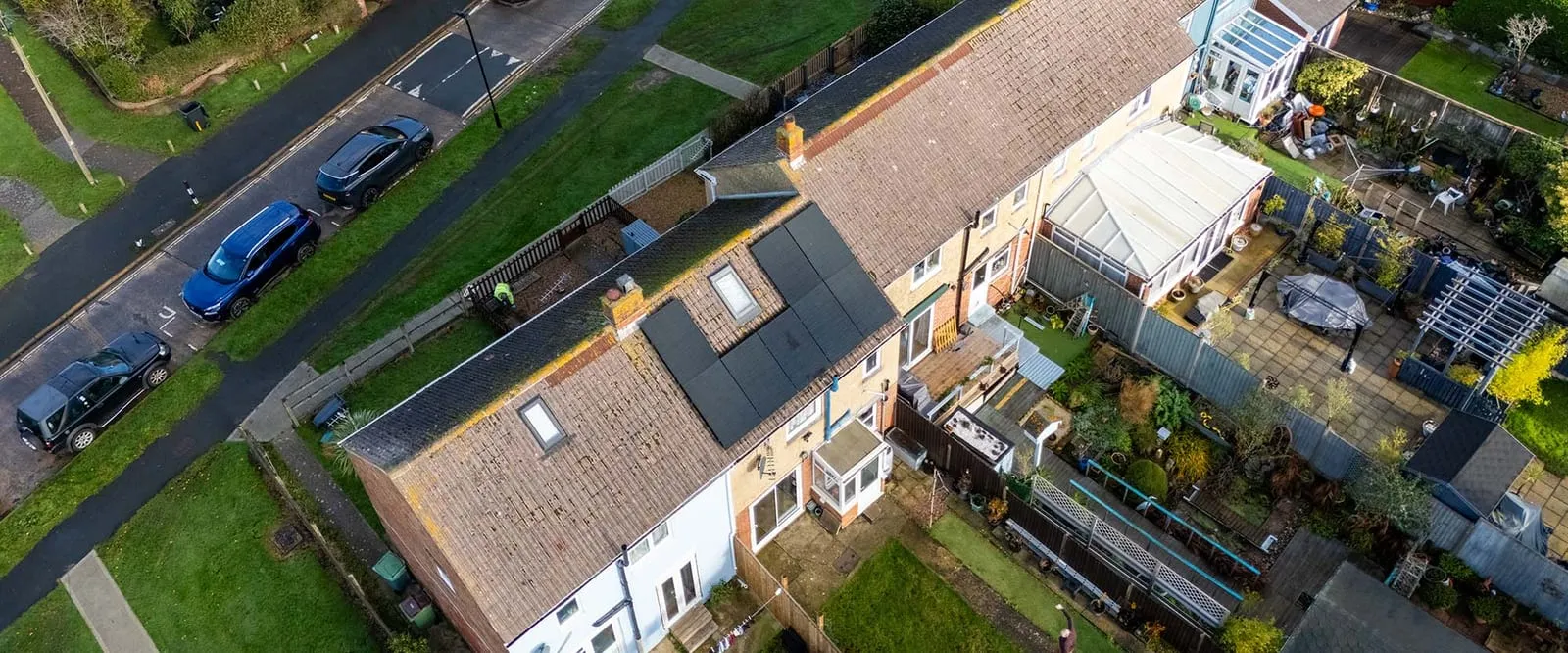
Leicester’s flat, weight-bearing industrial roofs weren’t built with solar in mind, but they turn out to be close to ideal for it. Across estates like Beaumont Leys, Meridian Business Park and Optimus Point, thousands of square metres of warehouse and factory roofline sit largely unused above businesses that are paying real money for grid electricity every quarter. With energy costs still the single biggest controllable overhead for most SMEs, and installed costs having settled into a more predictable band than the volatility of 2022–2023, the commercial solar maths in Leicester now warrants a proper look rather than a hunch.
This is a city of 355,218 people, an average house price around £235,000 — comfortably below the national average, which says something about the wider cost base businesses operate from here — and a manufacturing, logistics and food-processing sector that hasn’t gone anywhere despite a decade of “decline of the high street” headlines. What follows is a straight look at what commercial solar actually costs in Leicester, how the local roof stock stacks up, and what payback looks like against a typical local energy bill.
What Leicester businesses are actually paying per kWp
The national commercial solar benchmark sits at roughly £900–£1,200 per kWp installed, and Leicester doesn’t deviate from that in any meaningful way — there’s no unusual local premium or discount driven by geography. What does move the number, in both directions, is the same thing that moves it everywhere: roof type, array size and grid connection complexity.
A steel-portal warehouse roof on an estate like Optimus Point, with clear runs and straightforward access, tends to land at the cheaper end of that band once you’re above 50kWp, because economies of scale kick in on scaffolding, inverter count and labour days per kWp installed. A smaller, more fragmented industrial unit — several separate roof pitches, older cladding, a DNO connection that needs reinforcing — pushes towards the top of the range or beyond it. For a full breakdown of what drives that spread nationally, commercialsolarcostuk.co.uk is a useful cost benchmark to sanity-check any quote against before you sign anything, and our own commercial solar panel cost guide walks through the same £/kWp mechanics in more depth.
The other local factor worth naming honestly: VAT. The 0% rate that applies to residential solar and battery installations in Great Britain (in place until 31 March 2027) does not extend to commercial installations — a business installation is standard-rated at 20%, though a VAT-registered company can typically reclaim that as input tax in the normal way. It’s a detail that trips up a surprising number of first-time commercial buyers who’ve read about the domestic VAT holiday and assume it applies to them.
The industrial estate roof stock
Leicester’s commercial solar opportunity is concentrated on a handful of estates with the roof profile to make arrays work economically. Beaumont Leys, on the city’s northern edge, mixes retail warehousing with light industrial units — the kind of large, unshaded, south-facing roof that a system designer wants to see. Meridian Business Park, just off the M1/M69 interchange, is built around bigger logistics and office-park footprints, several of which already carry the roof loading capacity for a commercial-scale array without structural strengthening. Optimus Point, further out, is more purely industrial — factory units where daytime electricity demand from machinery lines up well with solar generation, which is the single biggest factor in whether a system pays for itself quickly or slowly.
That daytime-load alignment matters more than almost anything else in the commercial context. A business running shift patterns, cold storage, compressors or production lines between 7am and 6pm will self-consume a much higher share of what an array generates than an office that empties at 5pm — and self-consumed electricity is worth roughly double what exported electricity is worth, because you’re avoiding the full retail rate rather than earning an export tariff. If your Leicester premises sits on one of these estates and runs a warehouse or distribution operation, it’s worth reading the specific case for that building type on solarpanelsforwarehouses.co.uk or, for factory-floor operations, solarpanelsforindustrialunits.co.uk — both go into the load-matching question in more detail than a generic guide can.
For a Leicester-specific starting point, commercialsolarpanelsinstallation.co.uk’s Leicester page is built around exactly this local context and is worth reading before you get quotes in, simply so you know what a reasonable local proposal should look like.
Running the numbers against a typical Leicester energy bill
The average commercial energy spend for a Leicester business sits around £38,000 a year. At typical commercial rates — call it 25–30p/kWh once standing charges and non-commodity costs are folded in, noting commercial tariffs aren’t protected by the domestic Ofgem price cap and vary more by contract — that implies annual consumption somewhere in the region of 125,000–150,000 kWh.
Take a worked example for a business in that bracket: a 50kWp array, roughly the size that fits comfortably on a mid-sized industrial unit roof at Beaumont Leys or Optimus Point. At East Midlands solar yields of around 920 kWh per kWp per year — a touch below the sunniest parts of southern England but a solid, unremarkable UK yield — that system generates around 46,000 kWh annually.
If the business has a daytime-heavy load profile and self-consumes, say, 80% of that generation (36,800 kWh), it avoids roughly £9,200–£11,000 a year in grid purchases at the rates above. The remaining 20% exported under a Smart Export Guarantee tariff — rates vary by supplier, typically 12–20p/kWh at the top end — adds perhaps £1,100–£1,800 more. All told, a rough £10,500–£12,500 a year in combined savings and export income against an installed cost of £45,000–£60,000 puts payback in the region of four to five and a half years, with 20-plus years of largely free generation after that on a system whose panels are still warrantied to perform at a high level.
That’s illustrative, not a quote — actual figures depend entirely on your load profile, roof orientation and contract rates — but it’s the shape of the calculation any Leicester business should be running before committing. Our solar panel calculator and payback period guide let you run your own numbers against your actual bill rather than an average one, and businesssolarcalculator.co.uk offers a commercial-specific version of the same exercise.
Finance, PPAs and the battery question
Not every Leicester business wants to put £50,000+ of capital expenditure on the balance sheet, and for those that don’t, the market has matured well beyond “buy it outright or don’t bother.” Asset finance spreads the cost against the savings the system generates, and power purchase agreements let a third party own and maintain the array while you simply buy the electricity it produces at a rate below your current grid price — worth investigating via solarpowerpurchaseagreements.co.uk if capital outlay is the blocker, or commercialsolarfinance.co.uk for a broader look at the lending and leasing options available to UK businesses.
Battery storage is the other variable worth pricing in, particularly for Leicester businesses with weekend or overnight demand that solar alone can’t cover — a chilled distribution facility running compressors around the clock, for instance. Adding storage roughly doubles the capital outlay per kWh of self-consumption gained, but it can materially improve payback for sites with poor daytime/generation alignment; batterystorageforbusiness.co.uk is a reasonable starting point for sizing that decision correctly rather than over- or under-specifying it.
Council policy and the 2030 target
Leicester City Council has set a net-zero target for the city by 2030, sitting inside its wider Climate Action Plan, and the council’s own procurement position — a Sustainable Procurement Strategy that favours suppliers demonstrating on-site renewables — gives Leicester businesses a genuine commercial argument for solar beyond the energy-bill maths alone. If your business tenders for council contracts, or supplies businesses that do, on-site generation is increasingly something you can point to in a procurement response rather than a cost you have to justify in isolation.
None of that changes the underlying economics covered above, but it does mean a Leicester business installing solar in 2026 is aligning with, rather than working against, the direction the city’s largest public-sector buyer has already committed to.
Choosing an installer and getting it right first time
MCS certification is non-negotiable — it’s the baseline for SEG eligibility and for most finance and insurance products, and any installer proposing otherwise should be a hard pass. Beyond that, get at least two quotes that break down cost per kWp explicitly rather than presenting a single bundled figure, so you can compare against the commercialsolarcostuk.co.uk benchmark properly.
For businesses actually based in or around Leicester, Energy Concerns in Leicester is a local commercial solar, battery and EV installer working directly in the city rather than quoting remotely — worth having on your shortlist alongside a regional comparison quote, and Midland Solar, covering Birmingham and the wider West Midlands, is one credible option for that second opinion given the geographic overlap with the East Midlands supply chain.
Whoever installs the system, don’t treat commissioning day as the finish line. String inverters typically need replacing after 10–15 years even on a well-specified system, and panel output monitoring catches underperformance — a failed string, a soiling issue, shading from a new neighbouring building — long before it shows up as an unexplained jump in your energy bill. A dedicated operations-and-maintenance contract, rather than assuming the installer will notice a fault from three counties away, is worth budgeting for from year one; Solar Maintenance Solutions specialises specifically in that ongoing upkeep for commercial arrays across the UK, and thebritishsolarblog.co.uk’s maintenance guide covers what a sensible maintenance schedule actually looks like if you want the detail before signing a contract.
The bottom line for Leicester businesses
Commercial solar in Leicester isn’t a special case dressed up in local branding — it runs on the same £900–£1,200/kWp national economics as everywhere else, with East Midlands yields of around 920 kWh/kWp/year that sit slightly below the sunniest parts of the country but are perfectly workable. What makes Leicester specifically worth acting on now is the roof stock: Beaumont Leys, Meridian Business Park and Optimus Point between them offer exactly the large, daytime-load-matched, structurally sound roofs that make commercial solar payback fast rather than marginal, against an average local commercial energy spend of roughly £38,000 a year that most businesses would rather not keep handing to a supplier in full. The wider UK context backs the timing too — 2025 was a record year for MCS-certified installs nationally, a trend covered in more depth on Solar Weekly’s UK solar industry overview — and a Leicester business getting two or three properly itemised quotes this year, checked against the benchmarks above before signing anything, is working from a stronger position than most.