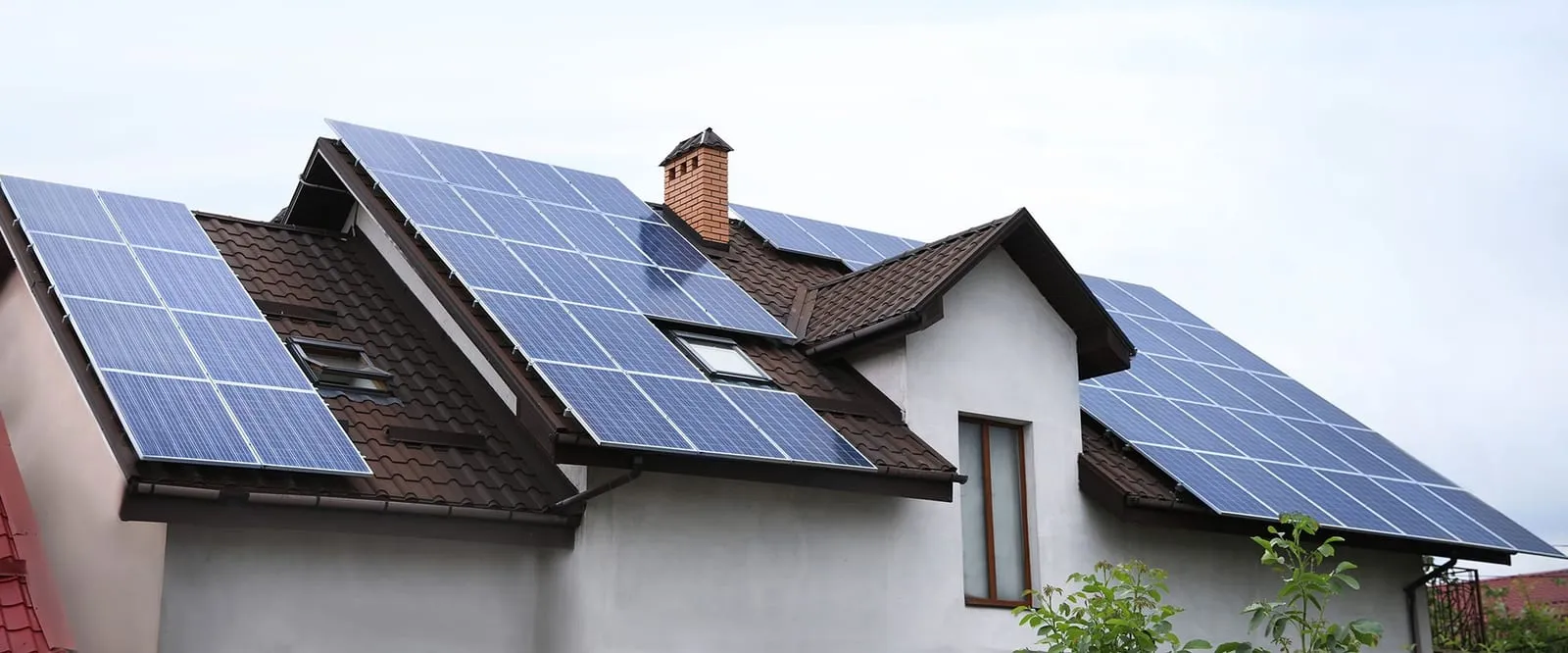
Luton doesn’t get talked about as a solar hotspot, but the numbers on the ground make a decent case for it. A town of 213,052 people wrapped around Luton Airport and the M1 corridor, built on Vauxhall Motors’ manufacturing legacy and now home to a dense belt of logistics and light-industrial roof space — that’s a lot of flat, south-facing warehouse and factory roofs doing nothing but keeping the rain out. With Luton Council committed to net-zero by 2040 under its Luton 2040 Net Zero Plan, and commercial energy bills still the single biggest controllable cost for most local occupiers, solar has moved from “nice to have” to a straightforward capital-allocation decision for a growing number of Luton businesses.
This piece looks at what commercial solar actually costs to install in and around Luton, how that stacks up against the national £900–£1,200 per kWp benchmark, what payback looks like against a typical local energy bill, and which parts of town have the roof stock to make the sums work.
Luton’s commercial roof stock: automotive legacy meets the M1 warehouse corridor
Luton’s industrial geography splits fairly cleanly into three types of commercial roof, and each one changes the solar maths.
Vauxhall Industrial Estate, built up around the footprint of the old Vauxhall Motors plant, is still threaded through with automotive supply-chain tenants — component suppliers, fabricators, panel-beaters and logistics firms that grew up serving the car plant and have stayed put since. That heritage matters commercially: automotive-adjacent manufacturers are increasingly under pressure from their own OEM customers to show Scope 2 emissions reductions, and a rooftop array is one of the few decarbonisation moves a small supplier can make unilaterally, without waiting on a customer contract to fund it.
Capability Green, the business park off the M1’s Junction 10 spur, is a different animal — mostly office and light-commercial units rather than deep-floorplate warehousing. Roof areas here tend to be smaller and more fragmented (plant rooms, HVAC units, lift overruns eating into usable space), so systems tend to sit in the 20–60 kWp range rather than the six-figure installs you see on a big shed.
Sundon Industrial Estate, further out toward the M1, is the estate with the real scale — large-format distribution and warehouse units with the kind of unbroken flat-roof area that makes a 150 kWp-plus array genuinely straightforward to fit. Given Luton’s position as an airport-adjacent logistics hub, it’s this estate, and others like it along the M1 corridor, where the biggest single opportunity for commercial solar in the town sits: big roofs, big daytime electricity draw from refrigeration, conveyor and forklift-charging loads, and a strong overlap between when the sun’s out and when the meter’s spinning fastest.
What Luton businesses actually pay per kWp
The national commercial band — roughly £900 to £1,200 per installed kWp, all-in, for a rooftop array — holds up reasonably well for Luton, with the usual caveats that come with roof type rather than postcode. A cost benchmark like the one maintained at CommercialSolarCostUK is worth checking against any quote you receive, because the spread inside that band is driven far more by roof condition and system size than by geography.
In practice: a large, unobstructed warehouse roof on an estate like Sundon — good structural capacity, easy scaffold-free access, one clean cable run to a plant room — will often land at or below the bottom of the £900–£1,200 band once you’re past 100 kWp, because fixed costs (scaffolding mobilisation, G99 grid application, inverter commissioning) get spread across more panels. A smaller, more fragmented roof on Capability Green, with multiple HVAC obstructions and a tighter access route, is more likely to sit at the top of the band or slightly above it. Older industrial roofs on Vauxhall Industrial Estate sometimes carry a third variable: a structural survey or asbestos-containing roof sheet (common on 1960s–80s industrial stock) can add cost before a single panel goes up, so get that checked early rather than after a quote’s been accepted.
One thing worth being precise about: the 0% VAT rate that applies to residential solar and battery installations in Great Britain until 31 March 2027 is a domestic measure. Commercial installations are usually standard-rated at 20% VAT — though for a VAT-registered trading business that’s input tax reclaimed in the normal way, not a net cost, so it rarely changes the underlying investment case.
The payback maths against a typical Luton energy bill
East of England sits toward the better end of the UK’s solar yield map — around 970 kWh per installed kWp per year, ahead of the national average and not far off the sunniest parts of the south coast. That yield, combined with local energy spend, is what actually determines payback.
Take a mid-size 100 kWp rooftop array — a realistic fit for a decent-sized unit on Vauxhall Industrial Estate or a smaller bay at Sundon:
| Line item | Figure |
|---|---|
| Install cost (£900–£1,200/kWp, midpoint) | ~£105,000 |
| Annual generation (970 kWh/kWp × 100 kWp) | ~97,000 kWh |
| Self-consumed (assume ~60% for daytime-shift operation) | ~58,200 kWh @ ~25p/kWh import price = ~£14,550 |
| Exported (remaining ~40%) | ~38,800 kWh @ ~15p/kWh SEG mid-range = ~£5,820 |
| Total annual benefit | ~£20,370 |
| Simple payback | ~5 years |
Set that against Luton’s average commercial energy spend of roughly £38,000 a year, and a 100 kWp system alone offsets close to two-fifths of that bill through direct self-consumption, with export income on top and roughly two decades of production left after payback (modern N-type panels degrade at only around 0.4% a year and are rated for 25–30 years). For context, £105,000 is a little more than a third of Luton’s average house price of around £290,000 — a useful sense-check for directors weighing up a rooftop investment against other uses of capital, given the solar asset is generating a return every sunlit hour rather than sitting still.
Two things move that number in either direction. Self-consumption is the big lever: a business running two shifts and heavy daytime refrigeration or process load (typical of Sundon-style logistics units) can push self-consumption well above 60%, which improves payback meaningfully since imported electricity is worth more than exported. On the other side, businesses that are largely closed at weekends and evenings — common on Capability Green’s office stock — will export a bigger share, which is fine but leans more heavily on Smart Export Guarantee rates, which vary by supplier and aren’t fixed nationally, so it’s worth shopping the SEG tariff separately from the installer contract. Adding a commercial battery narrows that gap by shifting self-consumption into the evening; it’s a conversation worth having with an installer once the core rooftop array is sized, and one covered in detail on BatteryStorageForBusiness.co.uk.
Paying for it: capital, loans, or a no-capex route
Not every Luton business wants £100,000-plus of capital tied up in a rooftop array, however good the payback. There are three broad routes:
Outright purchase, funded from cash or a business loan, gets the full return and — for most trading companies — access to capital allowances that shorten the effective payback further. Solar panels generally qualify as main-rate plant and machinery, meaning many businesses can claim relief via the Annual Investment Allowance (currently £1 million a year) or, for companies within the corporation tax regime, full expensing on qualifying spend. The detail depends on your company structure and current tax position, so it’s worth a specific conversation with your accountant rather than relying on a generic online figure.
Asset finance or a specialist loan spreads the £105,000 outlay over the panels’ working life instead of taking it as a single hit to cash flow — a route explained in more depth at Commercial Solar Finance, which walks through how repayment terms typically compare against the annual savings a system generates.
A power purchase agreement (PPA) removes the capital question entirely: a third party owns, installs and maintains the array on your roof, and you buy the electricity it generates at an agreed rate, usually below your existing import price, with no upfront cost. It suits businesses that would rather keep balance-sheet capital free for stock, staff or premises — the mechanics are set out on Solar Power Purchase Agreements.
Whichever route, it’s worth reading a general cost primer alongside any Luton-specific quote — thecostofsolar’s commercial solar panel cost breakdown and its solar payback calculator are both useful for stress-testing an installer’s numbers before signing anything.
Matching the estate to the system
For anyone weighing up which of Luton’s estates offers the better economics, the honest answer is “it depends what you occupy” rather than one estate beating another outright:
- Sundon Industrial Estate and comparable large-format logistics roofs along the M1 corridor make the strongest case for scale — 150 kWp-plus arrays, low cost-per-kWp thanks to unbroken roof area, and heavy daytime loads (refrigeration, conveyor systems, EV forklift charging) that push self-consumption up. If your business sits in this bracket, it’s worth reading SolarPanelsForLogistics.co.uk on the specific load profiles that make warehousing such a strong fit for rooftop solar.
- Vauxhall Industrial Estate’s mixed light-industrial and automotive-supply-chain stock suits mid-size systems, typically 50–120 kWp, and carries the added angle of decarbonisation pressure flowing down from automotive OEM customers — a case explored at SolarPanelsForIndustrialUnits.co.uk.
- Capability Green’s office-park stock generally sits at the smaller end, and is where getting an accurate roof survey (accounting for plant rooms, HVAC and access) matters more than chasing the lowest headline £/kWp.
Whichever bracket you’re in, starting from a proper commercial solar installation in Luton quote — with a roof survey, a G99 grid-capacity check with your distribution network operator, and a self-consumption estimate based on your actual half-hourly meter data — will tell you far more than any national £/kWp figure can on its own.
Finding the right installer
Luton doesn’t have a large concentration of MCS-certified commercial solar installers of its own, so most local businesses end up working with installers covering the wider Home Counties and East of England footprint. SOLA UK in the Home Counties covers Hertfordshire and the surrounding area, putting Luton comfortably within reach, while businesses further east toward Essex and East Anglia are often better served by a firm like EC Eco Energy, which handles commercial solar and battery installs across that stretch of the East of England region. Whichever installer you use, check MCS certification is current — it’s a prerequisite for Smart Export Guarantee eligibility — and ask specifically about post-install monitoring and cleaning, since a dirty or partially shaded commercial roof can quietly cost several percent of annual yield; specialist national operation-and-maintenance providers such as Solar Maintenance Solutions exist precisely because most installers don’t offer ongoing servicing as standard.
The core takeaway for Luton is unremarkable but solid: the town’s roof stock, energy spend and solar yield line up closely enough with the national commercial picture that a well-specified rooftop array on Sundon, Vauxhall Industrial Estate or Capability Green should pay for itself inside five to seven years under most financing routes, with fifteen-plus years of largely free generation after that. The work is in getting an accurate survey and a realistic self-consumption estimate before signing — not in hoping Luton is somehow a special case.