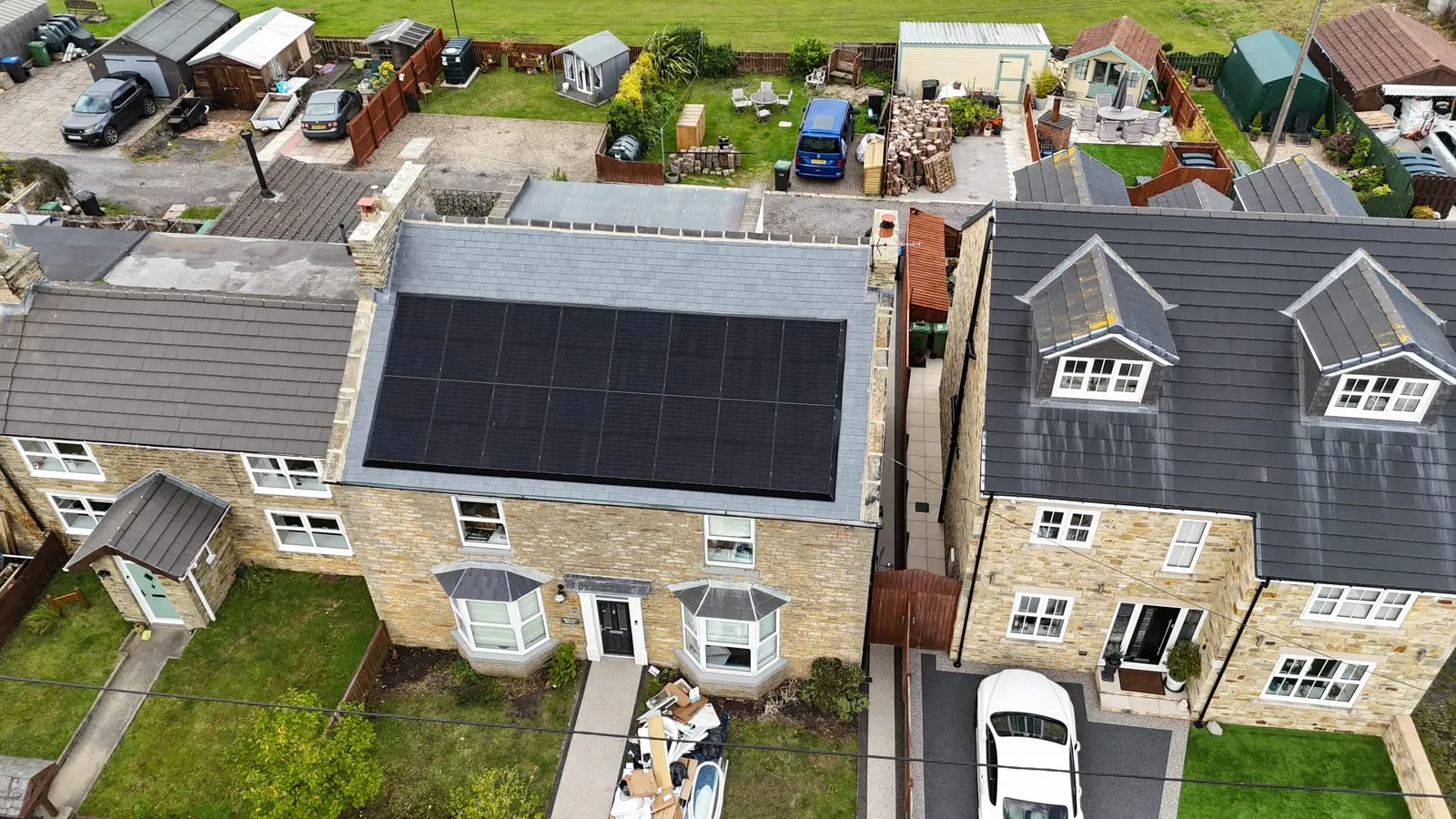
Milton Keynes doesn’t get talked about as a solar town the way Bristol or Brighton do, but its commercial roof stock tells a different story. This is a borough built around big, flat-roofed sheds and grid-square business parks — exactly the buildings that make the best economic case for solar. Here’s what commercial solar actually costs in Milton Keynes right now, how that stacks up against a typical local energy bill, and where the borough’s best roofs sit.
What Milton Keynes businesses are actually paying per kWp
Commercial solar in the UK is currently priced at roughly £900–£1,200 per kWp installed, and Milton Keynes sits squarely inside that national band rather than outside it. There’s no meaningful “Milton Keynes premium” — the town’s proximity to the M1, A5 and A421 means installers, scaffolders and electricians can move equipment and crews in easily, which if anything keeps quotes competitive against more remote parts of the South East.
Where the local number does shift is on the output side. Milton Keynes sits in the South East, where solar yield runs around 1,000 kWh per installed kWp per year — noticeably better than the UK-wide average of roughly 850 kWh/kWp, and closer to the top of the national range. That’s not a cost saving, but it is a payback saving: the same £/kWp buys more generated electricity here than it would in the Midlands or the North.
Before commissioning quotes, it’s worth benchmarking any number you’re given against the national cost data on commercialsolarcostuk.co.uk, which tracks the £/kWp band across system sizes and sectors. If a Milton Keynes quote lands well outside that range in either direction, ask why — it’s usually roof complexity (multiple roof faces, listed structural surveys, older asbestos-cement sheeting that needs load-bearing checks) rather than anything specific to the town.
For a practical, MK-specific starting point, commercial solar installation in Milton Keynes is a useful next stop before you get quotes — it sets out the local process from survey to commissioning.
Reading a £42,000 energy bill against a solar array
Milton Keynes commercial premises spend an average of around £42,000 a year on energy — a figure that puts real money behind the payback maths rather than leaving it abstract. The table below is illustrative, not a quote: it assumes a blended value of roughly 20p per kWh generated, mixing avoided import (Ofgem’s typical cap price sits around 25p/kWh) with exported units sold under the Smart Export Guarantee, where rates vary by supplier from roughly 12p up to around 20p/kWh at the top end. Actual figures depend on your tariff, your on-site consumption pattern and how much you export.
| Array size | Typical installed cost | Annual generation at MK’s ~1,000 kWh/kWp yield | Rough payback* |
|---|---|---|---|
| 10 kWp (small unit roof) | £11,000–£12,000 | ~10,000 kWh | ~5–6 years |
| 30 kWp (mid-size industrial unit) | £28,000–£33,000 | ~30,000 kWh | ~4.5–5.5 years |
| 50 kWp (larger warehouse roof) | £45,000–£55,000 | ~50,000 kWh | ~4–5 years |
| 100 kWp+ (distribution shed) | £90,000–£105,000 | ~100,000 kWh | ~4–5 years |
*Before finance costs; assumes reasonable daytime self-consumption. A business running single-shift daytime operations — most offices, many light-industrial units — will self-consume a bigger share of generation and pay back faster than one running mainly evenings or weekends.
Against a £42,000 annual spend, a 50 kWp array generating roughly 50,000 kWh a year can realistically offset somewhere between a sixth and a quarter of that bill on daytime import alone, before exports are counted — a meaningful dent without needing to cover the entire roof. Businesses wanting to run their own numbers against actual half-hourly meter data rather than these averages can use a business solar ROI calculator to model a specific site.
It’s also worth cross-checking any payback claim against a neutral source rather than an installer’s own projection — commercialsolarcostuk.co.uk and thecostofsolar’s own commercial solar panel cost guide both work through the underlying assumptions rather than presenting a single headline number.
Milton Keynes’s roof stock: Kingston, Tongwell and Linford Wood
What makes Milton Keynes genuinely interesting for commercial solar is the roof stock itself. This is a planned town built from the 1970s onward around large business parks and grid roads, and three estates in particular carry the kind of flat, unshaded, structurally simple roofs that solar economics love:
- Kingston — a large retail and logistics park where big-box units mean big, uninterrupted roof areas ideal for arrays well above 50 kWp.
- Tongwell — mixed light-industrial and distribution units close to the M1, where daytime operational hours line up well with solar generation for high self-consumption.
- Linford Wood — one of MK’s established office and business park areas, where lower daytime energy intensity per square metre of roof still supports a solid case once you factor in EV charging and battery storage.
Warehouse and distribution roofs like those at Kingston and Tongwell are a specific enough building type that it’s worth reading sector-specific guidance rather than generic advice — see the dedicated breakdown on solarpanelsforwarehouses.co.uk for how loading, roof-light spacing and structural surveys typically play out on that kind of shed. Office-park roofs such as those around Linford Wood tend to have different constraints (roof access, plant already on the roof, smaller usable area), covered in more detail on solarpanelsforofficebuildings.co.uk.
Milton Keynes itself is a town of around 287,060 people with an average house price near £320,000 — comparatively affordable for the South East — which has helped it stay a magnet for logistics, distribution and back-office employers needing decent-sized commercial floorplates close to the motorway network. That employment mix is exactly why the borough has more large, simple commercial roofs per head than most towns its size.
The VAT and finance picture for commercial installs
It’s worth being precise here, because the headline 0% VAT relief on solar and battery storage (in place across Great Britain until 31 March 2027, after which it’s scheduled to revert to 5%) applies to residential installations, not commercial ones. A Milton Keynes business installing solar on a commercial roof will typically pay standard-rate VAT on the works, though a VAT-registered business can usually reclaim it in the normal way — so the practical cash-flow impact is often smaller than it first appears, but it’s not the same relief homeowners get.
There’s also no direct government grant equivalent to residential solar support for most commercial installs — the Boiler Upgrade Scheme’s £7,500 doesn’t touch solar PV at all (it’s for air source heat pumps only), and schemes like the Improving Farm Productivity grant are specific to agricultural buildings, not general commercial premises. For most Milton Keynes businesses, the realistic options are cash purchase, asset finance, or a power purchase agreement where a third party owns and maintains the array and you buy the electricity it generates at a discount to grid price. Commercial solar finance options and PPA structures are worth comparing side by side before committing capital, since the right structure depends heavily on your balance sheet appetite and how long you expect to occupy the building.
Battery storage and export income
Because commercial solar generation peaks in the middle of the day and many businesses’ heaviest loads sit either side of that — first-shift starts, evening security lighting, cold-store compressors cycling overnight — battery storage is increasingly part of the Milton Keynes commercial conversation rather than an optional extra. A well-sized battery raises the self-consumption share used in the payback table above, directly shortening payback, and it also gives some resilience against half-hourly settlement exposure as more commercial meters move onto time-of-use tariffs. Battery storage for business is worth pricing alongside the array itself rather than as an afterthought bolted on later — retrofitting is usually more expensive than specifying both together.
Any array intended to sell surplus power needs MCS certification to be eligible for the Smart Export Guarantee, and it’s worth remembering SEG isn’t a fixed national rate — suppliers set their own, and the difference between a mediocre and a strong SEG tariff can be several pence per kWh, which adds up on a 50 kWp-plus array exporting tens of thousands of units a year.
Council direction: 2030 net zero and the Climate Energy Network
Milton Keynes City Council has set a 2030 net-zero target under its MK Sustainability Strategy, and the town has a long-running reputation for backing clean-tech infrastructure — the council operates its own Climate Energy Network, reflecting a civic posture that’s generally supportive of on-site generation rather than indifferent to it. That doesn’t translate into a bespoke commercial solar grant (there isn’t one, as covered above), but it does mean planning and building-control processes in the borough are generally well versed in handling rooftop solar applications, which in practice tends to mean fewer surprises and delays than in areas where solar planning applications are still relatively rare.
For businesses weighing whether now is the right moment against that backdrop, it’s worth knowing the sector context: 2025 was a record year for UK solar, with 257,397 MCS-certified installations completed nationally — up 32% on the year before — taking cumulative deployed capacity to around 21.6 GW and solar’s share of UK electricity to roughly 6.4%. Milton Keynes’s commercial estates are a small but real part of that national growth curve. The wider market dynamics behind that surge are covered in more depth on Solar Weekly’s UK solar industry overview, if you want the national picture alongside the local one.
Choosing an installer in Milton Keynes and the Home Counties
Whoever you use, insist on MCS certification — it’s a prerequisite for SEG eligibility and a reasonable proxy for competent installation practice generally. Milton Keynes sits within reach of several established Home Counties and regional installers rather than being served only by national chains. SOLA UK in the Home Counties covers Hertfordshire and the surrounding area and is worth a call for smaller commercial and mixed-use sites closer to the town centre, while regional firms such as Premier Electrical Renewables handle solar, battery and EV charging installs across a wider catchment and can be a sensible fit for larger warehouse or distribution roofs on the outer estates.
Get at least two or three like-for-like quotes, specified against the same roof survey and the same assumed self-consumption pattern — quotes that vary wildly in price for supposedly the same job are usually varying in panel tier, inverter warranty length, or scaffolding scope, not just margin. And once the array is in, ongoing performance matters as much as the install: unswept panels, a failing string inverter, or an export meter quietly under-reporting can all erode the payback numbers above without anyone noticing for months, so it’s worth reading up on routine solar panel maintenance once the system is commissioned rather than treating it as fit-and-forget.
Milton Keynes’s combination of South East solar yield, a genuinely large stock of simple flat commercial roofs across Kingston, Tongwell and Linford Wood, and an average £42,000 energy bill to offset makes the underlying economics of commercial solar here better than in most UK towns of comparable size. The number that matters most isn’t the headline £/kWp — it’s how much of your own generation you’ll actually use on site, so get that modelled properly before you sign anything.