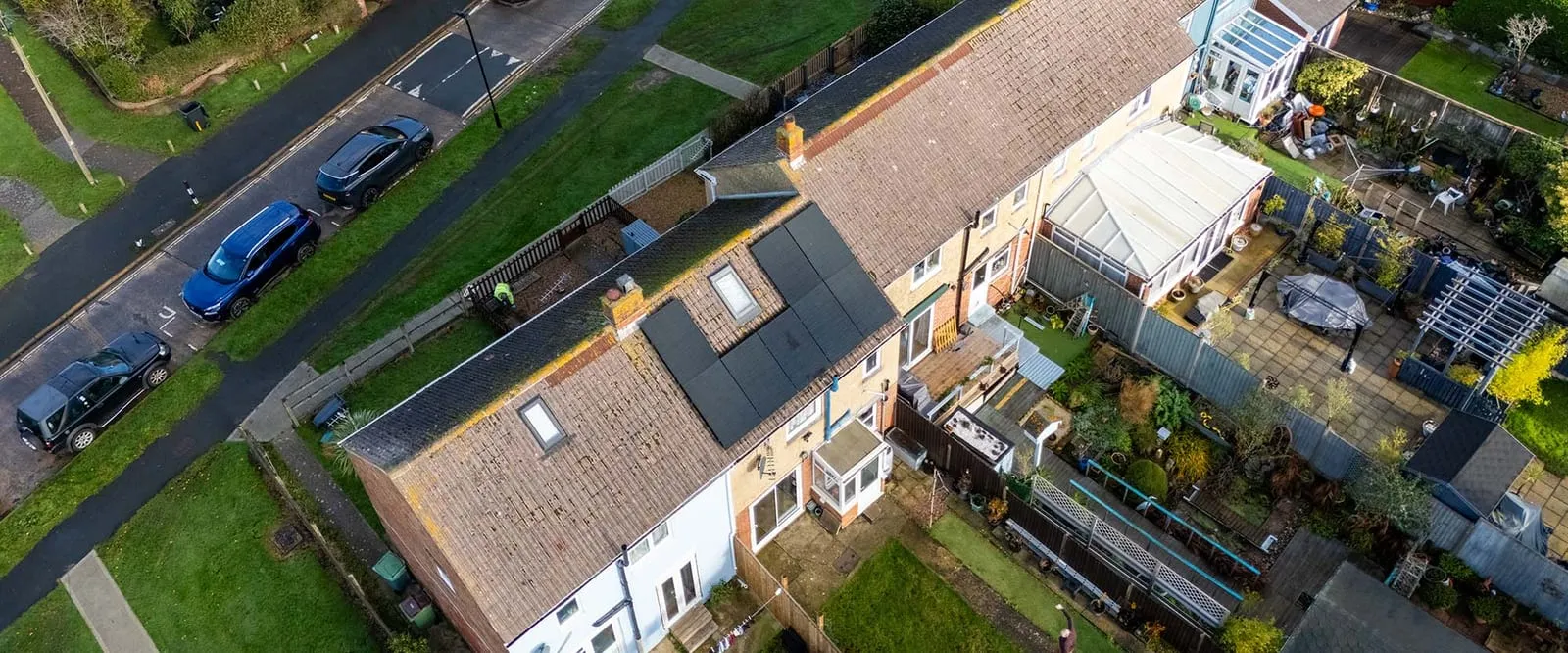
Norwich doesn’t get talked about as an industrial city, but it should. Between the food and drink processors ringing the outskirts, the insurance and logistics firms filling its business parks, and a council with a 2030 net-zero target on the wall, the city has a genuine commercial solar opportunity that most national cost guides skip straight past. This piece looks at what Norwich businesses actually pay per kWp, how that stacks up against a typical local energy bill, and which parts of the city make the best roof stock.
What Norwich businesses actually pay per kWp
The national commercial solar benchmark sits at roughly £900–£1,200 per kWp installed, covering panels, inverters, mounting, design and commissioning for a rooftop system of a few hundred kWp or below. Norwich businesses should expect to land inside that band rather than outside it — there’s nothing about the city’s geography or supply chain that forces prices materially higher.
Where you fall in the band depends on the roof, not the postcode. A single-storey steel-portal warehouse on an out-of-town estate — flat, unobstructed, easy scaffold-free access — will usually price toward the bottom of the range. A older multi-tenant unit in a tighter city-centre yard, with roof penetrations, asbestos-era cladding to work around, or a tricky grid connection, pushes costs toward the top. For a general sense of how those cost drivers stack nationally before you get quotes in, the commercial solar cost benchmarks at commercialsolarcostuk.co.uk are a useful sanity check against anything a Norwich installer proposes.
It’s also worth noting what the 0% VAT relief on solar and battery storage (in place in Great Britain until 31 March 2027) does and doesn’t cover: it applies to qualifying residential installations, not commercial ones, so business quotes should already reflect standard VAT treatment — don’t expect the relief to show up on a commercial invoice.
Running the payback numbers against a typical Norwich energy bill
Norwich’s commercial energy users spend, on average, somewhere in the region of £32,000 a year on electricity — a figure that puts the payback question in useful context. A system sized to offset a meaningful share of that bill, rather than a token rooftop array, is where the economics start to work hardest.
Using the East of England’s regional solar yield of around 970 kWh per kWp per year — comfortably above the UK-wide average of roughly 850 kWh/kWp — here’s roughly how the numbers scale for a Norwich rooftop:
| System size | Indicative install cost (£900–£1,200/kWp) | Estimated annual generation | Typical payback range* |
|---|---|---|---|
| 20 kWp | £18,000 – £24,000 | ~19,400 kWh | 5–8 years |
| 50 kWp | £45,000 – £60,000 | ~48,500 kWh | 4–7 years |
| 100 kWp | £90,000 – £120,000 | ~97,000 kWh | 4–7 years |
| 150 kWp | £135,000 – £180,000 | ~145,500 kWh | 4–7 years |
*Payback ranges assume a daytime-heavy load profile with strong self-consumption (offsetting import at roughly 25p/kWh) plus export of any surplus under a Smart Export Guarantee tariff, which varies by supplier — typically 12–20p/kWh at the better end. Businesses running single shifts with low weekend load will sit toward the longer end; those with daytime-heavy operations (food processing, cold storage, distribution) sit toward the shorter end.
Against a £32,000 annual bill, a well-sized 50kWp system offsetting a large share of daytime demand can realistically cut a third or more off that spend, which is the calculation most Norwich finance directors actually want to see before signing off capex. For a general primer on how payback periods are worked out and what shortens or lengthens them, the payback period breakdown and our wider commercial solar cost guide both go through the mechanics in more depth than we can here.
Norwich’s best commercial roof stock
Three areas do most of the heavy lifting for Norwich’s commercial roof stock, and each suits a slightly different type of solar project:
- Hellesdon Park — mixed light-industrial and trade units on the city’s north-west edge, with the kind of low-rise steel-frame roofs that keep install costs down and make for straightforward, fast-payback arrays.
- Vulcan Road — a long-established industrial corridor with a good mix of manufacturing, storage and distribution occupiers, many running daytime-heavy operations that are well suited to high self-consumption solar.
- Norwich Airport Industrial Estate — larger footprint units near the airport, often with bigger unbroken roof spans that support commercial-scale arrays well above the 100kWp mark.
Anyone assessing a roof on one of these estates should start with a proper structural and shading survey rather than assuming — but as a class, this is exactly the low-rise, large-footprint stock that makes commercial solar economics work. For businesses on these estates specifically, it’s worth reading through what a commercial solar installation in Norwich actually involves end to end, from survey through to commissioning, before getting quotes in.
Large flat-roofed units of this kind, particularly on estates like Norwich Airport Industrial Estate with generous yard space, are also worth assessing for ground-mounted or canopy-style solar over parking if roof space runs out — a growing option for businesses that have exhausted their rooftop capacity but still have land to spare.
Council policy: Norwich’s 2030 net-zero target and Solar Together
Norwich City Council has set a 2030 net-zero target, formalised through the Norwich 2030 Climate Strategy, which puts local authority weight behind the case for commercial solar rather than leaving it purely as a private-sector decision. The council’s own stance leans into the city’s strong agricultural and food production hinterland — recognising that Norfolk’s farming and food-processing economy has real rooftop and land potential for solar that a purely residential push wouldn’t capture.
Practically, the most visible council-backed scheme is Solar Together, a community bulk-buying programme the council operates to help residents and small organisations access competitively priced solar installations through a reverse-auction model. It’s aimed primarily at homes and smaller premises rather than large commercial rooftops, but it’s a useful signal of local appetite and a reasonable starting point for smaller Norwich businesses or mixed-use premises weighing up a first system, even if larger commercial arrays will usually be procured directly through a specialist installer instead.
Why the East of England’s sunnier skies help the sums
Yield is the one variable that quietly does a lot of work in any payback calculation, and Norwich benefits from being in one of the better-performing regions of the UK. At roughly 970 kWh per kWp per year, East of England generation sits well above the UK-wide average of around 850 kWh/kWp, and not far off the very best UK regions in the sunnier south. That difference compounds over a 25-year system life: on a 100kWp array, the gap between 850 and 970 kWh/kWp/yr is worth roughly 12,000 kWh a year — multiple years’ worth of extra generation over the system’s lifetime compared with a lower-yield region, at no extra install cost.
Combined with modern N-type panels (TOPCon, HJT and ABC cell types) degrading at around 0.4% a year and rated for 25–30+ years of service, a Norwich rooftop array installed today should still be generating close to its original output well into the 2050s.
The agricultural angle: Norfolk’s food and farming economy
Norwich sits inside one of the country’s most significant food and farming economies, and that hinterland is directly relevant to the city’s commercial solar picture — not every relevant rooftop or field sits inside the ring road. For farm businesses and food processors around the city weighing up panels on barns, packhouses or grain stores, England’s farm-specific support is the Improving Farm Productivity grant, funding roughly 25% of eligible costs (rates vary by UK nation) — a different, smaller-scale scheme to the commercial rooftop grants aimed at pure industrial and office buildings, and worth checking eligibility for separately. The farm and agricultural solar resources at solarpanelsforfarms.uk cover that ground in more detail for anyone running a farm business on Norwich’s outskirts rather than a straightforward industrial unit.
Financing and maintaining a Norwich commercial system
For businesses that don’t want to tie up £45,000–£180,000 of capital in one go, commercial solar finance options — asset finance, leasing, or a power purchase agreement where a third party owns and maintains the system in exchange for a lower per-kWh rate than the grid — are worth putting alongside a straight cash purchase before deciding. Reviewing the commercial solar finance options available for a business of your size is a sensible step before a board sign-off, particularly for the larger arrays that suit estates like Norwich Airport Industrial Estate.
Once a system is running, it’s easy to treat solar as fit-and-forget, but string inverters typically need replacing after 10–15 years (£500–£1,000 a time), and annual electrical and performance checks catch underperformance long before it shows up as a mysteriously high bill. Our sister site has a solid rundown of what routine solar panel maintenance actually involves, and a specialist O&M provider like Solar Maintenance Solutions is worth having on retainer for anything above a small rooftop array, especially where downtime on a working industrial unit has a real cost.
Choosing an installer in Norwich and East Anglia
Norwich sits within reach of several established East Anglian and East of England installers with genuine commercial track records rather than residential-only fitters bolting on a business offering. EC Eco Energy in East Anglia works across Essex and the wider region on commercial solar and battery projects, and Greenlinc Renewables, based in neighbouring Lincolnshire and MCS-certified, is another regional option worth getting a quote from alongside anyone quoting locally in Norwich itself. Whichever installer you shortlist, MCS certification isn’t optional if Smart Export Guarantee eligibility matters to your project — check it before signing anything. For a wider view of where UK commercial solar pricing and installer capacity is heading through the rest of the year, Solar Weekly’s 2026 industry data is a useful cross-check against whatever quotes land in your inbox.
For context on the wider city: Norwich is home to around 144,000 people, with an average house price near £270,000 — comfortably below the England average — which says something about the scale of the local economy behind these commercial energy bills. It’s not a city of headline-grabbing mega-warehouses; it’s a city of solid mid-sized manufacturers, food businesses and logistics operators for whom a £30,000-plus annual electricity bill is a real, trimmable cost rather than a rounding error.
The practical takeaway
Commercial solar in Norwich isn’t a special case that needs its own pricing model — it sits squarely inside the national £900–£1,200/kWp band, helped along by above-average East of England yields and a council actively pushing a 2030 net-zero target. The businesses getting the best returns are the ones matching system size to a genuinely daytime-heavy load profile, checking their roof against estates like Hellesdon Park, Vulcan Road or Norwich Airport Industrial Estate for the kind of low-rise, unobstructed stock that keeps install costs down, and getting at least two or three quotes from installers with proper commercial track records before committing capital.