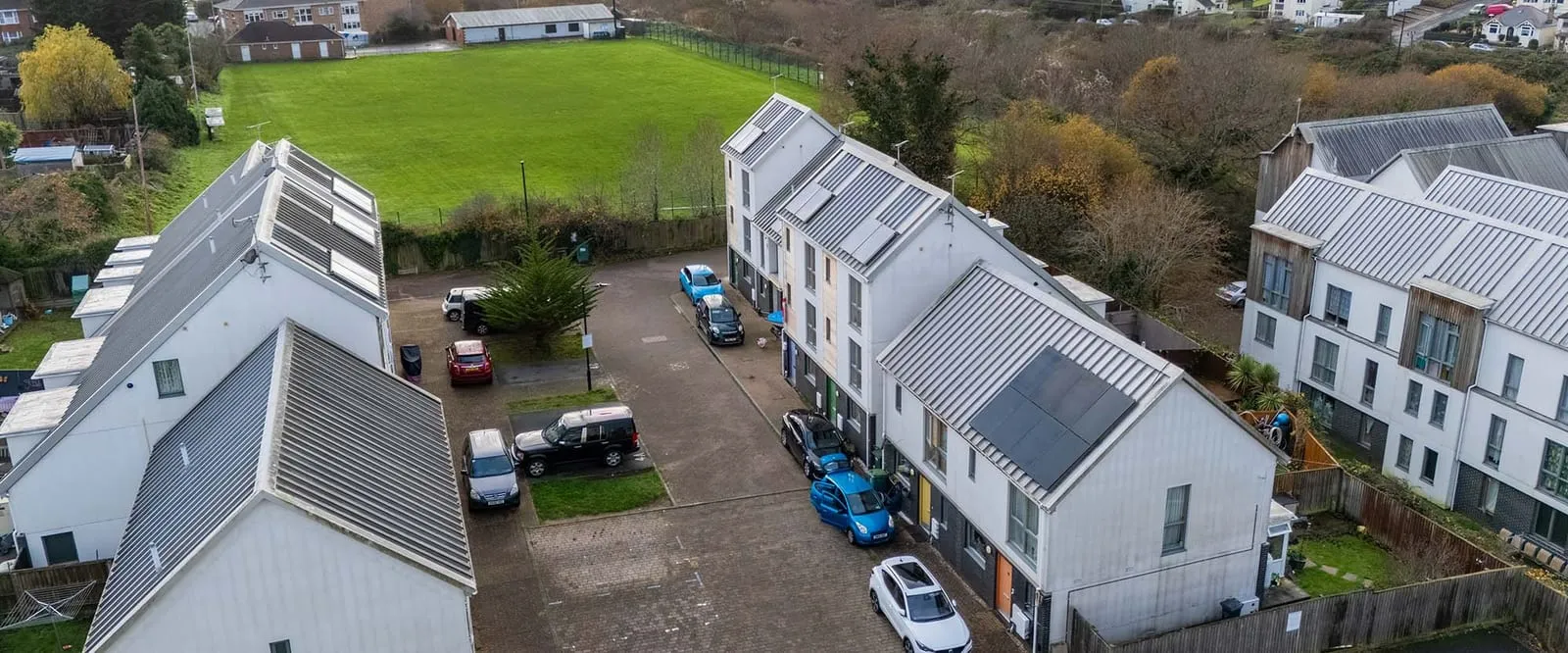
Swindon doesn’t get talked about as a solar town, but it should. A former car-manufacturing base that’s reinvented itself as the M4 corridor’s logistics engine, it has exactly the roof stock — big, flat, structurally sound sheds — that makes commercial solar the best-value energy decision most local operators will make this decade. Here’s what the numbers actually look like for a business weighing it up in 2026.
Why Swindon’s roof stock is unusual
Most towns have a scattering of commercial roofs worth a solar survey: a supermarket here, a business park there. Swindon has something more concentrated. It sits at the junction of the M4 and the A419/A420, which is precisely why national distributors, parcel networks and third-party logistics (3PL) operators have piled into the town over the past two decades. Warehousing and distribution now dominate the commercial property stock in a way few other towns of 233,410 people can match.
The estates worth naming: Greenbridge and Cheney Manor are long-established industrial areas with a mix of manufacturing, trade counter and distribution units — exactly the low-rise, high-roof-area buildings that make solar economics work. And then there’s the former Honda Swindon plant — the manufacturing giant closed the site in 2021, and redevelopment of that enormous footprint is ongoing. Whatever eventually occupies those buildings, the roof area alone (among the largest in the South West) makes it one to watch for anyone tracking commercial solar opportunity in the town.
If your business operates a warehouse, cross-dock facility or distribution centre anywhere near the M4 corridor, this is worth reading alongside a proper feasibility check — the economics for distribution centre and logistics roofs tend to be more favourable than almost any other commercial building type, because daytime shift operations mean more of what you generate gets used on-site rather than exported at a lower rate. The same logic applies to plain warehouse solar installations more generally, and to the smaller trade-counter and manufacturing units that make up estates like Cheney Manor, where industrial unit solar is increasingly the default rather than the exception.
What Swindon businesses are actually paying
There’s no meaningful regional cost premium for solar installation in Swindon versus the rest of the country — the M4 corridor is, if anything, easier and cheaper for installers to reach than more remote parts of the South West, so local quotes should sit squarely within the national commercial band rather than above it. As a cost benchmark for commercial solar across the UK, expect:
| System size | Typical installed cost (2026) |
|---|---|
| Small commercial (20–50 kWp) | £900–£1,200/kWp |
| Mid-size (50–150 kWp) | £850–£1,100/kWp (economies of scale) |
| Large rooftop (150 kWp+) | £750–£1,000/kWp on well-suited roofs |
So a 100 kWp system — a realistic size for a mid-sized unit on Greenbridge or Cheney Manor — lands somewhere around £90,000–£120,000 installed, before any finance arrangement. A larger distribution shed with 300–500 kWp of usable roof could be looking at £250,000–£500,000, though at that scale it’s worth getting a structural survey done early, since older industrial roofs (including anything dating from Honda-era construction) sometimes need reinforcement or a cladding upgrade before panels go up.
One VAT point worth being precise about: the 0% VAT rate on solar and battery storage that runs until 31 March 2027 applies to residential installations, not commercial ones. Commercial solar is normally standard-rated, but VAT-registered businesses reclaim the input VAT in the usual way, and the Annual Investment Allowance means most or all of the capital cost can typically be offset against corporation tax in the year of purchase. Worth confirming with your accountant before you commit, rather than assuming the residential 0% headline applies.
The maths against a typical Swindon energy bill
The average commercial energy spend for a Swindon business sits around £38,000 a year — a useful anchor for working out what solar is actually worth locally, rather than relying on generic national averages.
Swindon sits in the South West solar belt, with a typical yield of around 990 kWh per kWp installed per year — noticeably better than the UK-wide average of roughly 850 kWh/kWp, and closer to what you’d expect further south and west. A 100 kWp system at that yield generates roughly 99,000 kWh a year.
The value of that generation depends heavily on how much of it you use on-site versus export. This is where logistics and distribution operations have a real structural advantage over, say, a retail unit that shuts at 5.30pm: a warehouse running two shifts, cold storage, conveyor systems or EV charging for a fleet can typically self-consume a much higher share of what it generates during daylight hours. If a business self-consumes 65–75% of that 99,000 kWh at an import rate around 25p/kWh, and exports the rest under a Smart Export Guarantee tariff (rates vary by supplier, roughly 12–20p/kWh at the better end), the annual value works out somewhere in the £18,000–£23,000 range — offsetting roughly half of that £38,000 average bill from one rooftop array, before batteries or a second phase of panels are even considered.
Run against a £90,000–£120,000 install cost, that puts payback in the four-to-six-year range for a well-specified system on a daytime-heavy site — squarely in line with what commercial solar delivers nationally, and a genuinely strong return set against 25+ years of panel life. If you want to model your own numbers rather than take these as gospel, the payback maths behind commercial solar and a free solar panel calculator will get you closer to a figure for your specific roof and consumption profile than any blog-post average can.
Battery storage: worth adding, not essential to start
For businesses that operate outside daylight hours — night-shift warehousing, cold storage running 24/7, or any operation with peak demand after the sun goes down — pairing solar with a battery changes the maths again, letting you shift self-generated power into the hours when you’d otherwise be buying at full import rate. Commercial batteries installed alongside solar typically run from a few thousand pounds for a small buffer system up into six figures for a full site-load battery, and commercial battery storage is worth scoping at the same time as the panels, even if you phase the spend — retrofitting a battery later is possible but usually costs more than specifying the inverter and cabling for it upfront.
If your yard or car park has spare hardstanding — common on logistics sites with HGV turning circles or overflow parking — a solar carport or canopy can add generation capacity without eating into roof area at all, and gives staff and fleet vehicles shaded, weatherproofed parking as a side benefit.
The council backdrop
Swindon Borough Council has set a net-zero target for 2030, set out in the Swindon Sustainability Strategy, and the council’s own framing of the town’s decarbonisation opportunity leans heavily on its logistics base and the M4 corridor — the former Honda site in particular is treated as a significant piece of the puzzle for what comes next, whether that’s redevelopment for distribution, light industrial use, or something more mixed. None of that translates into a blanket local grant for commercial solar — there isn’t one, and businesses should be wary of anyone implying otherwise — but it does mean planning officers and the council’s own commercial strategy are generally receptive to rooftop solar applications on employment land, since it aligns directly with a target the authority has publicly committed to.
For context on how this compares to the picture nationally, 2025 was a record year for UK solar: MCS-certified installers completed 257,397 installations, a jump of roughly 32% on the year before, taking cumulative UK capacity to around 21.6 GW — about 6.4% of the country’s electricity. The commercial share of that growth is covered in more depth over at Solar Weekly’s look at the UK solar industry in 2026, if you want the wider market context behind the local numbers here.
Financing the install
Not every business wants to spend £100,000+ of capital upfront, and there’s no requirement to. A commercial solar installation in Swindon can be structured through straightforward asset finance — spreading the cost over three to seven years against the savings the system generates — or through a power purchase agreement where a third party owns and maintains the panels and you simply buy the electricity at a lower rate than grid import. Solar asset finance routes suit businesses that want to own the asset outright and claim the capital allowances themselves; a PPA suits businesses that would rather keep solar entirely off the balance sheet and take the savings as a straight reduction in energy bills from day one.
Getting quotes: who to ask
Any installer working commercial rooftops on the M4 corridor should hold MCS certification (a prerequisite for SEG eligibility) and be able to show recent commercial reference sites, not just domestic ones — the structural, electrical and fire-safety considerations for a 300 kWp warehouse array are a different discipline to a 4 kWp house roof.
D&R Energy in the South West specialises in commercial solar for exactly this kind of site — industrial units, distribution sheds and larger commercial roofs — and is a sensible starting point for a Swindon feasibility survey given the regional focus. It’s also worth getting a comparison quote from further along the region; Solent Solar covers commercial installs across Hampshire and into the wider South, and a second opinion on roof suitability, string design and panel spec rarely hurts before you commit six figures to a rooftop array.
For general background on panel technology and what “good” looks like on a spec sheet before you sign anything, this rundown of the best solar panels available in the UK is a reasonable primer, and it’s worth cross-checking any commercial quote against the broader commercial solar cost guide here on The Cost of Solar before signing.
The practical takeaway
Swindon’s roof stock — Greenbridge, Cheney Manor, and whatever eventually fills the old Honda footprint — is unusually well suited to commercial solar: flat, large, and attached to businesses that mostly operate in daylight hours, which is the single biggest factor in getting a fast payback. Against a typical £38,000 annual energy bill and a South West yield around 990 kWh/kWp, a mid-sized rooftop system realistically pays for itself inside five to six years and then delivers close to two decades of near-free electricity after that. The next step isn’t a guess from a blog post — it’s a proper site survey, a structural check on the roof, and two or three comparable quotes from installers who actually work on commercial buildings, not just houses.