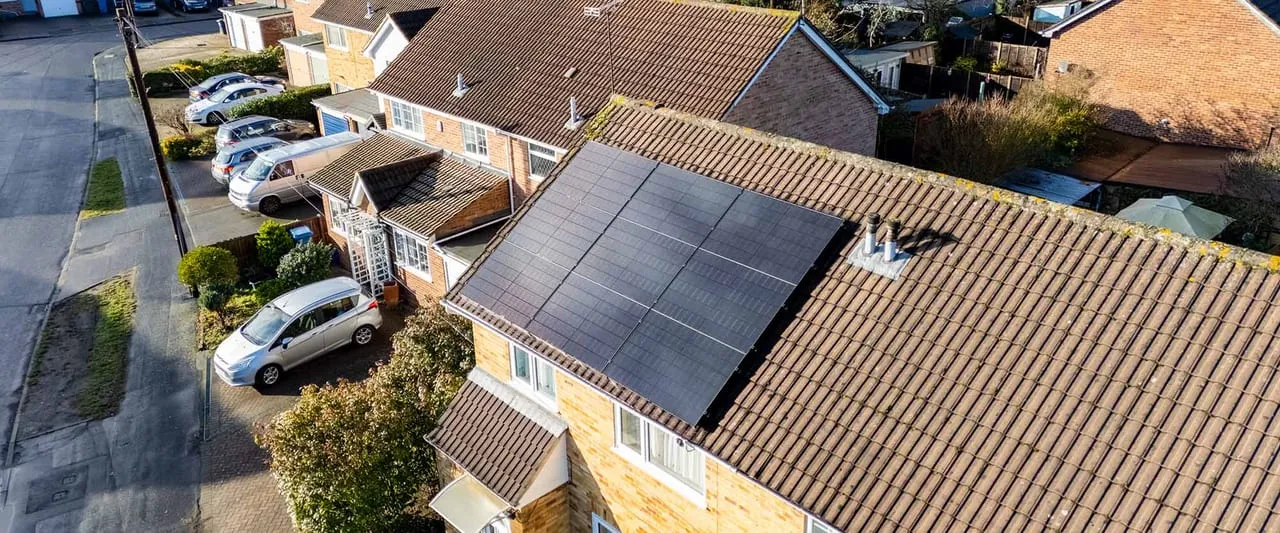
Farm roofs are some of the best solar real estate in the country — vast south-facing barn spans, no shading, and a business next door that already runs on electricity for milking, refrigeration, ventilation and grain drying. But “farm solar” isn’t one product with one price. A barn-roof array, a ground-mount field system and a dairy parlour retrofit all carry different £/kWp costs, different grants, and different payback logic. This guide breaks down what UK farm solar actually costs in 2026, what grant support is genuinely available (and what isn’t), and how to size a system against real farm loads rather than a generic domestic calculator.
Barn-mount vs ground-mount: the cost split
The single biggest cost driver on a farm solar quote isn’t panel wattage — it’s mounting method.
Barn and outbuilding roof-mount is usually the cheapest way to get panels up. Large steel-portal agricultural buildings have simple, unshaded roof planes and can take a high-density array with minimal scaffolding versus a domestic loft-and-tile job. Expect commercial-scale installed costs in the region of £900–£1,200 per kWp for a straightforward roof system in the 30–100kWp range, trending toward the lower end as system size increases. Fibre-cement or asbestos-containing roofs (common on older Dutch barns) add cost for suitable fixing systems or, in the worst case, roof replacement first — always get the roof condition surveyed before quoting panels, because a 20-year array on a 10-year roof is a false economy.
Ground-mount systems cost more per kWp because you’re paying for a mounting frame, ground screws or concrete footings, trenching for DC/AC cabling back to the point of connection, and usually fencing plus a wider planning and grid-connection process. Ground-mount on farmland typically runs £1,000–£1,400+ per kWp installed at commercial scale, though very large multi-MW ground arrays (crossing into solar farm territory) can bring the unit cost down through economies of scale. The advantage is you’re not constrained by roof orientation or structural loading, and you can optimise panel tilt and row spacing for maximum annual yield — useful if your barns are north-facing, in poor condition, or already earmarked for machinery storage rather than roof works.
A useful rule of thumb: if you have decent south-facing barn roof space, use it first — it’s close to free real estate. Only go to ground-mount once roof capacity is exhausted or unsuitable. For a wider look at how these figures compare across sectors, solarpanelsforagriculture.co.uk sets out farm-specific system sizing, and our own commercial solar panel cost breakdown covers the same £/kWp logic for non-agricultural buildings if you’re comparing against a diversified farm business (holiday lets, workshops, storage).
What a real farm system costs, by size
| System size | Typical installed cost (roof) | Typical installed cost (ground-mount) | Indicative farm use case |
|---|---|---|---|
| 10 kWp | £11,000–£15,000 | £13,000–£17,000 | Small holding, single barn, modest three-phase supply |
| 30 kWp | £28,000–£36,000 | £32,000–£42,000 | Mid-size dairy or arable unit, one large barn roof |
| 50 kWp | £45,000–£58,000 | £52,000–£68,000 | Poultry unit or larger dairy with year-round base load |
| 100 kWp | £90,000–£115,000 | £100,000–£135,000 | Multi-building farm, grain drying, chilled storage |
These are broad ranges — actual pricing depends on roof access, DNO grid capacity in your area, cabling runs between buildings, and whether you need a three-phase upgrade. Always get at least three MCS-certified quotes rather than working from a single number. solarpanelsforfarms.uk and solarpanelsforfarmbuildings.co.uk both publish sector-specific sizing guidance if you want to sense-check a quote against typical barn dimensions before you commit.
The grant picture: 25%, not 40%
There’s a persistent and costly myth doing the rounds in farming circles that solar qualifies for a “40% FETF grant.” It doesn’t, and repeating it to a lender or in a business plan will get your figures picked apart.
The Farming Equipment and Technology Fund (FETF) and its devolved-nation equivalents are grant schemes for specific listed equipment (slurry stores, robotic weeders, precision application kit, etc.) — solar PV is not generally an eligible FETF item, and the 40% figure that circulates online refers to different, older or non-solar funding rounds.
The relevant England scheme for on-farm solar is the Improving Farm Productivity grant, administered under the Farming Investment Fund, which has offered support in the region of 25% of eligible capital cost for qualifying farm infrastructure investment, including solar PV in some funding rounds — subject to caps, application windows opening and closing, and eligibility criteria that change between rounds. Support in Scotland, Wales and Northern Ireland runs through separate schemes with their own rates and windows (Scotland’s Agricultural Transformation Fund, Wales’s Farming Connect / Sustainable Farming Scheme capital grants, and Northern Ireland’s Farm Business Improvement Scheme), so don’t assume an England rate applies UK-wide.
Two things matter more than the headline percentage:
- Application windows are competitive and time-limited. Grants are typically opened for a defined period, oversubscribed, then closed — you cannot simply “apply for the farm grant” any time of year. Check current status before building it into cash flow.
- 0% VAT already does a lot of the heavy lifting. Residential solar and battery storage carries 0% VAT in Great Britain until 31 March 2027 (reverting to 5% after). Many farm installations — particularly on mixed-use holdings with a farmhouse — can benefit from this on the domestic portion, while the commercial/agricultural portion is typically VAT-recoverable for a VAT-registered farm business in any case. Run the numbers both ways with your accountant before assuming a grant is the only route to a better payback.
For farms structured as limited companies or VAT-registered partnerships, the combination of standard capital allowances, VAT recovery on the commercial share, and (where a window is open) a partial capital grant is usually a stronger and more reliable case than betting the whole project on securing a competitive grant round. solarpanelsforbarns.co.uk has a good rundown of which farm buildings tend to qualify under current guidance, and it’s worth reading before you submit anything.
Load matching: why dairy and poultry farms size differently
This is where farm solar diverges most sharply from a standard commercial roof. A retail unit or office has a load profile that roughly follows opening hours. A working farm has load patterns dictated by livestock and processes that don’t care what time the sun is out.
Dairy farms typically have two demand peaks a day — morning and evening milking, when the parlour, vacuum pumps, plate coolers and milk tank refrigeration all draw simultaneously. Neither peak lines up neatly with solar generation, which is why dairy installations are increasingly specified with a modest battery buffer (even 10–20kWh) to shift late-afternoon solar surplus into the evening milking peak, rather than exporting it at the Smart Export Guarantee rate and re-importing more expensive grid power two hours later. SEG export rates vary by supplier — typically in the region of 12–20p/kWh at the top end — against import prices around 25p/kWh, so avoiding the export-then-reimport round trip is usually worth more than the export payment itself.
Poultry units, particularly broiler sheds, have a very different and often more solar-friendly profile: near-continuous daytime ventilation, heating and lighting load that scales with bird age and outdoor temperature, meaning a much higher proportion of on-site solar generation gets self-consumed directly rather than exported. Grain drying and cold storage (root veg, potatoes) show similarly strong daytime coincidence — drying and refrigeration running hardest exactly when the panels are producing most.
The practical takeaway: get your installer to model your actual half-hourly (or at minimum daily) electricity consumption profile against expected solar generation before finalising system size. Oversizing a dairy system without storage just increases the exported (lower-value) fraction; undersizing a poultry or drying system leaves genuine self-consumption savings on the table. A specialist installer active in agricultural work — such as Greenlinc Renewables in Lincolnshire, working across one of England’s most intensive arable and horticultural counties, or YEERS covering Yorkshire’s mixed dairy and arable belt — will have seen enough farm meter data to size against your actual load rather than a generic commercial assumption.
What good farm quotes have in common
Whichever installer you use, a properly specified farm quote should include:
- A roof/structural survey confirming the barn can take the additional dead load, and confirming cladding material and fixing method
- A grid capacity check with your DNO — rural three-phase supplies can be capacity-constrained, and a connection upgrade (if needed) can be a material and sometimes slow-moving cost
- Half-hourly or daily load data used to size the array against real consumption, not a rule-of-thumb kWp-per-roof-area figure
- Clear VAT treatment for the mixed farmhouse/commercial elements of the installation
- MCS certification (a legal requirement for Smart Export Guarantee eligibility) and a named installer with genuine agricultural project references, not just domestic ones
If you’re weighing up roof versus ground-mount, or want a second read on whether a current grant window applies to your holding, installers such as ElectriFusion Solutions in South Yorkshire and Ecoaim in central Scotland both work across mixed commercial and rural sites and can talk through DNO capacity and load-matching specifics for your postcode before you commit to a spec. For the underlying commercial economics — payback periods, finance options and how agricultural solar compares to other business sectors — see our commercial solar panel cost guide and the wider payback period breakdown, both of which apply directly to a farm business case even though neither is agriculture-specific.
Farm solar remains one of the strongest commercial solar cases in the UK simply because the roof space is free, the base electrical load is real and constant, and — grant or no grant — 0% VAT and standard capital allowances already make the maths work for most holdings. Get the roof surveyed, get your actual consumption data in front of an installer, and treat any grant as a bonus on top of a case that should already stack up without it.