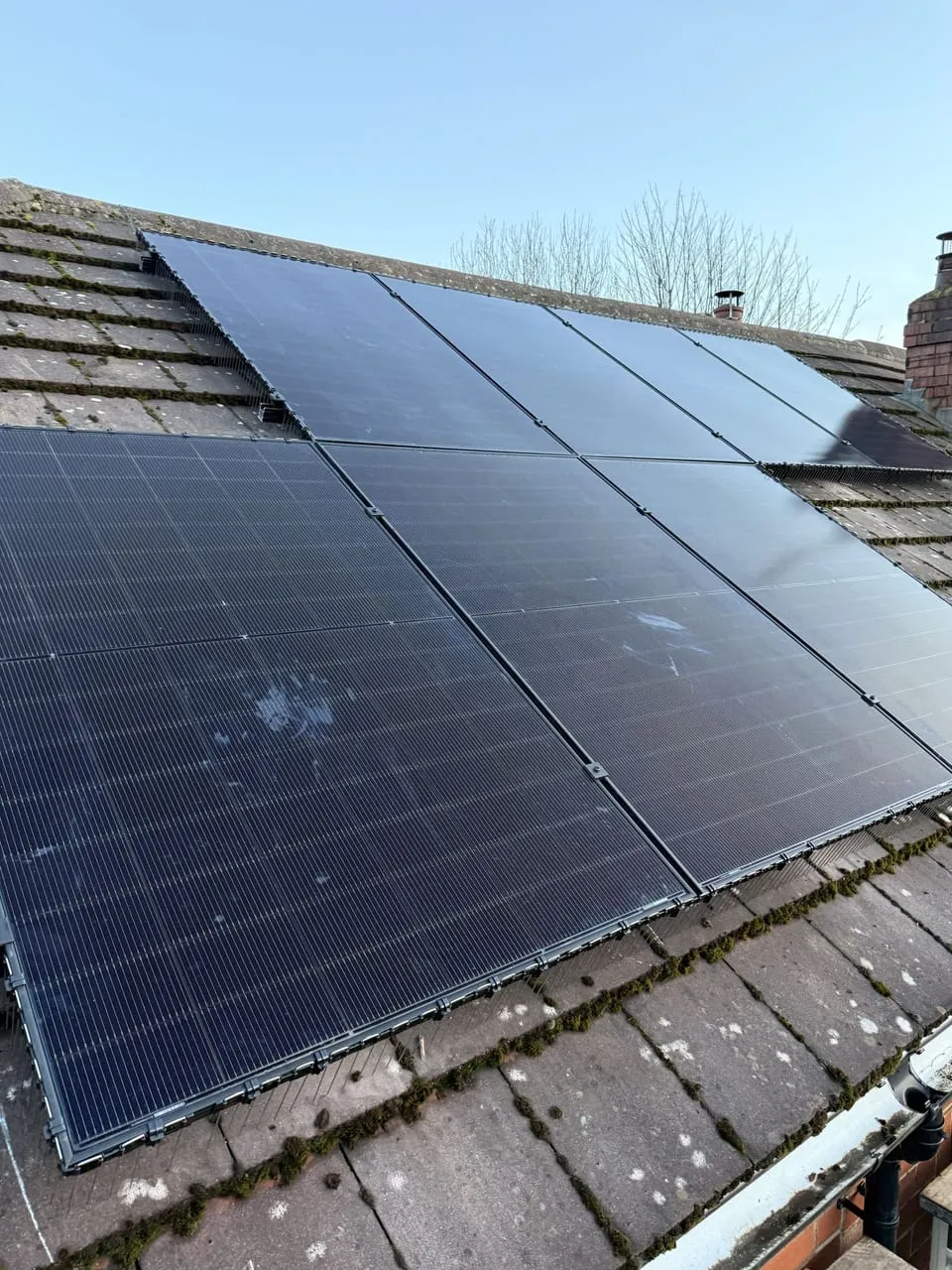
A carport isn’t just somewhere to park the car anymore — for a growing number of UK homeowners, it’s the cheapest square footage of unshaded roof on the property. If your house has a north-facing roof, a listed-building restriction, or a loft conversion that’s eaten your pitch space, a solar carport lets you generate power without touching the house at all. Here’s what one actually costs in 2026, how that stacks up against roof-mount, and where it makes financial sense.
What a domestic solar carport actually is
A solar carport is a freestanding, roofed structure — usually steel or timber-framed — with solar panels mounted on top instead of (or in addition to) a conventional roof covering. Domestic versions typically span a single or double parking bay, sit 2.1–2.4m clear at the eaves for vehicle access, and carry anywhere from 6 to 20 panels depending on footprint.
Unlike the large steel canopies you see over supermarket car parks — the kind covered in detail on solarcarparks.co.uk, which specialises in canopy structures for exactly this — a home carport is a much smaller, lighter-gauge build. But the engineering principles are the same: wind loading, drainage, cable routing to the property, and a structural frame that’s rated for the panel weight plus UK snow load.
Domestic carport costs in 2026
For a single-car domestic solar carport in the UK, expect to pay in the region of £8,000–£15,000 fully installed, depending on:
| Factor | Typical range | Notes |
|---|---|---|
| Single-bay carport, 2–3kWp | £8,000–£10,500 | Basic steel frame, standard panels |
| Double-bay carport, 4–6kWp | £11,000–£15,000+ | Larger frame, more panels, higher wind loading |
| Groundworks / foundations | £1,000–£2,500 | Concrete pad footings, drainage, ground survey |
| DNO / grid connection paperwork | Often included, sometimes £150–£300 extra | Needed for any new generation connection |
| EV charger integration | +£800–£1,500 | Charger unit + dedicated circuit, excl. charger hardware in some quotes |
For context, a same-sized roof-mount system without the structure costs considerably less — a 4kW roof array typically runs £6,000–£8,000 installed, because you’re not paying for a new load-bearing frame, footings, or bespoke bracketry. The carport premium is the structure itself: steel, foundations, and the extra design/engineering sign-off a freestanding structure needs that a roof retrofit doesn’t. It’s a genuinely different product, not a cheaper alternative to roof solar — you’re buying covered parking and generation in one build.
Commercial-scale canopy costs work out differently again, generally landing around £900–£1,200 per kWp for larger arrays where the structure cost per panel drops — worth knowing if you’re weighing up a small business car park rather than a driveway. solarcarparks.co.uk breaks down canopy specifications and costs at that larger scale if a business site is what you’re actually planning.
Why anyone chooses a carport over a roof
The maths only favours a carport in specific circumstances. The main drivers:
- No usable roof pitch. Flat-roof extensions, dormer bungalows with limited south/east/west-facing area, or a roof already at capacity after a previous partial install.
- Shading you can’t fix. Mature trees or a neighbouring building shade the roof for large parts of the day but the driveway is clear.
- Conservation area or listed building restrictions. Some local authorities are markedly more permissive about a freestanding garden structure than about visible roof-mounted panels on a period property — though this always needs checking with your local planning department, since rules vary by council and by curtilage.
- You want covered EV charging anyway. If you’re going to build a carport for weather protection regardless, adding panels to the same structure is a small cost delta against a bare steel frame — you’re already paying for foundations and framing.
- Roof age or condition. If your roof needs re-covering within 5–10 years, it’s often better sequencing to carport now and roof-mount later (or vice versa) rather than fit panels to a roof you’ll need to strip them off again for.
If none of those apply, roof-mount is very likely the cheaper, faster route to the same generation — a carport is a specific-circumstance solution, not a default upgrade.
Carport + EV charging: the pairing that changes the economics
This is where domestic carports earn their keep. A carport that’s already wired for a charge point turns “somewhere dry to park” into a mini generation-and-consumption loop: panels overhead, EV underneath, cable run already in place rather than retrofitted through an external wall later.
A few numbers worth having in your head:
- A 4kWp carport array at the UK’s typical yield of roughly 850 kWh per kWp per year (more like 900–1,000+ in the sunny south) produces somewhere around 3,400 kWh annually.
- Daytime EV charging from that array at home displaces electricity you’d otherwise buy at roughly 25p/kWh (Ofgem price cap territory, varies by tariff) — so self-consumed solar charging is worth considerably more to you than exporting the same unit via the Smart Export Guarantee, where rates vary by supplier and typically sit in the 12–20p/kWh range at the better end.
- Timing matters: solar generation peaks midday, and most EV charging historically happens overnight on cheap off-peak tariffs. A carport-EV pairing only captures full value if you can actually charge during daylight — weekend charging, working-from-home charging, or pairing with a home battery to shift the midday surplus into the evening.
If you’re weighing battery storage to capture more of that daytime generation for evening EV charging, expect £4,000–£8,000 installed for a typical domestic battery, or £8,500–£10,500 for something like a Tesla Powerwall 3 (13.5kWh) — a meaningful extra outlay on top of the carport itself, so it’s worth modelling whether your actual daytime charging pattern justifies it before adding one. For a wider look at what’s driving battery pricing this year, see our solar battery storage costs breakdown.
VAT, grants and the practical tax picture
The good news: a domestic solar carport, like roof-mount solar, currently qualifies for 0% VAT on installation in Great Britain, a relief that runs until 31 March 2027 (scheduled to revert to 5% after that date, on current government plans). That 0% rate applies to the panels and the installation of the generating equipment — always confirm with your installer exactly what falls inside the VAT-free scope versus what’s charged separately, since a bespoke structural carport build can blur the line between “generating equipment” and “building work” in ways a straightforward roof retrofit doesn’t.
There’s no universal home-solar grant in England. If your household is on a low income with a low-EPC-rated home, ECO4 or the Warm Homes scheme may cover elements of a wider retrofit — but a discretionary domestic carport is not what either scheme is designed for. In Scotland, Home Energy Scotland’s interest-free loan can help spread the cost. None of the farm-specific grants (the England Improving Farm Productivity grant, worth roughly 25% of eligible cost, varies by devolved nation) apply to a private domestic driveway installation — those are agricultural business grants, not homeowner grants, so don’t budget around them for a house build.
MCS certification still matters
Whatever route you take, insist your installer is MCS-certified. It’s the only way to remain eligible for the Smart Export Guarantee, and it’s increasingly a marker installers use in a market that’s growing fast — 2025 saw a UK record of 257,397 MCS-certified installs, up 32% on the year before, taking cumulative UK solar capacity to around 21.6 GW. A carport is a more bespoke structural build than a standard roof retrofit, so ask specifically whether the installer’s MCS accreditation and structural warranty both cover freestanding canopy structures, not just roof-mounted arrays — not every certified installer builds both.
For homeowners in South Yorkshire, ElectriFusion Solutions covers both solar and the electrical certification work a carport build needs — DNO applications, new circuits, EV charger wiring. In Central Scotland, Ecoaim handles solar-plus-battery installs including the groundworks and structural sign-off a freestanding carport requires. If you’re in Lincolnshire, Greenlinc Renewables is MCS-certified and worth a call for a site-specific structural quote, and in West Kent, Hazell Electrical combines the electrical and renewables side of a carport-plus-EV-point build under one roof (so to speak).
Getting a proper quote
Because a carport is a structural build rather than a retrofit, the quoting process needs a site visit, not just a satellite-imagery estimate. Things worth asking any installer before you commit:
- Is the quoted price all-in (foundations, DNO notification, cabling to the consumer unit) or will groundworks be billed separately once they’ve seen the ground conditions?
- What wind-loading standard is the frame designed to, and does the structural warranty explicitly cover it as a freestanding structure (not just the panels)?
- If you want EV charging integrated now or later, is the carport pre-wired for it, and does that change the foundation spec?
- What’s the payback period at your actual roof-versus-carport yield difference — get this modelled specifically, not assumed from a generic online calculator, since shading and orientation on a driveway install differ from a roof.
If you want to sense-check payback assumptions before you get quotes, our solar panel payback period guide and solar panel calculator are a reasonable starting point for domestic system economics generally, though a carport’s structural premium means you should adjust the capital cost upward from a standard roof-mount figure. And if your interest is really business or landlord-scale canopy parking rather than a single driveway, the Commercial Solar Panels Installation hub and Solar Panels For Car Parks both cover that end of the market in more depth than this piece can.
The bottom line
A domestic solar carport costs roughly £8,000–£15,000 installed — a real premium over the £6,000–£8,000 you’d pay for an equivalent roof-mount array, because you’re buying a structure as well as generation. It earns that premium when your roof genuinely can’t take panels, when you want covered EV charging built in from day one, or when sequencing around a roof replacement makes carport-first the sensible order of operations. For everyone else with a usable, unshaded roof pitch, standard roof-mount solar remains the cheaper way to the same kilowatt-hours.
Get two or three structural quotes, confirm MCS accreditation covers freestanding builds specifically, and model your actual daytime usage pattern — especially if EV charging is the reason you’re considering this in the first place — before signing anything.