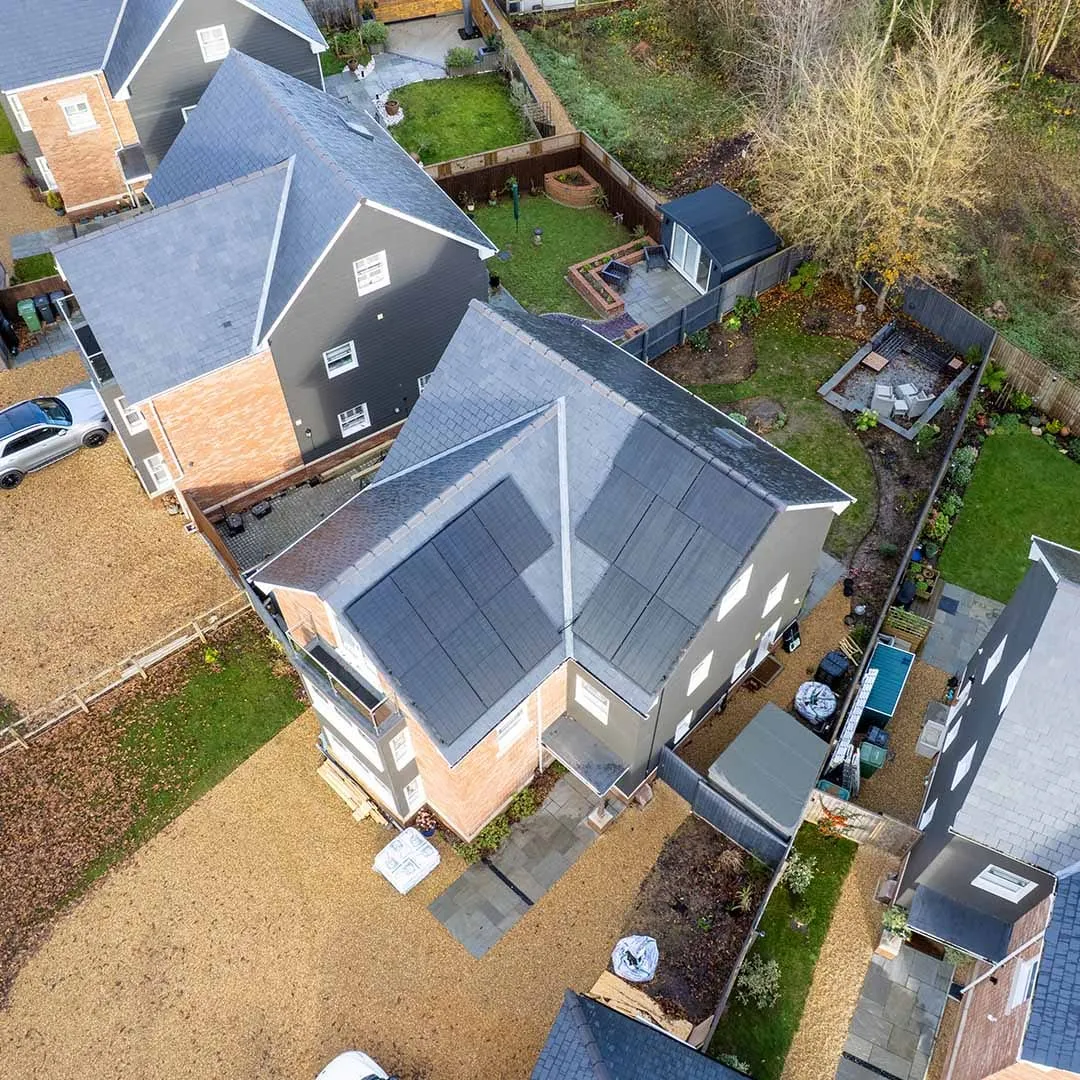
Every headteacher and school business manager asking about solar arrives at the same wall: capital budgets are already stretched, energy bills keep rising, and nobody wants to sign off a five-figure project on guesswork. This guide sets out what a typical school solar installation actually costs in the UK in 2026, how the maths on payback works, and — critically — how most schools actually pay for it without touching reserves, using Salix interest-free finance rather than a grant that doesn’t exist.
Why schools are a different calculation to houses
A house roof might take a 4-6kWp system. A primary or secondary school with a decent south-facing roof span is a different order of scale — most viable school installations sit somewhere between 30kWp and 50kWp, occasionally larger on colleges or academy trusts with multiple buildings. That’s the size where the economics genuinely work in a school’s favour: daytime usage (classrooms, IT suites, kitchens, heating pumps) lines up closely with daytime solar generation, so a much higher proportion of what’s generated gets used on-site rather than exported for a lower rate.
Schools also tend to have large, unshaded, flat or low-pitch roofs — ideal for solar — and predictable, term-time-heavy consumption patterns that make forecasting savings more reliable than for a typical commercial building with erratic hours.
What a 30-50kWp school system costs in 2026
Commercial-scale solar in the UK is currently priced per kWp installed, and school projects usually land in the same band as other commercial and public-sector installs — roughly £900-£1,200 per kWp once you include panels, inverters, mounting, scaffolding/access, and grid connection work. That gives a rough range of:
| System size | Estimated installed cost (2026) |
|---|---|
| 30kWp | £27,000 - £36,000 |
| 40kWp | £36,000 - £48,000 |
| 50kWp | £45,000 - £60,000 |
Three things move a school’s number up or down from that midpoint:
- Roof type and access. A flat GRP or felt roof needs ballasted mounting frames and may need a structural survey; a pitched slate roof is often cheaper to fix panels to but harder to scaffold safely on an occupied site.
- Distribution board and grid capacity. Older school electrical infrastructure sometimes needs upgrading before a 30kWp+ array can be connected — get this checked early, it’s the most common cause of budget overruns.
- Battery storage, if added. Most schools skip battery storage initially because usage is concentrated in daylight hours anyway, but a battery can still smooth demand spikes (kitchens, kilns, sports hall floodlighting) — expect this to add a meaningful chunk on top of the panel cost if included.
For a detailed breakdown of commercial pricing assumptions and how installers arrive at a quote, thecostofsolar’s commercial solar panel cost guide walks through the same £/kWp method in more depth, and our solar panel calculator is a useful sense-check tool before you get quotes in.
The funding question: there is no “school solar grant”
This is where a lot of school business managers get misled by out-of-date blog posts. There is currently no dedicated capital grant that simply hands a state school money to install solar panels. What actually exists, and what schools genuinely use, is different:
Salix Finance is the main route. Salix is a government-owned company that provides interest-free loans (historically 0% loans, and in some programme years outright grant funding for the public sector) specifically for energy efficiency and low-carbon technology in the public sector — including maintained schools, academies, and further education colleges. Solar PV is an eligible technology under Salix’s public sector schemes. The exact scheme name, funding pot, and whether it’s loan or part-grant varies year to year and is regularly oversubscribed, so the practical advice is: check the live Salix scheme details directly (via gov.uk or your local authority’s energy team) before budgeting, rather than relying on a fixed percentage figure — the terms change between funding rounds.
Local authority and academy trust capital programmes sometimes bundle solar into wider condition-improvement funding (e.g. Condition Improvement Fund bids for academies), but this is competitive and roof/solar work has to be justified alongside more urgent building fabric needs.
0% VAT is a genuine, immediate saving that applies right now: residential solar and battery installations are VAT-free in Great Britain until 31 March 2027. Note this specifically applies to residential — school and commercial installations are typically VAT-able at the standard rate, though VAT can usually be reclaimed by the local authority or academy trust depending on their VAT status, so it’s worth checking with your finance team rather than assuming either way.
Do not confuse any of this with the Boiler Upgrade Scheme (£7,500 towards an air source heat pump) — that’s a heating grant and does not cover solar PV in any form. And if your school is weighing solar alongside a heat pump upgrade as part of a wider decarbonisation plan, treat them as two separate funding conversations with separate eligibility rules.
What savings actually look like
This is the number that gets a business case past governors: most schools running a 30-50kWp array report £5,000-£10,000 a year in reduced electricity spend, depending on system size, roof orientation, and how much of the generated power is used on-site versus exported.
The mechanics behind that figure:
- UK solar yield averages around 850 kWh per installed kWp per year, rising towards 1,050+ kWh/kWp in the sunniest parts of southern England. A 40kWp array might therefore generate somewhere in the region of 34,000-40,000 kWh annually.
- Every kWh a school uses directly from its own panels avoids paying the grid rate — currently around 25p/kWh under the Ofgem price cap for many suppliers, though schools on commercial contracts should use their own actual unit rate, which can differ.
- Anything generated but not used on-site can be sold back under the Smart Export Guarantee (SEG), but be realistic about this: SEG rates are set by individual suppliers and vary widely, from a few pence up to around 12-20p/kWh at the better end — it is not a fixed national rate, and a school shouldn’t build its business case around the top of that range without a contracted quote in hand.
- MCS certification of both the installer and the installation is a prerequisite for SEG payments, so confirm your installer is MCS-certified before signing anything.
Payback on a well-specified 30-50kWp system typically lands somewhere in the 6-9 year range for schools with strong daytime self-consumption, against a panel lifespan of 25-30+ years and modern degradation rates of around 0.4% a year for current-generation panels. That leaves 15-20+ years of largely “free” generation after payback, which is the argument that tends to land best with finance committees and governors weighing up capital spend against a fixed schools budget.
Specialist guidance for schools and colleges
Because school and college projects have their own procurement rules, safeguarding-driven access constraints (working around term time, exam periods, and occupied buildings), and often need to go through a formal tender or framework process, it’s worth working from resources built specifically for the education sector rather than generic commercial solar content. solarpanelsforschools.co.uk is a dedicated hub covering the school-specific side of this — procurement routes, roof survey considerations around term-time access, and case examples at the scale most single-site schools need. For sixth-form colleges, FE colleges, and multi-building academy trusts where system sizes often exceed 50kWp and span several roofs, solarpanelsforcolleges.co.uk covers the larger-scale end of the same problem, including how multi-building sites sequence installations across several summer holidays rather than trying to do everything in one go.
If your school also has separate estate buildings — a sports hall, a swimming pool complex, or a large hall used for community lettings — it’s worth getting these scoped as part of the same survey even if they’re not the main teaching block, since standalone structures like these often have simpler flat or pitched roofs that are cheaper to fit than a listed or awkwardly-shaped main building. solarpanelsforsheds.co.uk and solarpanelsforgardens.co.uk are aimed at smaller standalone structures generally, but the same “separate roof, separate quote” logic applies to school outbuildings.
Getting quotes: what to ask installers
When you go out to tender or approach installers directly, ask for the quote broken down by:
- £/kWp for the panel and inverter system alone, so you can compare quotes on a like-for-like basis rather than total price, which can hide very different scopes.
- Scaffolding/access costs separately — these can be 10-15% of a school project’s total cost given the additional safety requirements of working on an occupied site with children present, and it’s the line item that varies most between installers.
- MCS certification confirmation in writing, since this is non-negotiable for SEG eligibility.
- Whether the quote includes distribution board or supply upgrade work, or whether that’s a separate cost to be confirmed after a site electrical survey.
- Expected annual generation (kWh) and the assumptions behind it — a credible installer will model this against your actual roof pitch, orientation and any shading (nearby trees, adjacent buildings), not just quote a generic per-kWp yield figure.
For schools in South Yorkshire, ElectriFusion Solutions and AMP Pro Electrical both handle commercial and public-sector installations around Doncaster; in Lincolnshire, Greenlinc Renewables is MCS-certified and has covered education-sector work in the county; and in Essex and East Anglia, EC Eco Energy specialises specifically in commercial and larger-scale solar and battery projects, which is the right scale bracket for most secondary schools. Getting two or three quotes from installers who already understand commercial/public-sector scale — rather than a residential specialist scaling up — tends to produce more realistic numbers at the tender stage.
The practical starting point
Before any of the above becomes real, get a roof survey done — most reputable commercial installers will do this free or for a nominal fee, and it will tell you your usable roof area, orientation, shading, and structural loading capacity, which together determine your realistic maximum system size far more than any budget figure does. From there, check the live Salix scheme terms for your school type (maintained, academy, or FE college — eligibility routes differ), get two or three like-for-like quotes using the checklist above, and model payback against your school’s actual current electricity unit rate rather than a generic national average. That combination — a proper survey, current Salix terms, and comparable quotes — is what turns “solar sounds like a good idea” into a business case a governing body can actually approve.