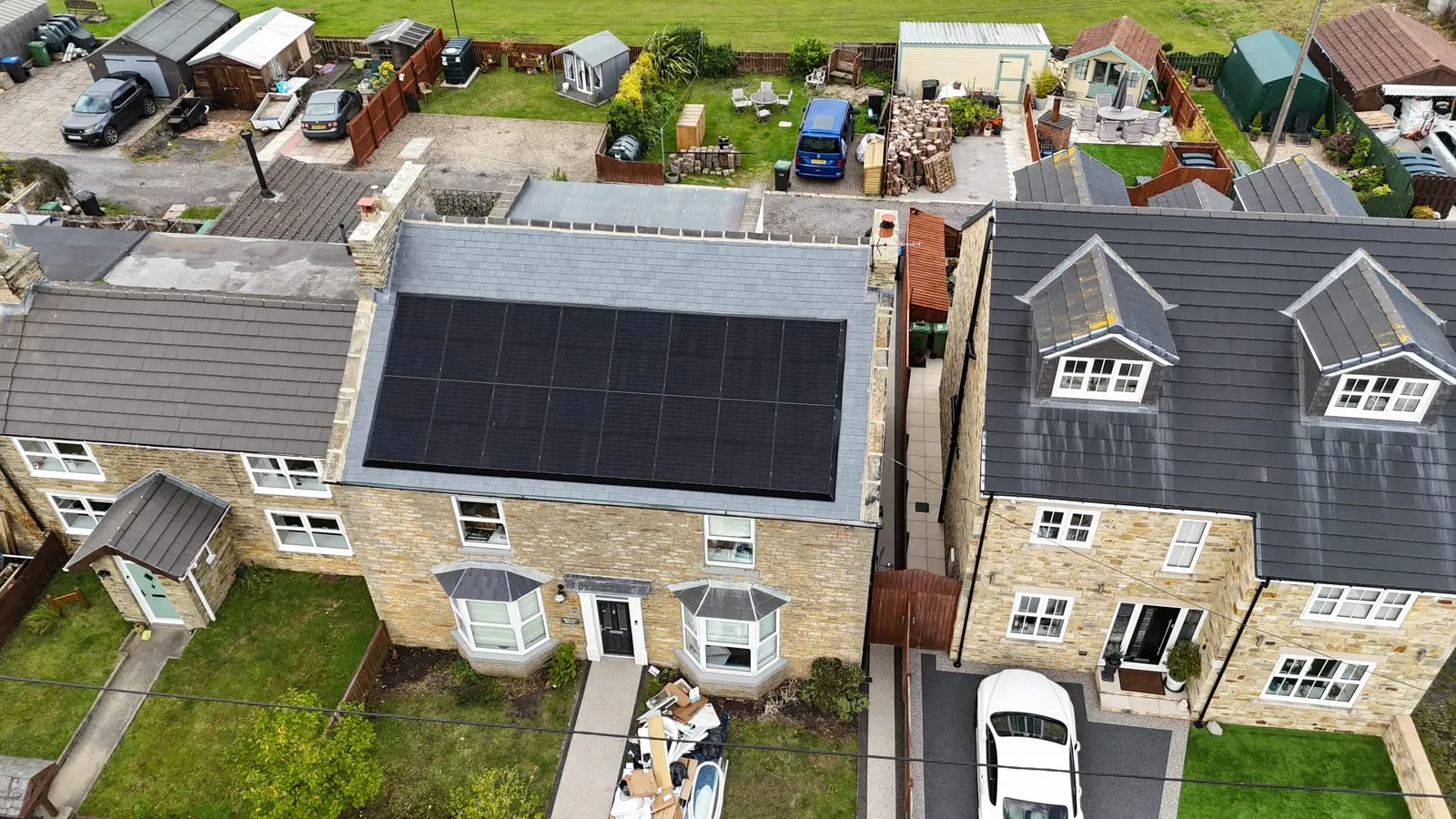
A 100kWp warehouse array and a 250kWp distribution-centre roof look similar on a drone photo, but the economics behind them are a different game entirely from a domestic 4kW install. Bigger arrays cost less per kWp, daytime industrial demand soaks up far more of the generation on-site, and the payback maths shifts from “nice to have” to “why wouldn’t you.” Here’s what warehouse solar actually costs in 2026, and where the real savings — and real risks — sit.
Why warehouses are different from a house roof
A typical home installer quotes per system. A commercial installer quotes per kWp (kilowatt-peak), because at scale the fixed costs — scaffolding or access equipment, a site survey, grid application, commissioning — get spread across a much bigger array, and the price per unit falls. On a 3-4kW home roof you’re paying a premium for a small crew to be on-site for a day. On a 200kWp warehouse roof, the same crew and the same access kit might cover 15-20 times the capacity in a few weeks, so the labour and mobilisation cost per kWp drops sharply.
Warehouses also bring a second advantage that houses rarely have: a roof that’s mostly flat, mostly unshaded, and enormous relative to the electricity demand of the business below it. A 5,000m² distribution shed can often fit 400-600kWp of panels without going near the edges. The constraint usually isn’t roof space — it’s how much of that generation you can actually use.
What warehouse solar costs per kWp in 2026
For commercial rooftop solar in the 50kWp-plus bracket, installed costs in the UK are typically £900-£1,200 per kWp, with the figure falling as system size increases. A few reference points:
| System size | Typical installed cost range | Approx. £/kWp |
|---|---|---|
| 50-100kWp | £55,000-£110,000 | £1,000-£1,200 |
| 100-250kWp | £100,000-£250,000 | £900-£1,100 |
| 250-500kWp | £220,000-£480,000 | £850-£1,000 |
| 500kWp+ | Site-specific, often sub-£900/kWp | £800-£950 |
Those ranges move around a lot depending on roof type. A standing-seam metal roof with clamp-fix mounting is usually cheaper per kWp than a membrane roof needing ballasted trays, and a roof that needs strengthening work, asbestos survey, or crane access for materials can add a meaningful premium regardless of array size. Older warehouse roofs — particularly those built before the 1990s — sometimes carry asbestos cement sheeting, and that survey and remediation cost should be budgeted separately, not folded into the “per kWp” headline figure.
It’s also worth checking the roof’s structural loading capacity before designing the array. Panels, mounting rails and cabling typically add 10-15kg/m² of dead load; most modern industrial roofs are designed with margin for this, but older or lightweight-clad buildings sometimes need a structural engineer’s sign-off first. This is one area where Solar Panels For Warehouses is worth reading before you get quotes, since it’s specifically built around warehouse roof types, loading and access constraints rather than generic commercial solar.
Why self-use rate is the number that actually matters
Domestic solar articles talk endlessly about export rates. For a warehouse, export is close to irrelevant — the entire commercial case rests on self-consumption: how much of the solar generation gets used on-site, displacing electricity you’d otherwise buy at the full import rate (currently around 25p/kWh under the Ofgem cap, though commercial tariffs vary by contract).
Warehouses and distribution operations are unusually well-suited to solar because their demand pattern lines up with generation:
- Refrigeration and cold storage run continuously, including through the middle of the day when solar output peaks.
- Conveyor systems, forklifts on charge, packing lines and dock-leveller motors draw load during standard daytime shift hours.
- Lighting, HVAC and office/welfare areas add a steady daytime baseline on top of the process load.
Because of this, well-sized warehouse arrays commonly achieve 70-90% self-use of what they generate — a huge contrast with an unoccupied house during the day, which might only self-consume 20-40% without a battery. At 80% self-use, an array generating 850 kWh per kWp per year (the rough UK average annual yield, higher in southern England, lower in Scotland) that displaces import at 25p/kWh is worth roughly £170-£180 per kWp per year in avoided electricity purchase alone, before any export income on the remainder.
That single figure — self-use percentage — should be the first thing any warehouse operator interrogates in a proposal. A supplier promising an oversized array with a low self-use rate is selling you export income at wholesale-ish rates instead of import savings at full retail rates, and the payback maths gets noticeably worse.
Sizing to load, not to roof space
The temptation with a big flat roof is to fill it. But if your daytime baseload is, say, 150kW and a supplier proposes a 400kWp array, a large share of midday generation in summer will have nowhere useful to go on-site and gets exported at whatever rate your supplier offers (commercial Smart Export Guarantee-style rates vary considerably by contract, typically well below the retail import price). The better approach — and the one a good commercial designer will model — is to size the array against 12 months of half-hourly meter data, so the array roughly matches the daytime demand profile rather than simply maximising panel count. Solar Panels For Logistics covers this sizing logic specifically for distribution and logistics operations, where multi-shift patterns and vehicle charging change the load curve compared with a single-shift warehouse.
Cold storage: a special case worth flagging separately
Cold storage and refrigerated distribution sites deserve their own mention, because their electricity profile is close to ideal for solar: refrigeration compressors don’t switch off at 5pm, so a cold store’s demand is flatter and more continuous across 24 hours than almost any other building type. That means self-use rates at the very top of the range — often 85%+ — are realistic, and the payback case is frequently stronger than for a standard ambient warehouse of the same size. It also means battery storage is less critical here than in a typical office or retail building, since so much of the daytime generation is being consumed as it’s produced rather than needing to be time-shifted. Solar Panels For Cold Storage is a useful next read if refrigeration is the dominant load on your site — it’s written around exactly this profile rather than generic commercial solar.
Payback periods at this scale
With 0% VAT currently applying to residential solar and battery storage in Great Britain (in place until 31 March 2027, after which it’s scheduled to revert to 5%), it’s worth being clear that this relief is a residential measure — commercial and industrial installations are typically VAT-able at the standard rate, though VAT treatment can depend on the entity and structure, so get specific advice rather than assuming.
On the numbers above — £900-£1,200/kWp installed, 850 kWh/kWp/yr generation, 70-90% self-use displacing c.25p/kWh import — simple payback for a well-sized 100-250kWp warehouse array typically lands in the 5-9 year range, before accounting for any capital allowances, on-site generation reducing exposure to future price rises, or additional revenue from export of the unused portion. Panels themselves are rated for 25-30+ years with modern N-type cells (TOPCon, HJT or similar) degrading at only around 0.4% per year, so a system with an 8-year payback still delivers 15-20+ years of largely “free” generation afterwards, minus an inverter replacement (string inverters typically last 10-15 years, at roughly £500-£1,000 each to replace on a domestic scale — commercial central or string inverter replacement costs scale with capacity).
Financing routes matter here too. Outright capital purchase gives the best long-run return, but a growing number of warehouse operators use asset finance or a power purchase agreement (PPA) structure to avoid the upfront capital outlay — worth comparing against a straight purchase before committing, particularly if the capital would otherwise be deployed elsewhere in the business. For the underlying figures on system pricing across sizes, our own commercial solar panel cost breakdown goes into more granular £/kWp bands, and our solar panel payback period guide walks through how to build your own site-specific payback model rather than relying on a generic industry average.
Getting the quote comparison right
Because commercial quotes are priced per kWp rather than as a fixed package, it’s easy for like-for-like comparison to go wrong. When comparing proposals, check:
- Panel technology and warranty — N-type panels command a premium over older P-type but degrade more slowly; check the performance warranty term, not just the product warranty.
- Inverter topology — string vs central inverters change both upfront cost and long-term maintenance/replacement cost.
- Self-use modelling — ask the installer to show their assumed self-use percentage and the meter data it’s based on, not just an assumed “typical” figure.
- Roof survey scope — has structural loading, roof condition, and (for older buildings) asbestos been assessed, or is that an unpriced risk sitting outside the quote?
- O&M provision — a large rooftop array needs periodic inspection, inverter monitoring and panel cleaning in dusty or high-particulate environments (logistics yards, near main roads); factor this into the real cost of ownership rather than treating the array as maintenance-free. A specialist like Solar Maintenance Solutions is worth a conversation at the design stage, not just after something goes wrong, particularly for larger arrays where a failed string can sit undetected for months without active monitoring.
For businesses weighing solar against other efficiency spend, it’s also worth checking whether a commercial-focused electrician or installer in your region already has warehouse or industrial-unit experience specifically, rather than a generalist residential fitter scaling up for the first time. D&R Energy in the Bristol area and EC Eco Energy covering Essex and East Anglia both work specifically in the commercial and battery space, and asking to see a comparable warehouse or industrial reference site is a reasonable request before signing anything.
If your interest is specifically in whether the numbers stack up before you get quotes at all, our solar panel calculator gives a starting estimate, though for anything above roughly 50kWp it’s genuinely worth commissioning a proper site-specific yield and self-use model rather than relying on a generic calculator — the gap between a good and a mediocre warehouse solar proposal is almost always in that self-use assumption, not in the headline £/kWp price.
The bottom line
Warehouse solar at 100-250kWp+ scale costs roughly £900-£1,200 per kWp installed, falling toward the lower end as size increases and rising where roof condition or access adds complexity. The number that actually determines whether it’s a good investment isn’t the headline price — it’s the self-use rate, which for a warehouse or distribution operation with continuous or daytime-heavy load commonly sits at 70-90%, well above what an unoccupied domestic roof achieves. Get 12 months of half-hourly meter data, size the array to the load rather than the roof, and treat the self-use percentage in any proposal as the figure to interrogate hardest.