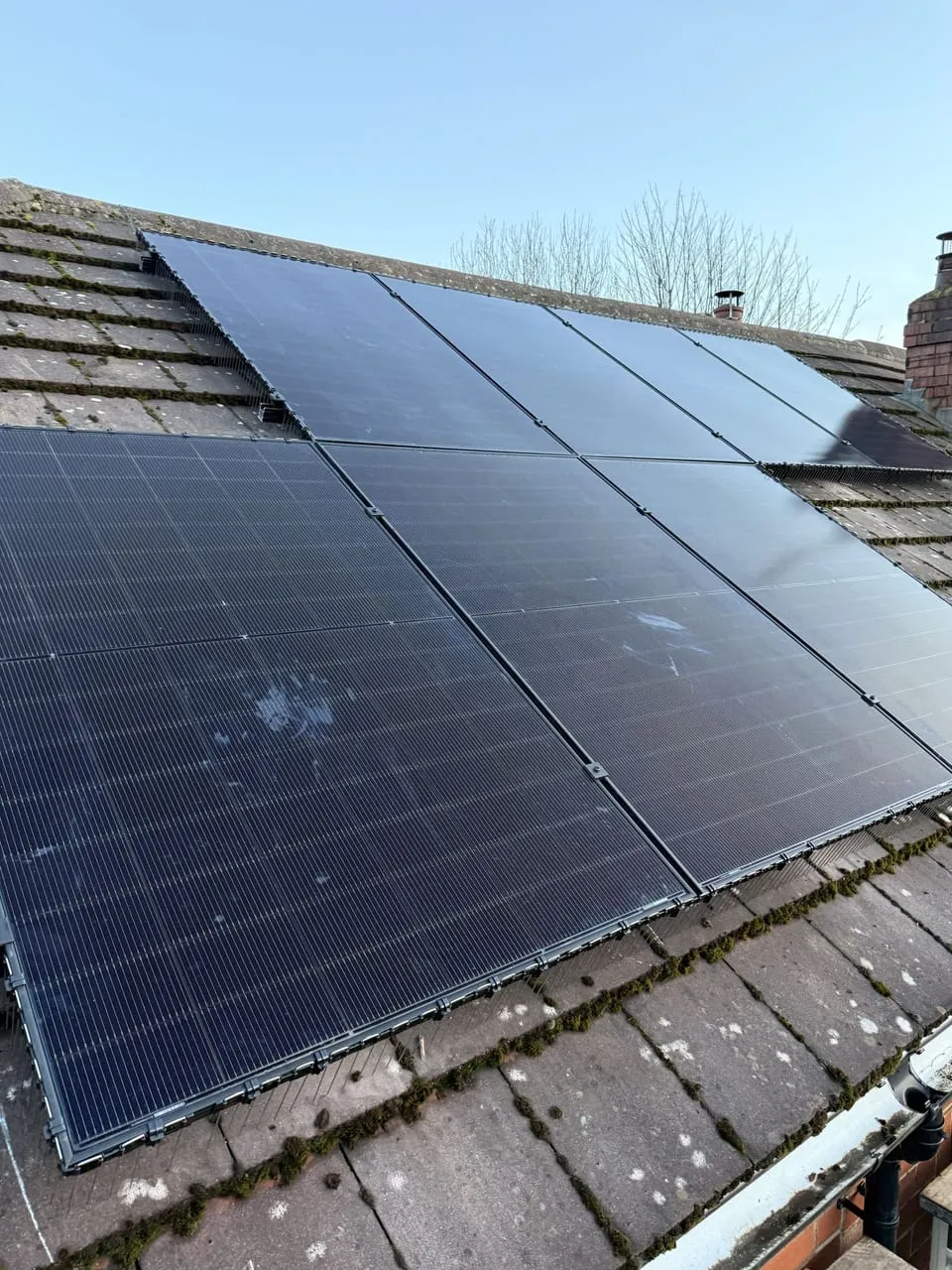
The cost of solar panels varies significantly by property type — not just because of roof size, but because of scaffolding access, structural considerations, planning requirements, and installation complexity. A bungalow can save £400-£800 on scaffolding alone compared to a three-storey Victorian terrace.
This guide gives specific costs, system sizes, and ROI considerations for every UK property type, based on 2026 installer data.
Detached Houses
Detached properties typically have the most roof space and flexibility — no party wall restrictions, often unobstructed access on multiple sides, and the ability to install on whichever elevation provides the best orientation. Most detached homes can accommodate 4-10 kWp systems.
| System | Installed Cost | Annual Savings | Payback | Typical Use Case |
|---|---|---|---|---|
| 4 kWp (10 panels) | £5,500 – £8,000 | £600 – £900 | 7-9 years | 3-bed, average usage |
| 6 kWp (15 panels) | £7,500 – £11,000 | £900 – £1,300 | 6-8 years | 4-5 bed, heat pump or EV |
| 8-10 kWp (20-25 panels) | £10,000 – £14,000 | £1,100 – £1,900 | 6-7 years | Large home, high usage, EV + battery |
Detached houses in the South and South West achieve the highest solar yields — up to 1,132 kWh/kWp in Brighton versus approximately 837 kWh/kWp in Inverness. But even in Scotland, a well-designed system pays for itself within 8-10 years at current electricity prices. See our main costs guide for regional price differences.
Semi-Detached Houses
Semis typically have roof space for 8-15 panels depending on orientation. The main consideration is which elevation faces south. If only the front or back faces south, you may be limited to 6-8 panels on that elevation. East/west split installations — panels on both sides of the roof — are increasingly common and deliver good all-day generation despite lower peak output.
Costs are identical to detached properties for the same system size. The only premium is if scaffolding access is restricted by the neighbouring property — expect an additional £100-£300 in scaffolding costs if the installation side is against the party wall.
Terraced Houses
Mid-terrace properties have the smallest roof footprint, typically supporting 6-10 panels. End-of-terrace properties have a side elevation that may provide additional space. Key considerations for terraces:
Limited roof space means maximising output per panel is critical — use high-efficiency 420W+ N-type TOPCon panels rather than cheaper 350-380W PERC panels. The difference between 8 panels at 350W (2.8 kWp) and 8 panels at 440W (3.5 kWp) is 25% more generation for only £200-£400 more in panel cost.
Scaffolding may need to span the front or rear elevation, potentially affecting neighbours. In conservation areas, front-facing panels may need planning permission (permitted development rights only cover rear-facing installations in many conservation areas).
| Type | System | Cost | Savings | Notes |
|---|---|---|---|---|
| Mid-terrace | 3-4 kWp (7-10 panels) | £4,500 – £7,500 | £450 – £750/yr | Roof space limits max size |
| End-of-terrace | 4-6 kWp (10-15 panels) | £5,500 – £10,000 | £600 – £1,200/yr | Side elevation adds capacity |
Bungalows
Bungalows often have excellent solar potential — large roof area relative to floor space, and no scaffolding required (or minimal scaffolding at eaves height only). This saves £400-£800 compared to a two-storey installation. The roof pitch is sometimes shallower than two-storey houses, which can actually improve summer generation at UK latitudes.
Many bungalows can accommodate 6-10 kWp systems, making them among the most cost-effective property types for solar. A 6 kWp system on a bungalow at £7,000-£9,500 (saving £500-£800 on scaffolding vs a two-storey house) with annual savings of £900-£1,300 delivers a payback of just 5-7 years.
Flats and Apartments
Individual flat owners generally cannot install solar on shared roofs without freeholder and management company permission — and even with permission, the logistics of shared roof space, maintenance responsibility, and benefit allocation make it complex.
Options for flat owners include communal solar (the building installs a shared system with costs and savings split between residents), balcony panels (plug-in solar panels producing 300-800W that connect to a standard socket — cost £300-£600, save £80-£150/year, no installation required), and ground-mounted systems if you own a garden area (costs 15-20% more than rooftop due to mounting frame and groundwork).
Listed Buildings and Conservation Areas
Listed buildings require Listed Building Consent before installing solar panels. This does not mean panels are prohibited — many listed buildings now have solar — but the application adds 8-12 weeks and planners may require specific panel positions (rear elevations only) or in-roof integrated systems rather than on-roof mounted panels. In-roof systems cost approximately 20-30% more than standard on-roof mounting but sit flush with the roof surface.
In conservation areas, panels on a rear roof slope that are not visible from a public highway are generally permitted development. Front-facing panels typically need planning permission. Check with your local planning authority before engaging an installer.
New Build Properties
The Future Homes Standard (expected to take effect from 2025-2026) will require new homes in England to produce significantly fewer carbon emissions. Solar panels are one of the most cost-effective compliance routes — already 35% of all UK solar installations in 2025 were on new-build properties (up from 32% when MCS began tracking in October 2023).
If buying a new build, check whether solar is already included in the specification. If not, ask the developer about adding it as an option — developers can install at lower cost than retrofit (no scaffolding, simpler electrical connection, economies of scale across the development) and often pass on some of that saving.
For detailed pricing by system size, see our main solar costs guide. For information on adding battery storage to maximise your investment, see our battery costs guide.