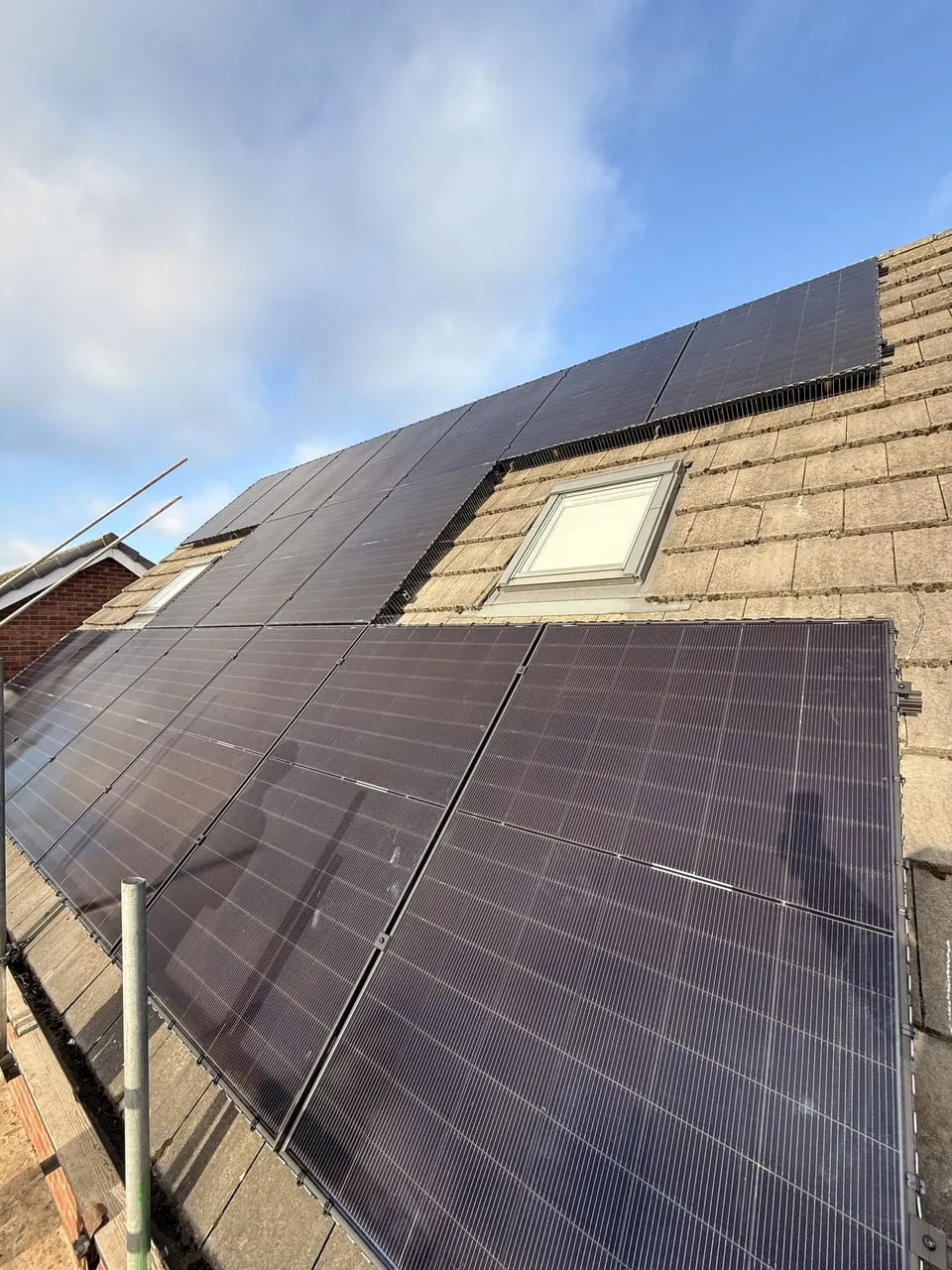
“Cheap solar panels UK” is one of the most searched phrases in the entire industry, and it’s also one of the most misunderstood. Everyone wants to pay less. The mistake is assuming “cheap” and “low quote” are the same thing — they’re not, and the gap between them is where a lot of UK homeowners lose money on a system that was supposed to save them money. This piece splits the difference honestly: which cheap decisions are actually smart, which corners genuinely shouldn’t be cut, and why the second-hand panel market is nowhere near the bargain it looks like on Facebook Marketplace.
What “cheap” actually costs in 2026
Start with the number everyone quotes and few people qualify: a typical 4kW residential system installed in the UK currently runs £6,000–£8,000, a smaller 3kW system around £5,000, and a 10kW system (increasingly common as households add EVs and heat pumps) sits at £13,000–£17,000. Those ranges already assume 0% VAT, which applies to residential solar and battery storage installed in Great Britain until 31 March 2027 — after which it’s scheduled to revert to 5%. If you’re weighing up timing as well as price, that’s a genuine, dated saving worth locking in rather than a sales gimmick.
Below the bottom of that range is where “cheap” starts meaning something different. A sub-£4,000 quote for a 4kW system on a UK roof is not a discount — it’s a different, thinner product, and it’s worth understanding exactly what’s been stripped out to hit that number. We’ve broken down the full national cost picture, including regional variation and commercial pricing, on our solar panel cost guide, and if you want to sanity-check your own roof and usage against real numbers rather than a generic average, the solar panel calculator is a better starting point than any single quote.
The £4,000 system, dissected
When a quote for a 4kW array comes in £2,000–£3,000 below the market range, the saving usually comes from one or more of five places:
- Panel tier. Budget Tier 2/3 polycrystalline or older-generation monocrystalline panels instead of modern N-type (TOPCon, HJT or ABC) cells. This isn’t automatically a problem — see below — but it does mean lower efficiency per square metre, so you may need more roof space for the same output.
- String inverter downgrade. A basic single-string inverter with no monitoring, or a stripped-back monitoring app, shaves real cost but leaves you blind to underperformance. If one panel in a string is shaded or faulty, output on the whole string drops and you may not notice for months.
- Mounting and racking. Thinner aluminium rail, fewer roof hooks per panel, or a flashing kit that isn’t matched to your roof tile profile. This is the single biggest false economy on the list — it’s invisible until a storm finds it.
- Labour compression. A two-person crew doing a job that should have three, or a day rate that doesn’t allow time for a proper isolation, earthing and commissioning check. Installation quality affects both safety and yield far more than panel brand does.
- No design survey. A remote quote based on satellite imagery and a postcode, with no shading analysis, roof structural check, or DNO (electricity network) notification built in.
None of that is disclosed on the quote — it’s discovered on the roof, or worse, discovered two winters later. If a quote is meaningfully below the ranges above, ask specifically what’s been substituted, not just “why is this cheaper.”
Where cutting costs is genuinely fine
Not every saving is a red flag. Some of the biggest myths in residential solar are that you need the newest, most expensive panel on the market to get a good result.
- Panel brand tier. A reputable Tier 1 panel from a manufacturer with a decade-plus UK track record, sold at a lower margin by a smaller installer, performs almost identically to a premium-branded panel with a bigger marketing budget. Modern N-type panels degrade at roughly 0.4% a year and are warrantied for 25–30 years regardless of brand prestige — the physics doesn’t care about the logo.
- String vs micro-inverters. Micro-inverters and power optimisers cost more and solve a real problem (shading, multiple roof faces) — but if your roof is a single, unshaded, south-facing plane, a good-quality string inverter does the job for less, and that’s a legitimate saving, not a corner cut.
- Local vs national installer. A well-reviewed regional installer often quotes lower than a national franchise carrying heavier overheads and lead-generation costs, for identical component specs. This is genuinely where “cheap” and “quality” overlap. Businesses like ecoaim.co.uk in Livingston or greenlincrenewables.co.uk in Lincolnshire (both MCS-certified) exist precisely in that local-value space — lower overhead, direct accountability, no call-centre layer between you and the person on your roof.
Correction on that last link — see the properly formatted version below.
The rule of thumb: if the saving comes from the supply chain (installer margin, panel brand, inverter architecture matched sensibly to your roof), it can be a smart saving. If the saving comes from the installation itself (racking, labour, survey, commissioning), it’s a false economy.
The second-hand panel trap
Second-hand and “surplus” panels turn up regularly on Marketplace, eBay and trade clearance sites, often at 30–50% below new retail. For a certain type of buyer — someone building an off-grid shed or caravan system with no MCS requirement — that can make sense. For a grid-connected home installation, it very rarely does, for four concrete reasons:
No MCS certification path. MCS (Microgeneration Certification Scheme) accreditation is required for Smart Export Guarantee (SEG) eligibility, and MCS installers won’t certify a system built from unverified second-hand panels of unknown provenance and condition. Lose MCS eligibility and you lose your right to be paid for the electricity you export — and SEG rates from suppliers currently range roughly 12–20p/kWh at the top end, so that’s real ongoing income forfeited, not a technicality.
No manufacturer warranty. New panels carry 25–30 year performance warranties and 10–15 year product warranties from the manufacturer. Second-hand panels typically carry none — the original warranty is usually non-transferable, and if the panel was removed from a commercial array during a repowering or insurance claim, you often can’t even verify why it was taken down.
Unknown degradation history. A panel’s output degrades gradually from day one, and that curve is affected by how it was handled, stored and previously wired. A panel rated at, say, 3% annual degradation in year one of a bad installation looks identical to a healthy panel on a datasheet — you cannot inspect degradation history by looking at glass.
Installer liability. Most reputable installers simply won’t fit customer-supplied second-hand panels, because doing so exposes them to liability for a product they didn’t select, test or warranty. If you do find one willing to, ask why — and ask what happens to your installer’s own workmanship warranty if the panels fail early.
The maths rarely works either: on a £6,000–£8,000 new 4kW system, panels themselves are typically 25–35% of the total cost. Even a 50% saving on second-hand panels only shaves perhaps £1,000–£1,400 off a job where you’ve just given up SEG income, a 25-year warranty, and installer accountability. It’s the wrong place to save.
Where the real savings are
If the goal is a genuinely lower bottom line without compromising the system, the levers that actually work are:
- Timing the VAT window. 0% VAT on both solar and battery storage in GB runs to 31 March 2027. On an £8,000 system that’s roughly £400 saved simply by not delaying into the 5% period, with no compromise on spec.
- Sizing to your actual usage, not the biggest roof-permitted array. Oversizing without a battery or export strategy wastes capital on panels exporting at low rates.
- Getting three quotes from installers who all do a proper site survey, not three desk-based estimates. Price variance across genuinely comparable specs is often 15–20% for no difference in outcome.
- Considering a smaller battery, or none at first, and adding storage later. A 4kW panel array without a battery is meaningfully cheaper than the same array with an 8–10kWh battery (typically £400–£700 per kWh installed, or £8,500–£10,500 for a 13.5kWh Tesla Powerwall 3), and batteries can be retrofitted once you’ve seen a year of real export/import data. Our battery storage cost guide breaks down that maths in more detail, and the payback period guide is worth reading before deciding whether storage pays for itself on your usage pattern.
For anyone weighing panels against a heat pump grant in the same renovation, it’s worth being precise: the Boiler Upgrade Scheme pays £7,500 towards an air source heat pump, and it does not cover solar PV — the two are separate schemes and separate applications, a mix-up we see installers get wrong regularly.
Commercial roofs: the same trap, bigger numbers
Everything above scales for businesses too, just with more zeros. Commercial installations typically run £900–£1,200 per kWp, and the same false economies apply — thinner racking rated for lower wind loads, undersized inverters, no proper structural survey on an industrial roof deck. If you’re speccing a larger commercial or agricultural roof, solarpanelsforwarehouses.co.uk and solarpanelsforfarms.uk both cover the sector-specific cost and structural considerations that residential guides don’t touch, and our own commercial solar panel cost breakdown covers the per-kWp maths in full. For businesses in Essex or East Anglia scoping a commercial-scale system properly, ececoenergy.com does site surveys built around exactly this kind of structural and financial due diligence rather than a desktop quote.
The honest checklist
Before accepting a “cheap” quote, ask for four things in writing: the panel manufacturer and model (not just “Tier 1”), the inverter brand and warranty length, confirmation of MCS certification for the whole installed system, and whether the quote included a site survey or was desk-based. A legitimate low quote will answer all four without hesitation. One that dodges the questions, or where the saving comes entirely from racking and labour rather than component choice, is the one to walk away from.
Cheap isn’t the enemy — a bad build masquerading as a discount is. The 2026 VAT window makes this a genuinely good year to install; just make sure the saving you’re chasing is the price of the system, not the quality of the roof it’s bolted to.