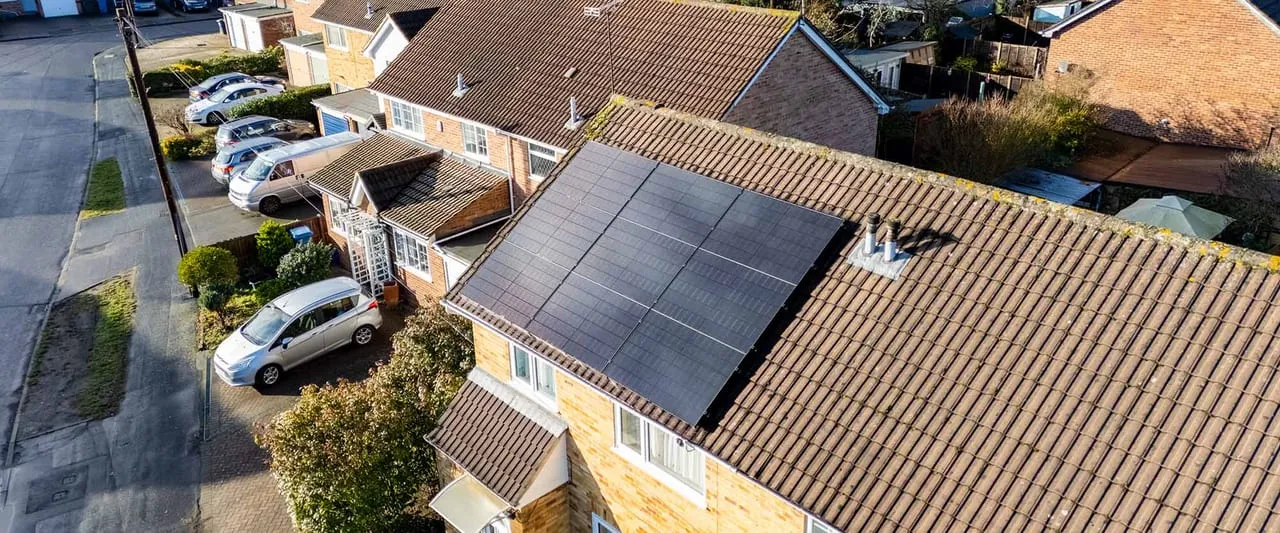
Solar economics in the UK changed twice in the last few years — first for the better (0% VAT, soaring import prices making the payback maths work harder for you), then in ways that make blanket answers useless. “Is solar worth it” depends far more on your roof, your household’s daytime usage, and your appetite for a battery than any headline percentage a salesperson quotes you. Here’s the honest 25-year version, with the caveats most sales pitches leave out.
The 2026 starting point
Right now you’re buying into solar at a genuinely good moment on cost, if not on subsidy. Residential solar PV and battery storage carry 0% VAT in Great Britain, a relief that’s scheduled to run until 31 March 2027 before reverting to 5%. On a typical £6,000-£8,000 4kW installed system, that’s a saving of roughly £300-£400 versus the old 5% rate — worth having, not decisive on its own.
What actually moves the needle is what you’re saving against. Ofgem’s price cap has kept typical import electricity hovering around 25p/kWh, and there’s no meaningful signal that’s heading back to 2019 levels. Every kWh you generate and use yourself is a kWh you’re not buying at that rate. That’s the whole engine of solar economics: it’s an electricity-price hedge disguised as a home improvement.
There is no universal home-solar grant in England. If your household is on a low income with a low-EPC-rated property you may qualify for ECO4 or the Warm Homes scheme (both means-tested, both about efficiency measures more than PV specifically), and Scottish homeowners can access Home Energy Scotland’s interest-free loans. Everyone else is paying full price and recovering it through the electricity bill, not through a rebate cheque. If a salesperson mentions a “government grant” for a standard homeowner install, that’s a red flag — check what they mean in detail, because for most people in 2026 it doesn’t exist.
The 25-year maths, worked through
Take a realistic mid-size example: a 4.2kW system on a south-facing roof in the Midlands, installed for £7,000. UK yield assumptions vary by orientation and shading, but a reasonable rule of thumb is around 850 kWh generated per kWp per year nationally, climbing toward 1,000-1,050+ kWh/kWp in the sunniest parts of the south. At 850 kWh/kWp, that system generates roughly 3,570 kWh a year.
Without a battery, a typical home consumes maybe 30-40% of solar generation directly (the rest exports), because most generation happens mid-morning to mid-afternoon while a lot of household demand is evening-weighted. Call it 35% self-consumed, 65% exported.
- Self-consumed savings: 3,570 kWh × 35% × 25p/kWh ≈ £312/year
- Export income via Smart Export Guarantee: 3,570 kWh × 65% × an assumed 15p/kWh (SEG rates vary by supplier, from roughly 12p up to 20p+ at the top end — this is not a fixed national tariff) ≈ £348/year
- Year-one return: roughly £660
That’s a simple payback of just under 11 years on the panels alone — before accounting for degradation, inverter replacement, or electricity price inflation, which cuts both ways (rising import prices shorten payback; nothing guarantees SEG rates hold).
Over 25 years, modern N-type panels (TOPCon, HJT, or ABC cell technology, which most reputable installers are now fitting) degrade at only around 0.4% a year and are rated to last 25-30+ years, so generation in year 25 is still around 90% of year one. Your string inverter almost certainly won’t last that long — budget £500-£1,000 for a replacement somewhere around year 10-15. Net across 25 years, after inverter costs, a system like this plausibly returns £11,000-£14,000 against a £7,000 outlay, assuming stable-to-rising electricity prices and no dramatic SEG collapse. That’s a genuine return, but it’s a 10-year-plus payback, not the 4-6 years some sales decks imply.
Where a battery changes the equation
The maths above assumes you’re exporting most of your midday generation for 12-20p/kWh and buying it back in the evening for 25p/kWh — a bad trade you’re stuck with unless you can shift consumption or store the surplus. A battery fixes that by letting you use your own cheap generation at 7pm instead of Octopus Agile’s evening peak rate.
A home battery installed today runs roughly £4,000-£8,000 depending on capacity (£400-£700 per kWh is the going rate), with a Tesla Powerwall 3 at 13.5kWh landing around £8,500-£10,500 fitted. Adding one to the system above pushes self-consumption from 35% up toward 60-70%, which meaningfully improves the return — but it also adds £4,000+ to the up-front cost, so the payback period on the combined system often ends up similar to panels alone, just with a bigger absolute saving each year once it’s paid off. Battery owners on time-of-use tariffs (charging overnight at 7-15p/kWh, using stored solar or cheap-rate power through the peak) tend to see the strongest numbers in the whole market right now, particularly paired with an EV.
If you’re weighing that decision in detail, The Cost of Solar’s battery storage cost breakdown and payback period calculator are worth running your own numbers through rather than relying on a single national average — your usage pattern matters more than any spec sheet.
Who genuinely benefits most
- Daytime-heavy households: retirees, remote workers, anyone running a heat pump, pool pump, or home office through the day will self-consume a much higher share of generation without needing a battery at all.
- South-facing roofs with minimal shading: orientation and shading swing generation by 20-30%+ between a good roof and a mediocre one. An east-west split roof can still work well if it matches a bimodal usage pattern (morning and evening peaks).
- Anyone on, or moving to, a time-of-use import tariff: solar plus battery plus Agile-style tariffs is where the strongest returns in the UK currently sit, because you’re arbitraging both directions — cheap overnight charging and free daytime generation against a 25p+ evening rate.
- Homeowners planning to stay 10+ years: given payback typically lands in the 8-12 year range for panels alone, this is not a flip-and-sell improvement; it’s a long-hold asset, though it does tend to support the sale price and EPC rating.
- Farms and small commercial premises with daytime load: for a working farm building or agricultural shed, the economics are often better than domestic because usage during generation hours is higher and roof area is larger — see SolarPanelsForFarms for the agricultural-specific numbers, including how England’s Improving Farm Productivity grant (around 25% of eligible cost, rates differ by UK nation — this is not the old 40% FETF scheme, which has been widely misquoted) can improve the maths for qualifying farm businesses.
Who should not buy solar in 2026
Be equally honest about who doesn’t come out ahead:
- North-facing-only roofs, or roofs in heavy permanent shade — generation can fall low enough that even 25-year paybacks struggle.
- Households moving within 3-5 years who need the cash value now rather than a long-run bill saving; solar helps EPC and kerb appeal but rarely returns its full cost in a resale premium alone.
- Very low daytime electricity users away from home all day with no battery budget — most generation gets exported at the lower SEG rate, stretching payback well past 15 years.
- Anyone being quoted with an AggregateRating-style “thousands of five-star reviews” pitch, a guaranteed fixed SEG rate for 25 years, or a solar-specific “government grant” that doesn’t match ECO4/Warm Homes/Home Energy Scotland eligibility — these are sales-pressure signals, not facts about your roof.
- Leasehold or listed properties without confirmed permissions — get planning and freeholder consent sorted before you get a quote, not after.
Getting a real number for your own roof
National averages are a starting point, not an answer. The two variables that matter most — your roof’s actual yield (orientation, pitch, shading) and your household’s daytime consumption pattern — are specific to you, and a proper MCS-certified installer should model both before you sign anything. MCS certification isn’t just a quality mark; it’s also required for SEG eligibility, so don’t proceed without it. 2025 was a record year for UK installs (257,397 MCS-certified installations, up 32% on the year before, taking cumulative capacity to around 21.6 GW and roughly 6.4% of UK electricity generation) — a sign the maths is working for a lot of people, not that it works identically for everyone.
For a Yorkshire installer that models yield and self-consumption properly before quoting, YEERS covers solar, battery, heat pump and EV in one survey. In the South Wales market, FLD Electrical does the same combined assessment for homeowners in Swansea. If you’re weighing a commercial-scale install instead — an office, warehouse, or larger footprint where the per-kWp cost drops to roughly £900-£1,200 — Commercial Solar Panels Installation and Solar Panels For Office Buildings both break down the business case in more depth than the domestic figures here can cover, and Commercial Solar Finance is a useful next stop if you’re financing rather than buying outright.
It’s also worth reading how the industry itself sees 2026 shaping up — Solar Weekly’s UK solar industry overview has the wider market context behind the record install numbers above, which helps explain why component and labour costs have stayed relatively stable even as demand has grown.
The honest bottom line
Solar in the UK in 2026 is worth it for the majority of homeowners with a usable roof and a multi-year time horizon — the maths clears a genuine profit over 25 years for most orientations, and 0% VAT plus persistently high import prices make the entry cost lower and the ongoing saving larger than at almost any point in the past decade. It is not a fast flip, it is not guaranteed by a fixed export rate, and a battery or time-of-use tariff is now doing more of the heavy lifting in the best-performing systems than the panels alone. Model your own roof and usage before you commission anything, be sceptical of anyone quoting a grant or guarantee that doesn’t match the schemes named above, and treat the 25-year number, not the year-one number, as the one that actually tells you whether it’s worth it.