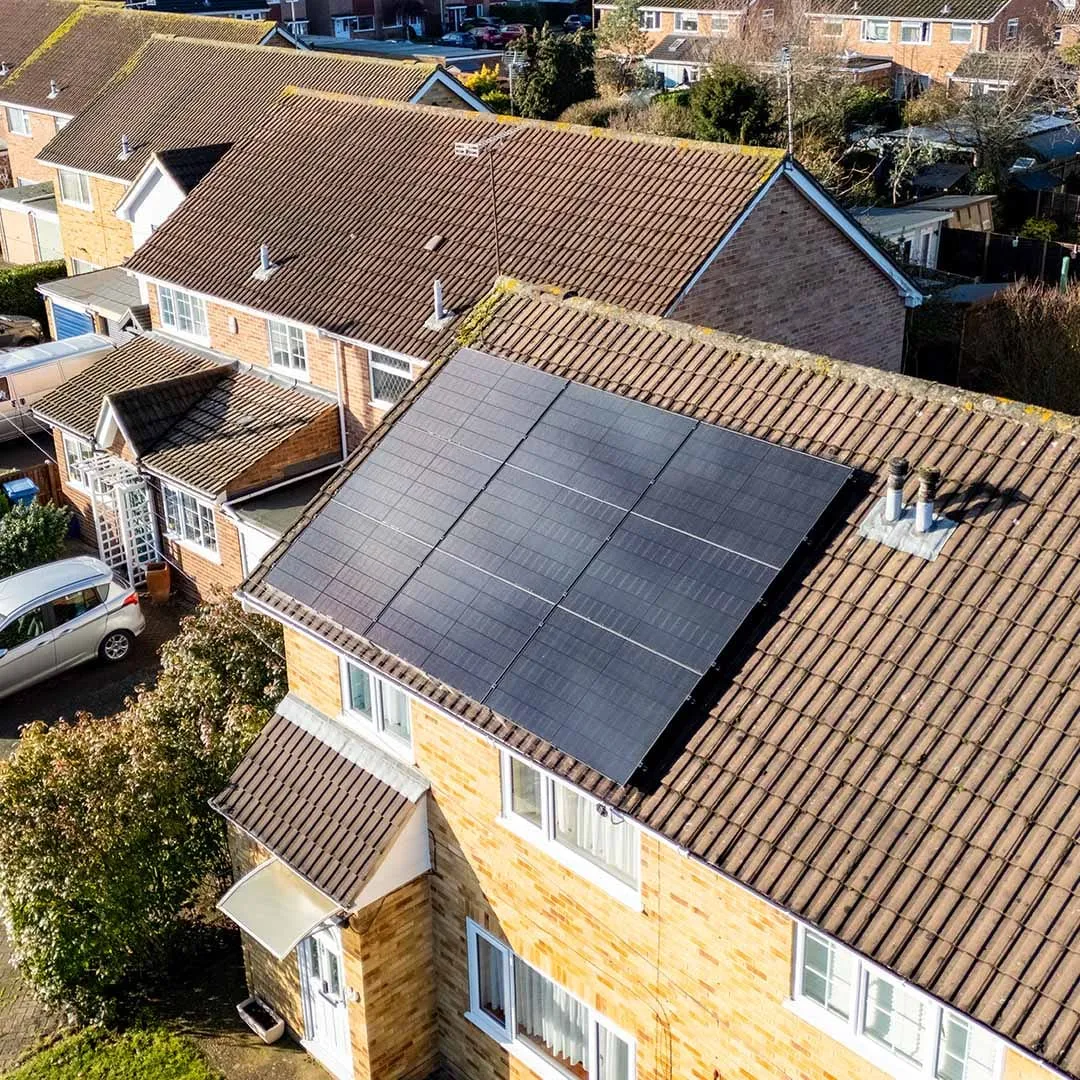
Since 1 April 2022, homeowners across Great Britain have paid 0% VAT on solar panels, battery storage and the labour to install them. That relief is legislated to run until 31 March 2027, after which the rate is scheduled to revert to the standard reduced rate for energy-saving materials — 5%. It sounds like a footnote. On a real invoice it isn’t. This post works through exactly what 5% VAT adds in cash terms, when the deadline actually bites for anyone ordering now, and whether “buy before the cliff-edge” is sound advice or just installer sales pressure.
What the 0% VAT relief actually covers
The relief applies in Great Britain (England, Scotland and Wales — Northern Ireland has separate, historically 5% VAT treatment for these products) to the supply and installation of qualifying energy-saving materials in residential accommodation. Solar PV panels, battery storage (including retrofits added to an existing solar system), and the associated installation labour all currently sit at 0%. It was introduced as a temporary boost during the energy price crisis and HMRC has confirmed the sunset date of 31 March 2027, at which point the rate is due to return to 5% — the rate that applied before April 2022, not the standard 20% rate that applies to most goods and services.
It’s worth being precise here because a lot of sales material rounds this up to “VAT is coming back” without saying which rate. Nobody is claiming solar is about to become VAT-standard-rated at 20%. The realistic reversion is to 5%, and even that could in principle be extended by a future Budget — but there’s no signal from HMRC or the Treasury that it will be, so treat 31 March 2027 as the planning date.
The maths: what 5% actually adds
This is where the “act now” argument either stands up or falls apart, and it stands up better in cash terms than most people expect once you do the sums on realistic 2026 system prices.
| System | Typical installed price (0% VAT) | VAT at 5% if bought after the deadline | Total cost with VAT restored |
|---|---|---|---|
| 3kW small residential | ~£5,000 | ~£250 | ~£5,250 |
| 4kW average residential | ~£6,000–£8,000 | ~£300–£400 | ~£6,300–£8,400 |
| 10kW larger home / small commercial | ~£13,000–£17,000 | ~£650–£850 | ~£13,650–£17,850 |
| Battery only (e.g. Tesla Powerwall 3, 13.5kWh) | ~£8,500–£10,500 | ~£425–£525 | ~£8,925–£11,025 |
| Solar + battery combined (typical 4kW + 5kWh) | ~£10,000–£14,000 | ~£500–£700 | ~£10,500–£14,700 |
So for a typical home installation, missing the deadline costs somewhere between £250 and £850 depending on system size — real money, but not the difference between a project stacking up and not stacking up. For a bigger commercial-scale array the absolute pound figure is larger, though the independent cost breakdown at thecostofsolar.co.uk shows commercial VAT treatment already works differently in a lot of cases (business premises don’t automatically qualify for the residential relief in the first place, so check which rate actually applies to your building before assuming either number).
The honest framing: 5% VAT is not a reason to rush a decision you haven’t properly scoped. It is a reason to not let a properly-scoped decision drag past March 2027 for no good reason.
Why the deadline matters more for timing than for panic
The date that matters isn’t when the panels go on your roof — for VAT purposes, what typically counts is the tax point of the supply, which for a solar installation usually means when the work is completed and invoiced, not when you sign the contract or pay a deposit. That has a real practical consequence: if you sign up in, say, January 2027 and the installer’s books a completion slot for April, you may have paid a 2027-scheduled deadline-beating price for a job that actually lands in the 5% window.
Installer capacity is the constraint that actually decides this, not desire. The run-up to 31 March 2027 is going to look a lot like the run-up to previous scheme deadlines in this sector — a surge of bookings in Q1 2027, and companies with a full order book simply can’t compress a 6–10 week install queue to fit everyone in before the date. If you’re seriously planning a 2026 or early-2027 install, get a firm survey and installation date in writing well before Christmas 2026, not a vague “we’ll fit you in” from an installer who’s already overbooked. MCS-certified installers with genuine capacity, like ecoaim.co.uk in Central Scotland or Solent Solar on the Hampshire coast, are worth talking to now precisely because slot availability — not VAT — is usually the binding constraint by Q4 2026.
Should you actually buy now, or does the maths not support urgency?
There’s a version of this article that just says “buy now before prices rise” — that’s marketing, not analysis. Here’s the more honest version.
The case for ordering in 2026 rather than waiting:
- You save the VAT (£250–£850 typically, as above) if your install genuinely completes before 31 March 2027.
- You get roughly nine more months of generation and export income than someone who waits and orders in early 2027 — at a typical UK yield of ~850 kWh per kWp/year (higher in the sunny south, up to ~1,050+), that’s real money the panels are earning while a “wait and see” household is still deciding.
- Installer capacity, as above, tightens as the deadline approaches, which historically also firms up prices rather than discounting them.
The case against rushing:
- 5% on a £7,000 system is £350 — not enough to justify a bad roof survey, an undersized system, or a rushed installer choice.
- Panel and inverter hardware costs have been broadly flat-to-falling in 2025–2026 as manufacturing capacity has grown; there’s no strong evidence that waiting a year means paying materially more for the hardware itself, VAT aside.
- If you don’t have consumer-unit capacity, a suitable roof aspect, or clarity on your own usage pattern, sorting those things properly matters more to the eventual return than the VAT line.
The sensible read: don’t buy an unsuitable or oversized system to beat a deadline, but if you’re already planning to go solar in the next 18 months, there’s no argument for deliberately waiting past March 2027 to do it. Every month of delay past that point is a month of 5% VAT plus lost generation, for no offsetting benefit.
What this means if you’re weighing several quotes right now
If you’re comparing quotes today, ask each installer to state clearly whether their quoted price is VAT-inclusive at the current 0% rate, and get it in writing that the invoiced completion date determines the VAT treatment — not the quote date. A reputable installer will have no issue confirming this; if one is cagey about it, that’s a flag independent of the VAT question itself.
Regional installers are generally better placed to give you a realistic completion date than large national outfits currently juggling a bigger backlog. In South Yorkshire, ElectriFusion Solutions has direct visibility of its own install queue; in Lincolnshire, Greenlinc Renewables (MCS-certified) can do the same; and in the West Midlands, Midland Solar is another to ask for a dated, written install slot rather than an estimate. For anyone weighing whether the numbers stack up before contacting an installer at all, running your own roof and usage figures through an independent solar panel calculator or checking current battery storage costs first means you go into any quote conversation already knowing roughly what a fair price looks like.
Commercial and landlord-owned property: a different VAT picture
Everything above is about residential relief. If you’re a business, landlord, or own a commercial building, the VAT position was never the same 0% relief in the first place — commercial solar generally sits outside the residential energy-saving-materials relief and is typically standard-rated at 20%, though it’s usually reclaimable as input VAT for a VAT-registered business, which changes the arithmetic completely versus a homeowner. If you’re assessing a commercial or multi-let building, it’s worth reading a dedicated commercial resource rather than assuming the residential VAT story applies — Commercial Solar Panels Installation covers the installation side for business premises, and Commercial Solar Finance is a better starting point for understanding how VAT recovery interacts with leasing, PPA and outright-purchase structures. Landlords specifically weighing solar against upcoming MEES/EPC obligations on rented property should also see Commercial Property Solar, since the investment case there is usually driven by compliance deadlines that sit alongside, not instead of, the VAT question.
For farms and agricultural buildings the picture is different again — England’s farm-specific support is the Improving Farm Productivity grant (around 25% of eligible cost, not the “40%” figure sometimes wrongly quoted), and rates and structures vary by nation, so check Solar Panels for Farms for the current position before assuming a domestic VAT rule applies to a farm building.
The battery-only angle
A growing share of 2026 enquiries aren’t for a first solar installation at all — they’re existing solar owners adding a battery to capture more of their own generation and to arbitrage against variable-rate tariffs. The 0% VAT relief covers retrofit battery storage in the same way it covers a full system, so a stand-alone battery bought before 31 March 2027 saves the same 5% versus buying it afterwards. On a £4,000–£8,000 battery that’s £200–£400 — smaller in absolute terms than a full system, but proportionally the same saving. If battery-only is what you’re weighing, YEERS in Yorkshire and Energy Concerns in Leicester both fit standalone battery retrofits onto existing arrays, which is a slightly different job to a from-scratch install and worth quoting separately rather than assuming it’s priced the same per kWh.
The bottom line
31 March 2027 is a real deadline with a real, calculable cost of missing it — typically £250 to £850 for a residential system, less for a battery-only retrofit. It is not, on its own, a reason to buy a system that hasn’t been properly surveyed, sized to your usage, or quoted by an installer who can give you a firm, written completion date well clear of the cut-off. If you were already planning to go solar in 2026 or early 2027, there’s no rational case for letting the project slide past the deadline; if you weren’t already planning it, £350 of VAT shouldn’t be what talks you into it. Get the survey, get the completion date in writing, and let the VAT saving be the confirmation of a decision you’d already made — not the reason for it.