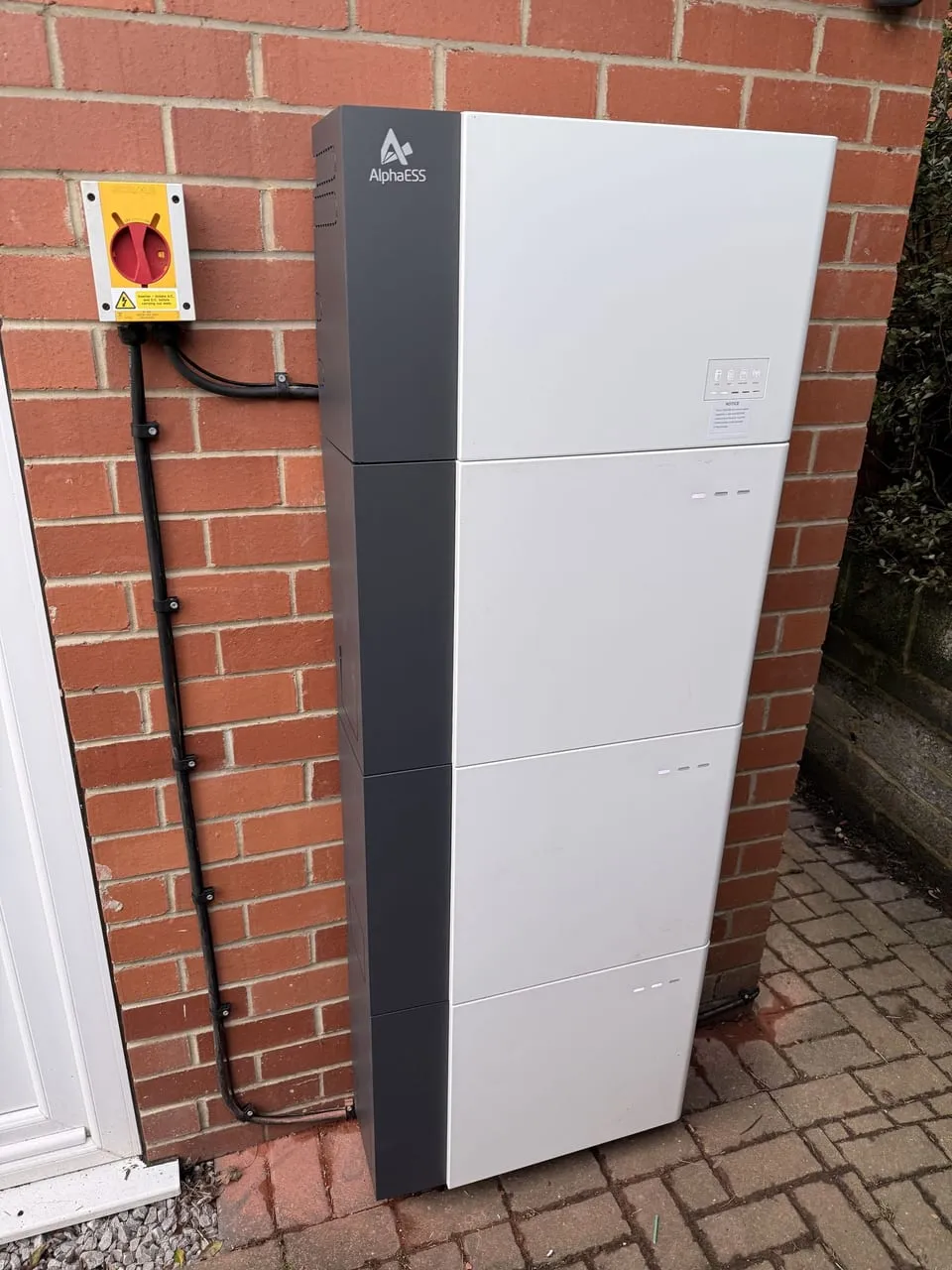
Battery prices are quoted a dozen different ways — “from £4,000”, “13.5kWh for under £9k”, “£150 a month on finance” — and none of it tells you whether you’re getting a good deal. The only number that lets you compare a 5kWh wall unit against a 13.5kWh Powerwall against a stacked commercial rack is cost per kWh of usable capacity. Get comfortable with that one figure and the rest of the sales pitch becomes background noise.
Why £/kWh is the only fair comparison
A quoted “battery price” bundles the cell cost, the inverter or hybrid electronics, installation labour, warranty terms, and increasingly a chunk of margin for the brand name on the casing. None of that is visible when you’re staring at a total price on a quote. Divide the installed price by the usable kWh and you strip all of that down to one comparable unit.
Two worked examples show why this matters:
- A 5kWh battery installed for £4,500 = £900/kWh.
- A 13.5kWh battery installed for £9,500 = £704/kWh.
The second system looks more expensive on the invoice but is actually the cheaper buy per unit of storage — and it’ll cycle more energy every night, which is what actually cuts your electricity bill. Quoting total price alone would have led you the wrong way.
The same logic applies to usable-vs-nameplate capacity. Some batteries only let you discharge to 90% or 95% of the stated capacity to protect cell life; others (particularly LFP-chemistry units, now the UK domestic standard) allow closer to 100% depth of discharge. Always ask for the usable kWh figure, not the nameplate one, before you do the division — a “10kWh” battery with a 90% usable limit is really a 9kWh battery for cost-comparison purposes.
What UK households are actually paying, per kWh, in 2026
Based on typical installed pricing across the domestic market this year, home battery storage runs roughly £400–£700 per kWh installed, with a full system (battery + hybrid inverter or AC-coupled retrofit + labour) landing most households at somewhere between £4,000 and £8,000 all-in for a 5–10kWh unit. Premium branded units — Tesla’s Powerwall 3 (13.5kWh) being the obvious example — tend to sit at the upper end, installed for roughly £8,500–£10,500, which works out close to £650–£780/kWh once you include commissioning.
Why the spread? A few genuine cost drivers, not just brand markup:
- Chemistry and cycle life. Lithium iron phosphate (LFP) cells dominate UK installs now because they’re safer and typically rated for more charge cycles than older NMC chemistry, but cell sourcing and pack engineering still vary by manufacturer.
- AC-coupled retrofit vs DC-coupled/hybrid. Adding a battery to an existing solar system via a simple AC-coupled retrofit is usually cheaper per kWh than replacing the inverter with a hybrid unit, though hybrids often edge out slightly better round-trip efficiency.
- Installer labour and region. London and the South East typically run 10–15% above the rest of the country for the same kit, simply on labour day-rate.
- Warranty depth. A 10-year warranty backed by a manufacturer with a genuine UK service network is worth paying a premium for over a shorter or unsupported one — factor this into the £/kWh figure as effective insurance, not pure waste.
For a full breakdown of these price bands by brand and capacity, The Cost of Solar’s battery storage cost guide tracks installed pricing across the market and is worth cross-checking against any quote you receive.
The sweet spot for UK homes
Most UK households import somewhere between 8kWh and 15kWh of grid electricity on a typical day once you strip out solar generation, and evening/night demand (when there’s no sun to offset it) is usually the biggest single chunk of that. That’s the number a battery needs to cover to be worth its keep — not your total daily consumption, but your after-dark consumption.
For a typical 3–4 bedroom home with a 4kW solar array, that puts the practical sweet spot at 8–10kWh usable capacity. Go much smaller and you’re routinely running the battery flat before morning and still buying peak-rate grid power; go much larger and you’re paying for capacity that sits unused most nights, stretching your payback period for no extra saving. Households on time-of-use tariffs who deliberately charge overnight on cheap rates to offset a high daytime load (or who run an EV) are the main exception — for them, a 13–15kWh battery can genuinely earn its keep by shifting more expensive peak import to cheap off-peak.
The maths only works if you also look at what the battery is for: self-consumption of your own solar generation (avoiding buying at ~25p/kWh what you already generated for free), or tariff arbitrage (charging at a cheap overnight rate and using it at peak), or exporting to the Smart Export Guarantee when rates are favourable — SEG rates vary by supplier and are typically in the region of 12–20p/kWh at the better end, so a battery that lets you choose when to export can add a modest but real return on top of self-consumption savings. None of these mechanisms benefit meaningfully from oversized capacity beyond your realistic evening/night load.
Commercial buyers should run the identical exercise at a different scale — a warehouse or factory’s evening/weekend baseline load is the number to size against, not peak daytime demand, and the specialists at batterystorageforbusiness.co.uk size commercial packs against exactly that baseline-load logic rather than headline kWh.
Don’t buy on price per kWh alone
Cost per kWh is the right comparison metric — it is not the only decision criterion. Two batteries at an identical £650/kWh can differ hugely in:
- Round-trip efficiency (how much energy you get back out for what you put in — typically 85–95% for good lithium systems; a poor inverter pairing can lose several percentage points here, quietly eroding your payback).
- Cycle warranty (some manufacturers guarantee a set number of cycles or years, whichever comes first — read which one actually applies to your usage pattern).
- Stackability — whether you can add a second battery later without replacing the first, useful if you’re not sure yet whether 5kWh or 10kWh is right for you.
- MCS certification of both the installer and the product — required if you want SEG export payments, and worth confirming in writing before any deposit is paid.
This is exactly the kind of detail a good local installer will walk through against your actual half-hourly usage data rather than a generic brochure figure. In South Yorkshire, ElectriFusion Solutions will size a battery against your smart meter data before quoting rather than defaulting to a standard package, and in Essex and East Anglia, EC Eco Energy does the same exercise for commercial sites where the load profile is far less predictable than a house. If you’re in Central Scotland, Ecoaim in Livingston pairs battery sizing with existing or planned solar generation rather than quoting storage in isolation — genuinely useful, because an oversized battery paired with an undersized array just sits half-charged.
Putting it together: a worked comparison
| System | Usable capacity | Installed price | £/kWh | Notes |
|---|---|---|---|---|
| Budget AC-retrofit | 5kWh | £4,200 | £840/kWh | Cheapest entry, shorter warranty typical |
| Mid-range hybrid | 9.5kWh | £6,800 | £716/kWh | Sweet spot for most 3-4 bed homes |
| Premium branded (e.g. Powerwall 3 class) | 13.5kWh | £9,500 | £704/kWh | Best £/kWh at scale, strong warranty/support network |
| Commercial rack | 50kWh+ | £900–£1,200/kWh range* | — | *Commercial pricing is quoted per kWp/kWh differently — always ask for an apples-to-apples figure |
The pattern holds across nearly every quote we’ve reviewed: bigger, well-specified batteries usually beat smaller ones on £/kWh, right up to the point where capacity exceeds what your household or business can realistically use in a night. Past that point, you’re paying for kWh that never get discharged, and the metric stops rewarding you for buying more.
If you’re weighing a battery against solar-only, or trying to work out whether adding storage to an existing array actually pays back faster than upsizing the panels instead, The Cost of Solar’s payback period calculator and the solar panel calculator are worth running both scenarios through before committing. For the installer side of that conversation, SOLA UK in Hertfordshire and the Home Counties, and YEERS across Yorkshire, both quote battery and solar as a combined system rather than two separate line items — which is the only way the £/kWh comparison actually reflects what you’ll pay.
Businesses looking at storage alongside a larger commercial solar install should also check sizing against building type — Solar Panels For Warehouses and Solar Panels For Farms both cover how storage interacts with demand charges and export limits for exactly those property types, which changes the payback maths from a straightforward domestic comparison.
The bottom line
Ignore the headline price on any battery quote. Divide installed cost by usable kWh, compare that figure across at least three quotes, then size the capacity against your actual evening/night load — not your daily total, and not the biggest unit the installer has in stock. A well-specified 9–10kWh battery at £700/kWh will outperform an oversized 15kWh unit at the same rate that sits half-empty every morning. That’s the whole calculation, and it’s the one number worth writing down before any installer sets foot on site.