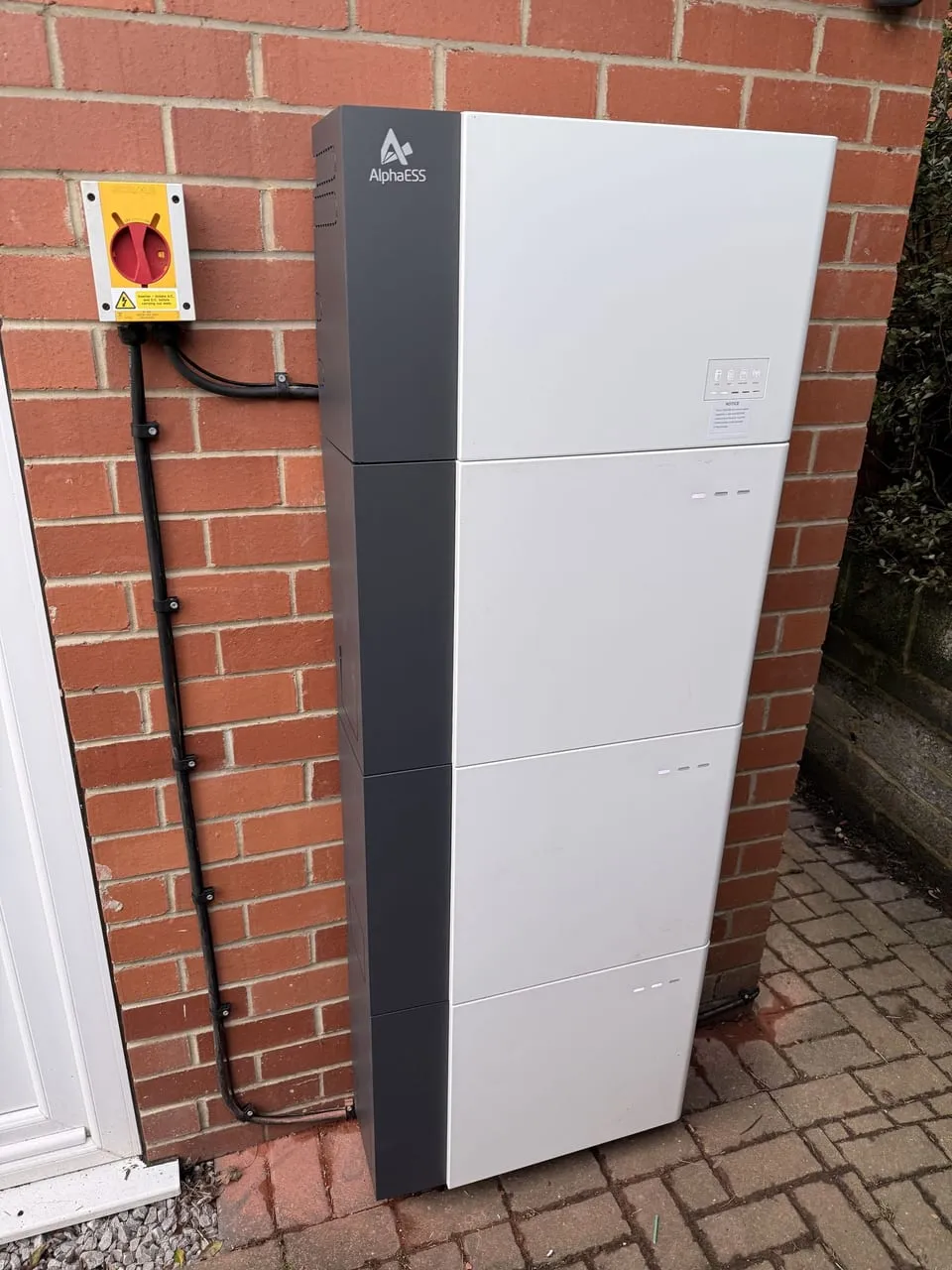
Tesla’s Powerwall 3 has become the default reference point for UK home battery pricing — the “iPhone of batteries” that every quote gets compared against. But the sticker price only tells part of the story. This piece breaks down what a Powerwall 3 actually costs installed in the UK in 2026, how its price and capabilities stack up against GivEnergy, Fox ESS and Sunsynk, and — critically — what you get for the extra money.
How much does a Tesla Powerwall 3 cost in the UK?
A Tesla Powerwall 3 costs about £7,400–£9,500 fully installed in the UK (July 2026): roughly £6,500 for the unit, £900 for the Backup Gateway, and £1,000–£2,500 installation labour. Complex installs and premium installers push the total toward £10,500. Here is the itemised breakdown:
| Component | Typical UK price (July 2026) |
|---|---|
| Powerwall 3 unit (13.5kWh, integrated inverter) | ~£6,500 |
| Backup Gateway 2 | ~£900 |
| Installation labour, wiring & commissioning | £1,000 – £2,500 |
| Typical installed total | £7,400 – £9,500 (up to ~£10,500) |
| Expansion unit (adds 13.5kWh, no second inverter) | from ~£3,800 fitted at the same time; more standalone |
Quotes across the market genuinely disagree by £3,000+ on identical hardware — some certified installers advertise fitted prices near £7,400 while others quote £10,000+ — which is exactly why we publish this table dated, and why you should always get three itemised quotes rather than one bundled number.
Tesla Powerwall 3: the headline numbers
The Powerwall 3 is a 13.5kWh usable-capacity battery with a built-in hybrid inverter (rated up to 11.04kW AC output), meaning it can function as both the battery and the inverter for a solar installation rather than needing a separate string inverter alongside it. That integration is the single biggest difference between Powerwall 3 and most competitor batteries, and it changes the maths considerably.
Installed cost: expect roughly £8,500–£10,500 for a single Powerwall 3 fitted by an approved installer in the UK, depending on region, existing consumer unit work, and whether it’s paired with new solar or retrofitted to an existing array. That works out to roughly £630–£780 per kWh of usable capacity — at the premium end of the domestic battery market.
For comparison, a “normal” AC-coupled battery retrofit in the UK typically runs £4,000–£8,000 installed for a 5–10kWh unit, or £400–£700 per kWh. Powerwall 3 sits above that range, and the reason is largely the integrated inverter and Tesla’s own installation/commissioning requirements rather than the cell chemistry itself (like most 2026-era home batteries, it uses LFP — lithium iron phosphate — cells, which are more thermally stable and typically rated for a longer cycle life than older NMC chemistries).
Under the current 0% VAT rate on residential battery storage in Great Britain (in place until 31 March 2027, after which it’s scheduled to revert to 5%), none of the above prices carry the VAT sting they would have a few years ago — so there’s a genuine incentive to get any battery project, Powerwall or otherwise, installed before that deadline.
What you actually get for the premium
It’s easy to see Powerwall 3’s price and assume it’s simply expensive. The counterargument installers make — and it holds up — is that you’re not just buying a battery:
- Integrated hybrid inverter. No separate inverter box, no extra wall space, one warranty to worry about, and one less point of failure/incompatibility down the line.
- 11.04kW continuous AC output, which is enough to run a UK home through most demand spikes (kettle, oven, EV charger) without falling back to the grid.
- Whole-home backup capability (with the right switchgear) — genuinely useful given how often UK storms take out rural and semi-rural supplies.
- Expandable — up to three additional Powerwall 3 Expansion units can be daisy-chained off one Powerwall 3 for extra capacity without adding inverters.
- 10-year warranty as standard, with a stated 70% capacity retention guarantee at the end of that period — competitive with, though not dramatically better than, the market norm.
Where it’s weaker: Tesla’s installer network in the UK is smaller and more selective than the open panel of MCS-certified installers who fit GivEnergy, Fox ESS or Sunsynk kit, so you have less choice of who does the work and less scope to shop the install labour separately from the hardware. Software and app control are polished, but some installers report less flexibility for bespoke tariff-optimisation setups compared with the open ecosystems around GivEnergy and Sunsynk.
Powerwall 3 vs GivEnergy
GivEnergy is a Wales-based manufacturer (assembling and testing product in the UK) and probably the most common non-Tesla battery fitted by UK solar installers. A GivEnergy AC-coupled battery in the 9.5–13.5kWh range typically installs for £5,500–£9,000, putting it at roughly £450–£700/kWh — meaningfully cheaper per kWh than Powerwall 3.
The trade-off is that most GivEnergy batteries are AC-coupled retrofits sitting alongside a separate solar inverter (though GivEnergy also sells hybrid all-in-one inverter/battery units at a similar price point to a Powerwall). GivEnergy’s strength in the UK market is depth of installer support, a genuinely open app/API ecosystem for tariff optimisation (useful if you’re on Octopus Agile or similar time-of-use tariffs), and — because of the size of its UK installer base — competitive labour pricing. If your priority is squeezing every extra pence out of a smart export/import tariff arbitrage strategy, GivEnergy’s ecosystem is arguably more mature for that than Tesla’s.
Powerwall 3 vs Fox ESS
Fox ESS batteries (commonly the 10.35kWh or larger stacked units) tend to land in a similar £450–£650/kWh installed range to GivEnergy — so again notably below Powerwall 3 on a pure £/kWh basis. Fox ESS’s hybrid inverters are also popular with UK installers for combined solar-plus-storage installs, and the stackable module design means capacity can be added in smaller, cheaper increments than Tesla’s Expansion units.
What you’re giving up against Powerwall 3 is mostly brand recognition and out-of-the-box backup simplicity — Fox ESS whole-home backup setups need more careful specification by the installer, whereas Tesla’s backup gateway is a known, repeatable configuration across installs.
Powerwall 3 vs Sunsynk
Sunsynk has built a strong UK following, particularly among installers who want a hybrid inverter plus stackable battery at the lower end of the price spectrum. Sunsynk battery-plus-hybrid-inverter packages often come in below £450/kWh, making it usually the cheapest of the four names on this list for equivalent usable capacity — sometimes by a significant margin once you account for the separate inverter cost most non-Tesla systems still carry.
The gap is mostly around brand-level warranty backing and secondary/resale confidence — Sunsynk is a newer entrant to UK consumer consciousness than Tesla, GivEnergy or Fox ESS, even though the underlying hardware and installer feedback have both improved sharply over the past couple of years.
Side-by-side: rough UK installed £/kWh (2026)
| Battery | Typical usable capacity | Installed cost (GB) | Approx. £/kWh | Inverter |
|---|---|---|---|---|
| Tesla Powerwall 3 | 13.5kWh | £8,500–£10,500 | £630–£780 | Integrated hybrid |
| GivEnergy (AC or hybrid) | 9.5–13.5kWh | £5,500–£9,000 | £450–£700 | Separate or hybrid option |
| Fox ESS | 10.35kWh+ (stackable) | £5,000–£8,500 | £450–£650 | Separate hybrid |
| Sunsynk | 5.32–16kWh (stackable) | £4,000–£8,000 | £350–£500 | Hybrid |
These are indicative UK ranges, not fixed prices — actual quotes depend heavily on your property’s existing wiring, DNO (District Network Operator) constraints, scaffolding/access, and whether the battery is retrofit-only or bundled with a new solar array. Always get at least two or three like-for-like quotes before committing; our solar panel calculator is a reasonable starting point for sizing a system before you start collecting battery quotes, and our deeper solar battery storage costs breakdown covers the wider market beyond these four brands.
Does the Powerwall 3 premium pay back?
On raw £/kWh, no — Powerwall 3 is the most expensive battery on this list, and if minimising cost-per-kWh-stored is your only goal, Sunsynk or Fox ESS will usually beat it. Where Powerwall 3 earns its premium is in three specific scenarios:
- You want a single integrated hybrid system (inverter + battery in one unit, one warranty, one app) rather than managing separate solar inverter and battery warranties.
- Whole-home backup is a priority, particularly in rural areas with less reliable grid supply, where Tesla’s backup gateway configuration is well-proven.
- You value the brand/resale angle — rightly or wrongly, Powerwall carries recognition with future buyers that a Sunsynk or Fox ESS unit currently doesn’t.
If none of those three apply, the money saved by choosing GivEnergy, Fox ESS or Sunsynk is real and can often fund a larger solar array or an EV charger instead. Battery choice also interacts with your Smart Export Guarantee tariff — export rates vary by supplier (broadly 12–20p/kWh at the better end), so it’s worth checking which battery/inverter combinations your chosen SEG supplier actually supports before you commit, since not every inverter brand is compatible with every export tariff’s monitoring requirements.
Getting quotes that are actually comparable
The most common mistake homeowners make is comparing headline battery prices without normalising for capacity, inverter inclusion, and installation complexity. When you’re quote-shopping, ask each installer for:
- Usable kWh (not nameplate/gross capacity — these differ)
- Whether the inverter is included or it’s a battery-only retrofit onto an existing inverter
- Whether whole-home backup is included or a separate cost
- The warranty term and the guaranteed capacity retention at the end of it (typically stated as a % after 10 years)
MCS certification matters here too — it’s a precondition for Smart Export Guarantee eligibility, so confirm any installer and product combination is MCS-certified before signing.
If you’re in South Yorkshire, ElectriFusion Solutions fit both Tesla Powerwall and GivEnergy systems and can talk through the whole-home-backup trade-off directly. In Central Scotland, Ecoaim run solar-plus-battery installs where the GivEnergy/Sunsynk price gap against Powerwall tends to matter most, given the lower average solar yield further north stretching the payback period on the pricier option. Homeowners in West Kent comparing quotes are better served asking Hazell Electrical for a side-by-side on hybrid vs AC-coupled retrofits, and in Yorkshire more broadly, YEERS cover solar, battery and EV charging together, which is useful if you’re trying to size a battery against future EV charging load rather than today’s usage alone.
On the commercial side, battery economics are a different calculation entirely — larger systems, different tariff structures, and often demand-charge avoidance as the primary driver rather than self-consumption. Battery Storage for Business covers that ground in more depth if you’re sizing storage for a commercial site rather than a home, and Commercial Solar Finance is worth a look if you’re weighing loan/lease structures against the higher capital cost of commercial-scale storage.
Tesla Powerwall installation cost: what the labour part is
People often search for the “installation cost” separately, so it is worth splitting the number. Of a typical £7,400–£9,500 installed price, the hardware is the large majority; the installation element — a certified installer’s labour, the Backup Gateway wiring, consumer-unit work and commissioning — typically accounts for £1,000–£2,000 depending on how far the unit sits from your consumer unit, whether whole-home backup is being configured, and any groundwork for an outdoor mount. Tesla only warrants systems fitted by its certified installer network, so there is no legitimate way to buy the unit and pay a general electrician less to fit it. If a quote’s installation line looks unusually cheap, check it includes the Gateway and commissioning rather than treating them as extras.
Powerwall 3 Expansion pack pricing
The Powerwall 3 Expansion unit adds another 13.5kWh of storage without a second built-in inverter — it piggybacks on the main unit’s electronics, which is why it comes in meaningfully cheaper than a second full Powerwall. UK quotes for an Expansion vary widely: fitted at the same time as the main unit, advertised prices start around £3,800–£4,000 (Octopus has listed £3,773 concurrent with a Powerwall 3), while standalone retrofit quotes run higher once a separate visit and commissioning are priced in, though pricing varies by installer and by whether it is fitted on the same visit. The honest question before buying one: most UK homes cannot cycle 27kWh of storage daily outside of EV-heavy or heat-pump households, so check your actual evening consumption before doubling capacity — the payback maths gets worse with every kWh you do not use — run your own numbers through our free battery payback calculator before doubling up.
The bottom line
Tesla Powerwall 3 costs roughly £8,500–£10,500 installed in the UK for 13.5kWh usable capacity — the most expensive £/kWh of the four brands compared here, but bundled with an integrated hybrid inverter and a mature whole-home backup configuration that the cheaper alternatives don’t match out of the box. GivEnergy and Fox ESS sit in a £450–£700/kWh middle ground with wider installer choice and stronger tariff-optimisation ecosystems; Sunsynk is usually the cheapest route to stackable capacity. None of these figures include the VAT saving currently available on residential storage until 31 March 2027, so whichever battery you land on, timing the install before that deadline is free money left on the table if you delay. Get capacity-normalised quotes from at least two installers, check MCS certification and SEG-tariff compatibility, and decide whether whole-home backup or lowest £/kWh matters more for your household before you sign.