If you’ve searched “solar battery storage cost UK” and come away more confused than when you started, that’s because most pages quote a single number and move on. Battery pricing depends on chemistry, brand, installer margin, whether you’re retrofitting to an existing solar array or fitting new, and — increasingly — whether you want a battery big enough to run the house through a winter evening or just to soak up daytime export. Below are real, sourced 2026 price ranges by size and brand, what actually drives the £/kWh number, and how to tell a fair quote from an inflated one.
Why battery prices vary so much
A “10kWh battery” quote can range from £5,500 to £10,000+ depending on three things: the cell chemistry (LFP — lithium iron phosphate — is now standard and safer/longer-lived than older NMC chemistries), whether the inverter is hybrid (solar + battery combined) or the battery is AC-coupled to an existing solar inverter, and installer overheads (scaffolding, consumer unit upgrades, DNO notification for larger systems). Battery-only retrofits onto an existing solar array are usually cheaper per kWh than a combined solar-plus-battery new install, because you’re not paying for a second inverter or reworking the whole DC side.
The other variable people miss: usable vs nameplate capacity. A “13.5kWh” battery rarely delivers all 13.5kWh to your loads — depth-of-discharge limits on some chemistries mean the usable figure can be 5-10% lower. Always ask for usable kWh when comparing quotes, not just the marketing capacity.
Installed cost by size: 5kWh, 10kWh, 13.5kWh
These are UK-installed prices for 2026, including the battery, inverter/hybrid work where needed, and standard installation labour — not including scaffolding or unusual electrical works.
| Capacity | Typical installed cost (2026) | Approx £/kWh |
|---|---|---|
| 5kWh | £4,000 – £5,500 | £800 – £1,100 |
| 10kWh | £6,500 – £9,500 | £650 – £950 |
| 13.5kWh (Powerwall-class) | £8,500 – £11,500 | £630 – £850 |
Two patterns worth noting. First, £/kWh generally falls as capacity rises — you’re spreading fixed installation and inverter costs over more storage, so a single 10kWh unit is nearly always cheaper per kWh than two 5kWh units. Second, retrofitting a battery onto solar you already have typically comes in £500-£1,500 cheaper than adding both solar and battery together, because the DC installation and much of the electrical work is already done. If you’re weighing up whether to add storage now or wait, our own solar battery storage costs breakdown goes deeper on the retrofit-vs-new-build maths, and the solar panel payback period guide shows how a battery changes your payback timeline (it usually lengthens it slightly on paper, while cutting your actual annual bill by more).
For context on the solar side of the equation — because most battery buyers are pairing storage with panels, not adding it in isolation — our cost of solar panels UK page has the current per-kWp figures, and you can run your own numbers through the solar panel calculator rather than relying on a single generic quote.
Brand-by-brand: what you’re actually paying for
Not all batteries at the same nameplate capacity cost the same, and the gap isn’t always justified by quality — sometimes it’s brand recognition, sometimes it’s genuinely better hardware, monitoring software or warranty terms. Here’s how the five brands homeowners ask about most often actually compare.
GivEnergy — a UK-based brand (design and support based in Wales) that has become the volume default for many installers because of price and a strong all-in-one hybrid inverter range. A GivEnergy 9.5kWh battery with hybrid inverter typically installs for £6,500-£8,500. Good value, widely serviced, 10-year warranty as standard on most models.
Fox ESS — a Chinese manufacturer with a strong UK installer network and competitive stacked-battery modules (2.6kWh increments up to large arrays). Similar price bracket to GivEnergy, often slightly less, with the advantage of being able to add modules later rather than buying all your capacity upfront.
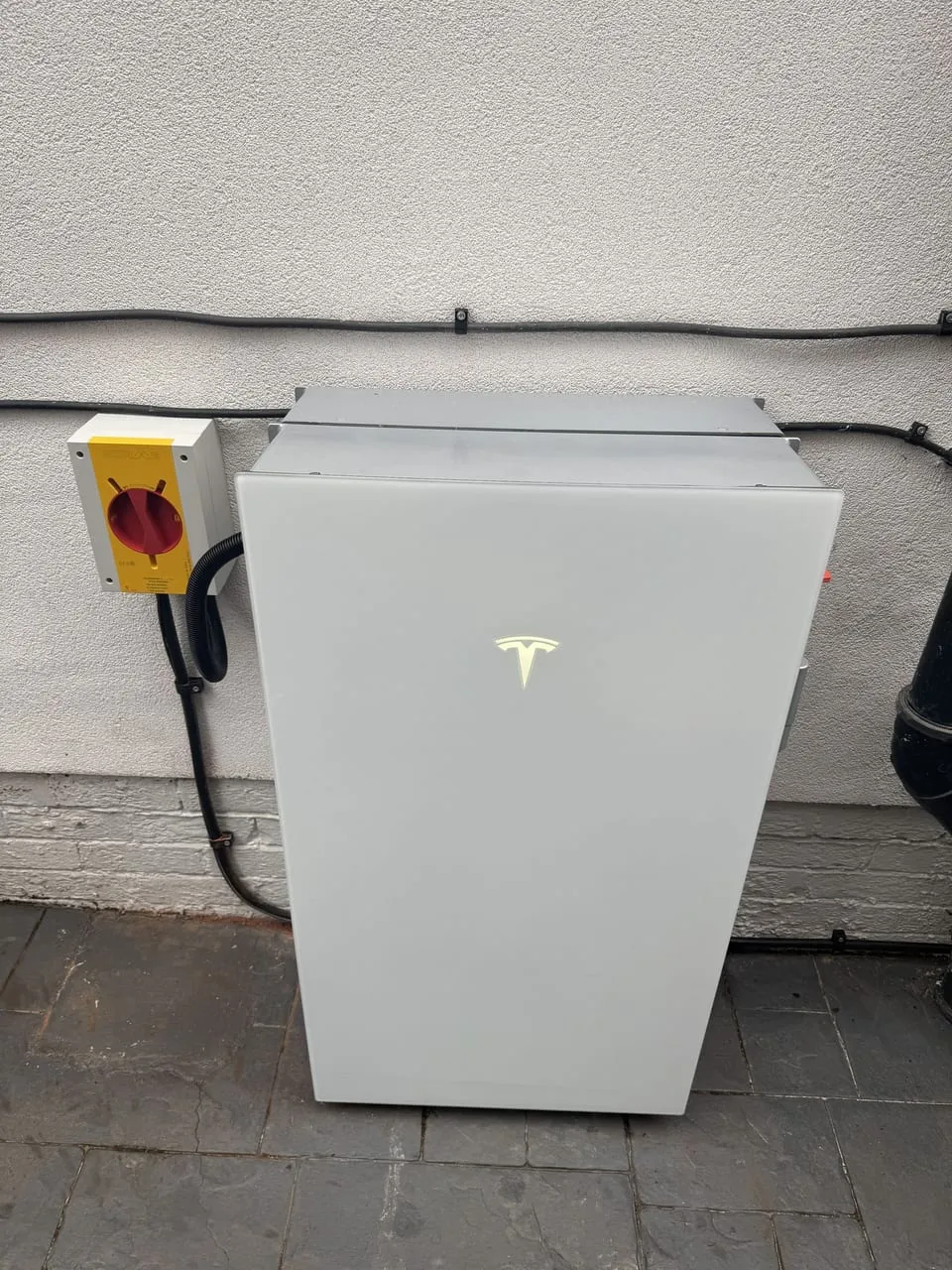
Tesla Powerwall 3 — the 13.5kWh integrated unit (battery + built-in solar inverter + backup gateway) typically installs for £8,500-£10,500 in the UK. It’s a premium single-SKU product: no module stacking, but a slicker app, strong brand recognition if you ever sell the house, and Tesla’s own certified installer network. It suits people who want one simple all-in-one box rather than a build-your-own system.
Sunsynk — another value-focused hybrid inverter and battery brand, similar positioning to GivEnergy and Fox ESS on price, popular with installers who want a lower-cost stacked system for larger households needing 15kWh+.
Pylontech — a battery-only specialist (no inverters), almost always paired with a separate hybrid inverter from another brand (commonly GivEnergy, Growatt or SolarEdge). Pylontech’s US2000/US3000 modules are a known quantity in the trade for reliability, and buying battery and inverter separately can sometimes work out cheaper than an integrated unit — but you’re relying on the installer to spec compatible kit correctly.
None of these brand differences matter much if the installer behind them is poor. D&R Energy in Bristol and Energy Concerns in Leicester both fit multiple brands rather than pushing one house SKU, which tends to produce more honest capacity recommendations than an installer who only sells one battery line.
Retrofit vs new-build install: does it matter for price?
Yes, and by more than most quotes make explicit. Retrofitting a battery to an existing solar array with an existing solar inverter usually means an AC-coupled battery: a separate small inverter for the battery itself, wired into your consumer unit alongside the existing solar setup. This is quick to install (often one day) and doesn’t touch your existing panels or DC wiring, but it means running two inverters instead of one, which loses a small amount of round-trip efficiency.
A new-build combined install can use a single hybrid inverter that handles both solar and battery, which is more efficient and usually cheaper overall if you’re starting from scratch — but irrelevant if you already have solar and don’t want to swap out a working inverter. If your existing solar inverter is more than 8-10 years old and near the end of its 10-15 year working life anyway, it’s worth pricing a hybrid replacement against a bolt-on AC-coupled battery, because you may be able to combine the inverter replacement and battery addition into one, more cost-effective job.
For homeowners in Yorkshire specifically weighing this up, YEERS quotes both routes side by side rather than defaulting to one, and in South Wales FLD Electrical does the same for households with older SolarEdge or SMA inverters approaching replacement age.
What actually determines whether a battery pays for itself
The 0% VAT relief on residential solar and battery storage (in place across Great Britain until 31 March 2027, scheduled to revert to 5% after) makes now a genuinely better time to buy than it will be from April 2027, all else equal — that’s an automatic saving of several hundred pounds on a typical battery-only job. Beyond VAT timing, three things drive the actual payback:
- Your import tariff. At the current typical Ofgem price cap level of around 25p/kWh, every kWh you avoid importing by using stored solar (instead of exporting it for a lower Smart Export Guarantee rate) is worth roughly double what exporting it earns you.
- Whether you’re on a time-of-use tariff. Batteries pay back fastest on tariffs with a cheap overnight rate and expensive peak rate, because you can charge cheap and discharge at peak — this is arguably a bigger payback lever than solar generation itself for some households.
- Export rates vary by supplier, typically in the 12-20p/kWh range at the better end via the Smart Export Guarantee, so a bigger battery that lets you use more of your own generation rather than exporting it can be worth more than chasing the top SEG tariff.
MCS certification remains a requirement to access SEG payments at all, so always check an installer’s MCS number before signing — this applies to the battery installer as much as the original solar installer if they’re different companies.
Commercial-scale battery storage costs differently
Everything above is domestic pricing. If you’re looking at a business site — a warehouse, hotel, office or farm — the economics and the pricing structure change substantially: commercial batteries are usually costed in £/kWh at a much lower rate than domestic due to scale, but total project costs run into tens of thousands, and the case for storage often rests on demand-charge avoidance and peak-shaving rather than simply “storing solar for later.” Battery Storage for Business covers that commercial pricing model in more depth, and if you’re specifically weighing a warehouse roof array plus storage, Solar Panels for Warehouses and Solar Panels for Farms both cover the commercial-scale numbers that domestic guides like this one don’t touch — including the Improving Farm Productivity grant route (around 25% of eligible cost in England; rates differ in Scotland, Wales and Northern Ireland) that’s often confused with the old, no-longer-applicable “40% FETF” figure still floating round some older blog posts.
Getting a quote you can actually compare
Ask every installer quoting you for: usable kWh (not nameplate), whether the inverter is hybrid or AC-coupled retrofit, the battery chemistry, the warranty length and what it actually covers (cycles, not just years, matters more with heavy daily use), and their MCS number. A quote that only states “10kWh battery — £8,000” without those details isn’t comparable to one that states them, even if the headline number looks similar. If you want a general sense of who’s active and reputable in your region before you start collecting quotes, installers like ElectriFusion Solutions in South Yorkshire, Ecoaim in Central Scotland and Hazell Electrical in West Kent all publish their own battery pricing and brand choices rather than requiring a call to get a ballpark figure — a reasonable first filter when you’re at the research stage rather than ready to commit.
Battery storage in 2026 is a genuinely different proposition to five years ago: LFP chemistry is now the default rather than the exception, prices per kWh have fallen as competition between GivEnergy, Fox ESS, Sunsynk and others has intensified, and the VAT window gives a concrete reason to act before April 2027 rather than drift. The number that matters most isn’t the headline installed cost, though — it’s the £/kWh once you strip out inverter and labour overhead, because that’s the figure that actually lets you compare a 5kWh quote against a 13.5kWh one on equal terms.