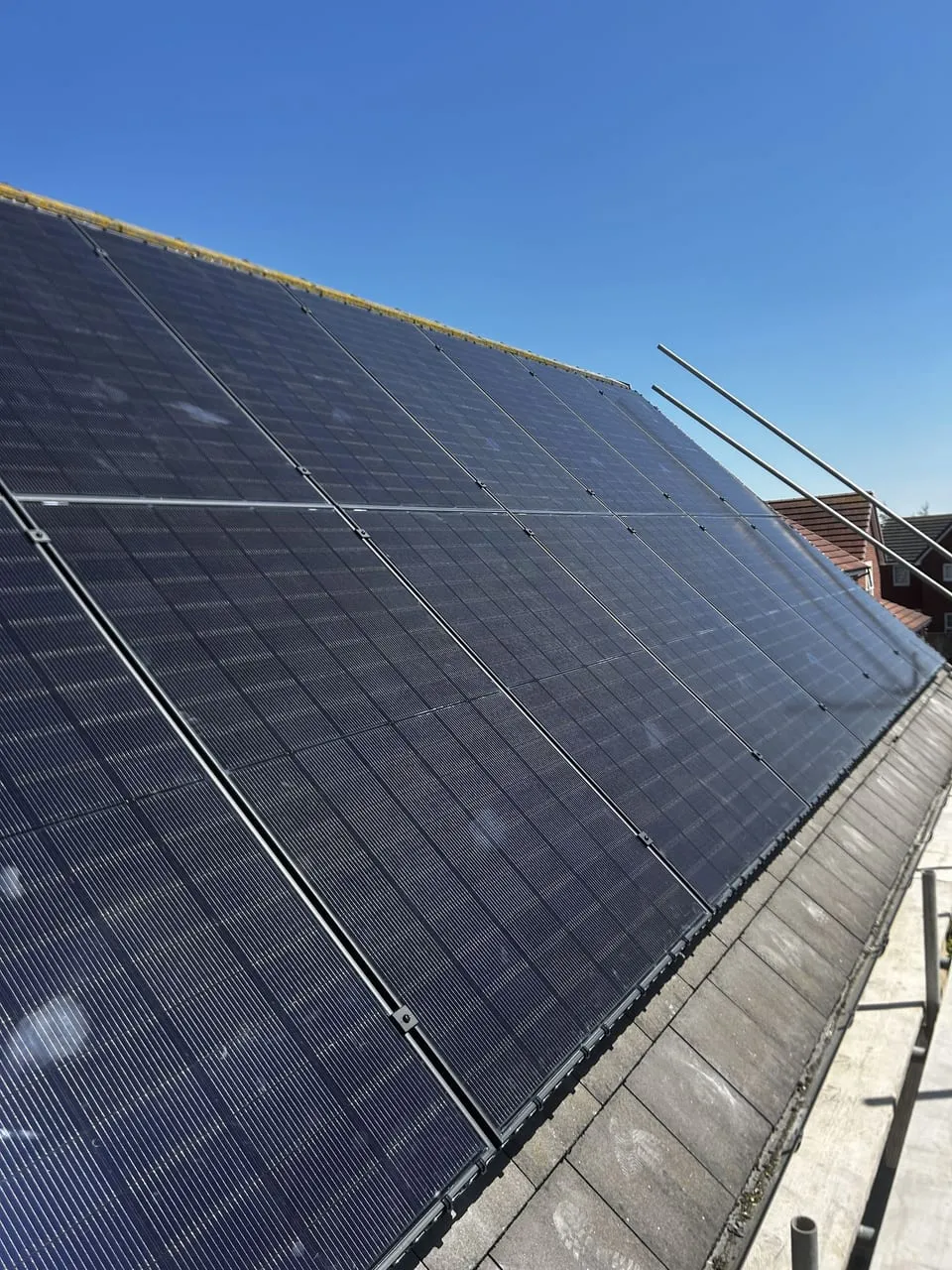
Pigeons and gulls don’t care that you spent thousands on a solar array — they see a warm, sheltered, predator-free ledge under the panels and move straight in. It’s one of the most common maintenance calls installers get in year two or three of a system’s life, and it’s almost entirely preventable for a modest one-off cost. Here’s what bird proofing actually costs in the UK in 2026, why it matters more than most homeowners assume, and where DIY attempts go wrong.
Why birds target solar panels in the first place
A roof-mounted solar array creates a gap of roughly 5–15cm between the underside of the panels and the roof tiles. That gap is dry, sheltered from wind and rain, warmed by the panels above, and — critically — out of reach of cats and foxes. For pigeons, gulls, starlings and jackdaws, it’s close to ideal nesting real estate. Once one pair moves in, droppings and old nesting material attract more birds the following season, and the problem compounds.
This isn’t a minor aesthetic nuisance. Bird activity under panels causes three distinct problems:
- Yield loss from droppings and debris. Bird mess is opaque and often sits directly over one or more cells within a panel. Because panels are wired in series strings, a single heavily-soiled cell can drag down the output of the whole string, not just that one panel — the “shading effect” from droppings behaves similarly to leaf litter or snow shading. Installers report noticeable output drops on affected strings, sometimes into double-digit percentages on badly-affected arrays, until the panels are cleaned.
- Physical damage. Nesting material (twigs, moss, feathers) can jam under panel frames, lift edges, and hold moisture against seals and cabling. Droppings are acidic and, left for months, can etch a panel’s glass or anti-reflective coating. Wiring insulation gets pecked at by some birds looking for nesting material, which is a genuine fire-risk and warranty issue.
- Blocked gutters and guttering damage. Nesting debris washes into gutters below the array, causing overflow and, in the worst cases, water ingress at the roofline.
None of this is catastrophic on its own, but left unaddressed for a few seasons it turns a routine array into one needing panel removal, deep cleaning, and re-sealing — a bill running into hundreds of pounds rather than the modest cost of prevention. For a fuller picture of ongoing running costs across the panel’s 25+ year life, see thecostofsolar’s breakdown of solar panel payback periods, which factors maintenance alongside degradation and yield.
What bird proofing actually costs in the UK (2026)
The good news: proofing is cheap relative to the system it protects, and it’s a one-off cost rather than a recurring one, provided it’s installed correctly the first time.
| System size / roof type | Typical bird mesh install cost (2026) |
|---|---|
| Small domestic array (4kW, single row) | £250–£400 |
| Typical domestic array (4–6kW, full roof) | £300–£600 |
| Large or complex roof (dormers, multiple arrays) | £500–£900 |
| Commercial/flat-roof array (per linear metre run) | £15–£30/m, plus access costs |
Most residential jobs land in the £300–£600 bracket, in line with the primary estimate for this article. What moves a job up or down that range:
- Roof pitch and access. A straightforward pitched roof with ladder access is quick. Anything needing scaffold towers or a cherry picker adds £150–£300+ before a single clip of mesh goes on.
- Perimeter length, not panel count. Bird mesh pricing is driven almost entirely by the linear metres of panel edge to be proofed, not the kWp of the system. A long, narrow array (e.g. a single row along a ridge) can cost more to proof than a compact, squarer array of similar wattage.
- Existing infestation. If birds are already nesting, expect an additional charge for safe removal of nests and droppings, and disinfection, before mesh goes on — typically £50–£150 extra, and timing may be restricted (see below).
- Mesh material. PVC-coated galvanised steel mesh is the standard and most durable choice; stainless steel or powder-coated aluminium systems cost more but last longer and resist corrosion better in coastal areas.
Installers sometimes bundle bird proofing into the original installation quote for a small uplift (often £150–£300 less than a retrofit, since scaffolding/access is already in place), which is worth asking about at the point of purchase rather than waiting for a problem. It’s a sensible question to raise with installers such as ECOaim in Livingston or Greenlinc Renewables in Lincolnshire when getting a quote, particularly on roofs with known local pigeon or gull activity.
What “proper” bird proofing looks like
A correctly fitted system is not just mesh stapled around the edge. A durable installation involves:
- PVC-coated wire mesh (typically 25–50mm aperture — small enough to exclude pigeons and gulls, large enough not to trap smaller birds or restrict airflow/cooling under the panels).
- Purpose-made clips, usually aluminium or stainless steel, that grip the panel frame without penetrating the frame, panel glass, or roof covering. This is the detail that separates a professional job from a DIY one — see below.
- Full perimeter coverage, not just the exposed front edge. Birds are persistent and will find any gap at the sides or rear of an array.
- A gap left for airflow. Panels need ventilation underneath to avoid overheating and yield loss in summer; a good installer designs the mesh run to exclude birds without sealing the array like a drum.
On flat commercial roofs, the equivalent problem is usually gulls and pigeons roosting on or under East-West mounted arrays; the fix is similar mesh systems designed for trough-mount racking, and this is a routine addition on the commercial jobs handled by installers like D&R Energy in Bristol or EC Eco Energy in Essex on warehouse and industrial roofs. If you manage a larger commercial roof and haven’t budgeted for bird proofing as part of the O&M plan, it’s worth reviewing alongside general upkeep — see solarpanelsforwarehouses.co.uk and solarpanelsforindustrialunits.co.uk for what a properly specified commercial install and maintenance schedule should include.
Why DIY bird proofing is a false economy
DIY bird mesh kits are widely sold online for £30–£80, and the material itself isn’t the issue — PVC-coated mesh is PVC-coated mesh. The risk is entirely in the fitting method, for three reasons:
1. Warranty invalidation. Almost every panel manufacturer’s warranty explicitly excludes damage caused by unauthorised modification or unqualified work on the array — and some clip designs sold for DIY fitting rely on small self-tapping screws or spring clamps that pinch or pierce the panel frame or backsheet. If a manufacturer inspects a failed panel and finds a hole drilled through the frame or clamp damage to the edge seal, that’s grounds to reject a claim on a panel that might otherwise have run fault-free for 25 years. On a 4kW+ system, that’s a much bigger loss than the saving on a mesh kit.
2. Roof and electrical safety. Fitting mesh means working at height, around live DC cabling, often without appropriate roof anchor points or edge protection. MCS-certified installers carry the relevant roof-work insurance and competency for this; most homeowners, understandably, don’t have the ladders, harnesses, or experience to do it safely on a pitched roof.
3. Doing it badly is often worse than not doing it at all. Loose-fitting DIY mesh with gaps at corners or clip points doesn’t just fail to exclude birds — it can trap them, creating a welfare problem and a worse mess than an open gap would have. A mesh system needs tension and full perimeter continuity to work; a partial or sagging fit is close to useless.
The sensible approach is to get bird proofing quoted and fitted by the installer who did (or would do) the original install, or a specialist bird-proofing contractor who works routinely with solar arrays and understands panel warranty terms. If your system is already a few years old and due a general health check, a bird-proofing quote is worth bundling with a wider inspection — panel cleaning, inverter check, cable and connector inspection — rather than treating it as an isolated job. Solar Maintenance Solutions specialise in exactly this kind of post-installation O&M work nationally, and can usually assess and quote bird proofing as part of a broader maintenance visit.
Timing matters — nesting season restrictions
Under the Wildlife and Countryside Act 1981, it’s an offence to intentionally damage or destroy an active bird’s nest, or the eggs or chicks in it (this covers most wild bird species, not just protected ones). In practice this means:
- If birds are already nesting under your panels, a competent installer will usually wait until the nest is naturally vacated (chicks fledged) before removing debris and fitting mesh — typically outside the core UK nesting season of roughly March to August, though some species nest later.
- This is exactly why prevention before nesting starts is so much cheaper and simpler than remediation after birds have moved in: proofing an empty gap takes an afternoon; removing an active nest legally can mean a delayed job and a longer wait.
- If you’ve spotted birds investigating (rather than fully nested) under your panels, get a quote promptly — there’s often a window to act before eggs are laid.
Is it worth it for the yield alone?
Run the numbers on a typical domestic system: a 4kW array generating around 3,400 kWh/year (at the UK’s roughly 850 kWh/kWp average yield) is worth in the region of £700–£850/year in avoided import at today’s typical ~25p/kWh electricity price, plus whatever export income applies under your Smart Export Guarantee tariff. If bird droppings are persistently shading even 5–10% of one string, that’s a plausible £35–£85/year in lost value — before counting the acceleration of glass and seal wear from months of acidic residue sitting on the panel surface. A one-off £300–£600 mesh install pays for itself in yield protection alone within roughly 4–8 years, on top of protecting the panel’s physical condition and your warranty position for the remaining 20+ years of its service life.
For context on what you’re protecting, it’s worth reading up on realistic panel costs and lifespans — see thecostofsolar’s guide to UK solar panel costs and thebritishsolarblog’s explainer on how solar panels perform in the UK climate — both useful context for weighing a maintenance spend like this against the value of the asset it protects.
The practical takeaway
Bird proofing isn’t optional extra-cost fluff — it’s cheap insurance against yield loss, panel degradation, and warranty disputes, and it typically costs far less than the problems it prevents. Budget £300–£600 for a standard domestic pitched-roof install, ask for it as a line item when you first get solar quoted rather than waiting for droppings to appear, and always have it fitted by a qualified installer rather than a DIY kit — the labour, not the mesh, is what you’re paying for. If birds have already moved in, get a professional assessment promptly rather than disturbing an active nest yourself, both for legal reasons and because a proper strip-and-refit job is a bigger, costlier task than prevention ever is.