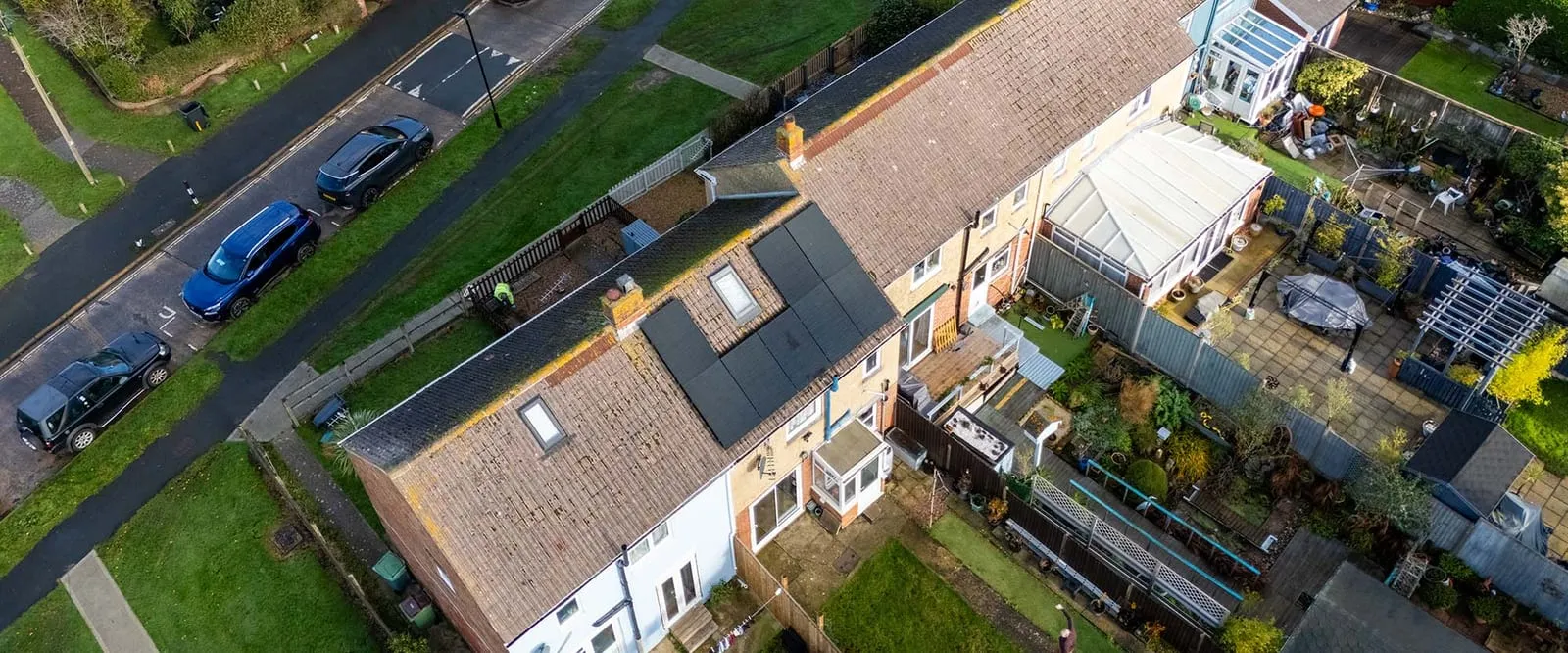
If you’ve ever stared at a solar quote wondering whether £7,200 for a 4.2kW system is fair, or whether the installer’s “payback in 6 years” claim stacks up, you’re exactly who our solar panel calculator was built for. This post explains the maths behind it in plain terms, then shows you how to take any quote you’ve received and pressure-test it line by line — because the calculator is only half the job. The other half is knowing what a genuinely competitive quote looks like once the sales pitch is stripped away.
What the calculator actually does
Our free tool isn’t a lead-generation form dressed up as a calculator — there’s no “get your instant quote” trap at the end, no phone number required. It’s a standalone estimator built around four inputs: your system size (kWp), your postcode or region, your current annual electricity usage, and roughly how much of your generation you’ll use versus export. From those, it models:
- Annual generation — using regional yield data, not a flat national average
- Self-consumption vs export split — the single biggest driver of your real savings
- Bill savings — generation you use directly, valued at your import rate
- Export income — generation you don’t use, valued at your Smart Export Guarantee (SEG) rate
- Simple payback — installed cost ÷ annual financial benefit
- 25-year lifetime return — accounting for panel degradation and one likely inverter replacement
None of this is guesswork dressed up as precision. Every constant in the model is sourced, and we’d rather show you the range than hand you a falsely confident single number.
The yield assumption
UK solar yield varies more by geography than most quotes acknowledge. A well-oriented south-facing roof in Cornwall or Hampshire can produce over 1,000 kWh per kWp per year, while the same system in central Scotland or northern England is closer to 800–850 kWh/kWp/yr. National “average” figures you’ll see quoted elsewhere (900–1,100 kWh/kWp) are usually skewed toward the sunnier south and shouldn’t be applied uniformly. Our calculator asks for your region specifically so it doesn’t flatten the country into one number — this matters if you’re comparing a quote from an installer in, say, Hampshire against one covering Central Scotland, because the underlying generation potential genuinely differs by 15–20%.
If your installer’s proposal shows a yield estimate, ask what regional dataset or tool it came from (most reputable firms use MCS-aligned software such as PVGIS-derived modelling). If the number looks flat regardless of postcode, that’s a shortcut, not a calculation.
The cost side: what “installed cost” should include
This is where our calculator deliberately asks you to enter your own installed price rather than guessing one for you — because publishing a single “average cost” figure invites exactly the kind of lazy benchmarking that leads homeowners astray. As a general steer for 2026, typical fully-installed prices (materials + labour + scaffolding + inverter + commissioning, VAT included) run roughly:
| System size | Typical installed cost (2026) |
|---|---|
| 3 kW | ~£5,000 |
| 4 kW | £6,000–£8,000 |
| 6 kW | £8,500–£11,000 |
| 10 kW | £13,000–£17,000 |
These are wide ranges deliberately — roof complexity, scaffolding access, panel tier (standard poly/mono vs premium N-type TOPCon or HJT), and inverter brand all move the number by thousands. For a deeper breakdown of what’s actually inside those figures, our own cost of solar panels in the UK guide goes line-by-line through hardware, labour and soft costs, and the payback period guide walks through how financing and usage patterns change the years-to-breakeven number specifically.
One number worth remembering: 0% VAT applies to residential solar and battery storage installations in Great Britain until 31 March 2027, after which it’s scheduled to revert to 5%. If you’re comparing quotes now, make sure every figure you’re benchmarking is VAT-inclusive on the same basis — some installers quote net, some quote with VAT already zero-rated, and mixing the two makes your comparison meaningless.
How to sanity-check an installer’s quote, line by line
Once you’ve got a real quote in hand, run it against these checks before you sign anything.
1. Benchmark the £/W (or £/kWp)
Divide the total installed cost by the system’s peak output in watts. A 4.2kW system at £7,140 is £1.70/W. As a rough 2026 domestic benchmark, expect £1.50–£2.20/W for a straightforward roof, rising toward £2.50/W+ for difficult access, multiple roof faces, or premium panel/inverter specs. If a quote comes in well under £1.30/W, ask what’s been cut — often it’s panel tier, warranty length, or scaffolding safety margin. If it’s well over £2.50/W with no obvious complexity, that’s your negotiating room.
Commercial-scale installs price differently — expect roughly £900–£1,200/kWp for larger systems where economies of scale kick in, which is why a 50kW warehouse or school roof looks nothing like five domestic installs stacked together. If you’re quoting for a larger site, our commercial solar panel costs page and the wider commercial solar installation resources are the right benchmark, not a domestic one.
2. Check the panel spec, not just the wattage
Two 400W panels can be worlds apart. Modern N-type panels (TOPCon, HJT, or back-contact/ABC cell designs) degrade at roughly 0.4% per year and are commonly warrantied for 25–30 years, versus older P-type panels degrading closer to 0.5–0.7%/yr with 20–25 year warranties. A quote should name the actual panel model, not just “tier 1 monocrystalline” — that phrase describes manufacturer bankability, not performance.
3. Interrogate the inverter line separately
String inverters typically last 10–15 years and cost roughly £500–£1,000 to replace — that’s a real cost that belongs in any 25-year payback model, and a lot of consumer-facing calculators quietly omit it. If your installer’s own payback projection assumes zero inverter replacement across 25 years, the numbers are optimistic. Ask specifically whether it’s a string inverter, power optimisers, or microinverters, since the failure/replacement profile (and price) differs.
4. Battery storage — cost per kWh, not just headline price
If a battery is bundled in, separate its cost out and check it against roughly £400–£700 per kWh of usable capacity, or £4,000–£8,000 installed for a typical domestic unit. A Tesla Powerwall 3 (13.5kWh usable) typically installs for £8,500–£10,500 — useful as a reference point since it’s the most quoted product in the market. Our solar battery storage costs breakdown covers the main chemistries and sizing logic if you want to go deeper before comparing quotes from firms like FLD Electrical in South Wales or Energy Concerns in Leicester, both of whom quote battery and solar as separate line items rather than one bundled figure — which is the standard you should hold every quote to.
5. Export rate — get the actual number, not “up to”
The Smart Export Guarantee is not a fixed national rate — it’s a market of tariffs offered by licensed suppliers, and rates vary meaningfully, from a few pence per kWh up to roughly 12–20p/kWh at the top end for the best current tariffs. If a quote’s payback projection uses an export rate without naming the actual tariff and supplier, ask for it explicitly — a 5p/kWh assumption versus an 18p/kWh assumption can shift your payback period by a year or more on an export-heavy system. And critically: MCS certification is required for SEG eligibility, so confirm the installer and the specific installation will be MCS-registered, not just that the company holds MCS accreditation in general.
6. Grants and VAT — don’t let a salesperson conflate these
Be wary of any quote that references a blanket “government grant” for a standard residential rooftop system — there currently isn’t one for most homeowners in England. What exists is narrower: ECO4 and the Warm Homes schemes, both means-tested and targeted at low-income households in low-EPC-rated homes, and in Scotland, Home Energy Scotland interest-free loans (not a grant) for eligible homeowners. If you’re a farm business, the England scheme is the Improving Farm Productivity grant at roughly 25% of eligible costs — not the old FETF 40% figure that still circulates online and is now outdated for solar. And if anyone quotes the Boiler Upgrade Scheme (£7,500) as covering part of your solar cost, stop them — that grant is for air source or ground source heat pumps only and has no application to PV.
7. Ask what “25-year performance” actually models
A credible 25-year projection should show: annual degradation (0.3–0.5%/yr for modern panels), at least one inverter replacement, and no assumption that electricity prices stay flat for a quarter of a century. If a proposal shows a straight-line savings graph with no dip for inverter replacement and no sensitivity to import price changes, ask for the underlying assumptions in writing.
Reading regional quotes against real installer benchmarks
Because so much of the cost variance is regional — scaffolding rates, roof types, travel distance for the installer — it helps to compare quotes against firms actually operating in your area rather than a single national figure. A quote from Greenlinc Renewables covering Lincolnshire will reflect different access and labour costs than one from Premier Electrical Renewables or a Doncaster-based firm like ElectriFusion Solutions, even for an identical 4kW spec. None of that means one is overcharging — it means £/W benchmarking has to allow a genuine regional band, not a single target figure.
For businesses rather than homeowners, the calculation changes further again: commercial electricity contracts, three-phase supply considerations, and capital allowances all move the payback math. If you’re weighing a larger installation, the sector-specific cost pages — warehouse solar, school solar, or farm and agricultural solar — carry sector-specific benchmarks that a generic domestic calculator won’t capture, because roof size, daytime usage profile, and grant eligibility all differ by building type.
The bottom line on using the calculator well
Treat the output as a sanity-check range, not a guaranteed number. Run your own quote’s numbers through the same logic the calculator uses — regional yield, real installed £/W, named export tariff, VAT basis, and an honest 25-year model including inverter replacement — and you’ll spot an inflated or overly optimistic quote within minutes. If two quotes for a similar spec differ by more than about 20% in £/W with no complexity difference, ask both installers to itemise: panel model, inverter type and brand, mounting system, scaffolding, and commissioning/paperwork (MCS certificate, DNO notification, SEG registration). The gap is almost always in one of those lines, not in some invisible margin.
If you want a second read on installer marketing claims specifically — including how the industry itself talks about pricing and performance — our sibling site Solar Weekly tracks the trade side of the market, while The British Solar Blog covers the performance and “does it actually work here” questions we deliberately keep out of a pricing-focused calculator.