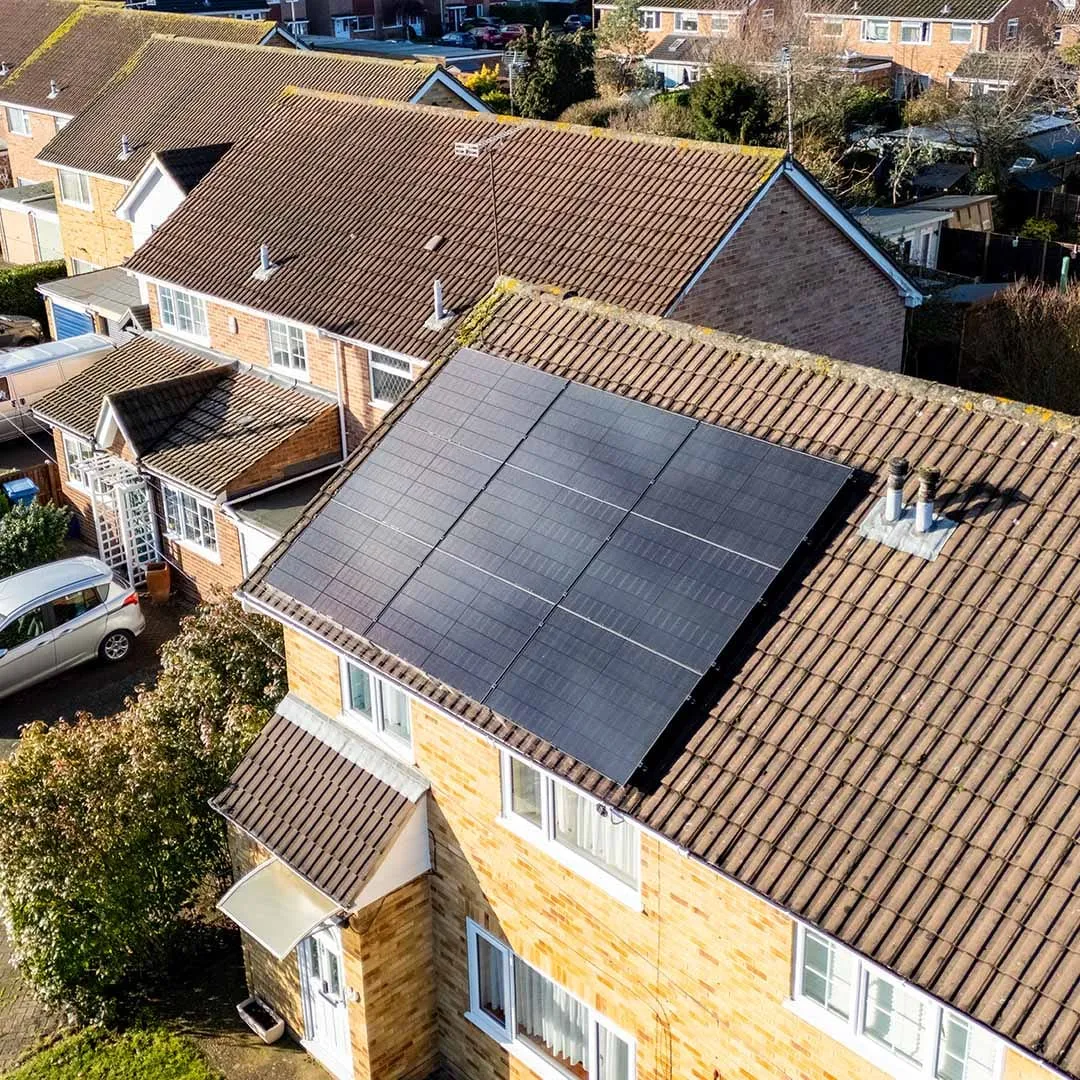
Every few weeks someone emails a solar forum asking how to “go off-grid” for a cabin, a narrowboat or a smallholding, expecting the answer to be cheaper than a grid-tied roof. It almost never is. Off-grid solar means building your own private power station — panels, batteries, charge controllers, an inverter and usually a generator for backup — sized to survive the darkest week of a British December with zero help from the National Grid. That’s a fundamentally different (and pricier) engineering problem than clipping a grid-tied array onto a house that already has mains power as a fallback.
This piece sets out realistic 2026 UK costs for genuine off-grid systems, how the sizing maths differs from a normal home install, and why — for anyone who isn’t literally off the grid by geography — staying grid-tied with a battery is usually the smarter financial call.
What “off-grid” actually means (and what it doesn’t)
Off-grid means there is no mains electricity connection at all — no fallback, no export, no Smart Export Guarantee income, nothing. Everything you use has to be generated, stored and managed on-site. This is genuinely different from a grid-tied home with a battery that can still pull from the mains if the sun doesn’t cooperate.
True off-grid setups are mostly found in:
- Canal boats and narrowboats — 12V/24V DC systems, small daily loads, engine charging as backup
- Remote cabins, shepherd’s huts and static caravans — no grid connection nearby, or the cost of a grid connection (sometimes £10,000–£40,000+ for rural spurs) makes solar-plus-battery cheaper than connecting at all
- Smallholdings and agricultural outbuildings — a barn, workshop or polytunnel some distance from the farmhouse supply
- Glamping pods and holiday lets built where a grid connection isn’t available or desired
If your house is already on the grid and you’re just weighing “should I add a battery”, that’s a different question — and one where thecostofsolar.co.uk’s battery storage cost guide and payback period breakdown are more directly useful than anything below.
The sizing problem: you’re building for the worst day, not the average day
Grid-tied solar is sized around annual yield — you might average 850 kWh per kWp per year in most of the UK, rising towards 1,050+ kWh/kWp in the sunniest parts of the south. If a grid-tied system underproduces in January, the grid simply fills the gap and you notice it only on the bill.
Off-grid systems can’t do that. You have to size for autonomy — enough battery capacity and enough panel area to get you through several consecutive grey days in midwinter, when solar in the UK can produce a fifth of its summer output or less. That means:
- Panel arrays are usually oversized relative to average need, because you’re designing around the worst month, not the average month
- Battery banks need several days of usable capacity (not the 1-day buffer typical of a grid-tied home battery)
- Most serious off-grid installations still include a backup generator, because no amount of extra panel area reliably fixes a run of dark December days
- Inverters need to handle 100% of your peak load with nothing to fall back on if you undersize
This is the single biggest reason off-grid costs more per kWh delivered than grid-tied: you’re paying for capacity that sits unused most of the year, purely as insurance against the worst week.
Realistic 2026 UK cost bands
These are all-in figures for equipment plus installation, in 2026 GBP. Off-grid systems vary enormously with load and duty cycle, so treat these as sensible starting bands rather than quotes.
| Setup | Typical system | Approx. all-in cost |
|---|---|---|
| Narrowboat / small cabin (lighting, phone charging, small fridge) | 200–400W panels, 12V/24V, 2–5kWh battery | £1,500–£4,000 |
| Shepherd’s hut / holiday pod (modest daily use, no heating) | 1–2kW panels, 5–10kWh battery, small inverter | £6,000–£12,000 |
| Off-grid cabin with occasional heavy loads (kettle, washing machine) | 2–4kW panels, 10–20kWh battery, backup generator | £12,000–£25,000 |
| Smallholding / outbuilding with workshop tools or livestock equipment | 4–8kW panels, 20–40kWh battery, generator, dedicated switchgear | £25,000–£50,000+ |
| Full off-grid farmhouse replacing a grid connection entirely | 6–10kW+ panels, 30–60kWh+ battery, generator, professional design | £40,000–£80,000+ |
A few things drive these numbers up compared with a standard grid-tied home:
Battery capacity dominates the budget. Lithium battery costs run roughly £400–£700 per kWh installed, and off-grid systems need far more of it than a grid-tied top-up battery. A Tesla Powerwall 3 (13.5kWh) runs about £8,500–£10,500 fitted — and that’s designed as a grid-tied backup unit, not a multi-day off-grid bank, so serious off-grid setups often use several large lithium racks or older but cheaper lead-acid/AGM banks where budget is tight (at the cost of lifespan and usable depth of discharge).
You need a generator, realistically. Diesel or petrol backup generators (2–10kVA) add roughly £1,000–£5,000 depending on size, plus fuel and servicing. Skipping this is the most common way off-grid budgets blow up later — when the customer accepts a genset “for emergencies only” and then runs it every dull fortnight in November.
Installation and design labour is specialist. Off-grid design (load calculations, autonomy days, charge controller sizing, DC wiring for boats) is a narrower skill than standard grid-tied MCS installation, and pricing reflects that.
VAT relief still applies. The 0% VAT rate on residential solar and battery storage installations in Great Britain runs until 31 March 2027 (reverting to 5% after), which helps on materials for domestic off-grid installs — though smaller DIY or marine components bought individually may not always qualify, so check with your supplier.
Grants and schemes: mostly not built for this
It’s worth being blunt here, because misinformation about “off-grid grants” circulates constantly:
- There is no universal England-wide solar grant for homeowners. ECO4 and the Warm Homes scheme are means-tested and tied to low-EPC-rated properties, not simply “wants to go off-grid”.
- The Boiler Upgrade Scheme pays up to £7,500 towards an air source heat pump — it does not fund solar panels or batteries at all, a mix-up worth correcting whenever you see it quoted for solar.
- Scottish applicants can look at Home Energy Scotland’s interest-free loans, which can cover solar and battery costs alongside other home energy measures.
- If the “off-grid” project is actually a farm building or agricultural outbuilding, England’s Improving Farm Productivity grant offers roughly 25% of eligible costs for qualifying farm solar — rates and schemes differ by nation, so check current terms before budgeting on it. For a fuller sector breakdown, solarpanelsforfarms.uk and solarpanelsforagriculture.co.uk both cover current agricultural funding routes in more depth, and solarpanelsforbarns.co.uk is worth a look if the “off-grid building” in question is specifically a barn or outbuilding rather than the main house.
- The Smart Export Guarantee is irrelevant to a true off-grid system by definition — there’s no grid connection to export to, so none of that ~12–20p/kWh top-rate income applies. It only matters if you eventually decide to connect.
Why grid-tied almost always wins on money
Here’s the uncomfortable maths for anyone choosing off-grid by preference rather than necessity: a grid-tied 4kW system with a modest battery, installed for roughly £8,000–£14,000 all-in, gives you effectively unlimited backup capacity (the grid) plus export income, for a fraction of the cost of a true off-grid bank sized to survive a UK winter unaided. The off-grid premium is entirely the cost of self-sufficiency — batteries and generator capacity that a grid-tied home simply doesn’t need, because the grid is the backup.
If a grid connection is physically available and the quote for connecting isn’t extortionate, it is very hard to make off-grid cheaper over a 20-year horizon once you account for battery replacement (most lithium chemistries degrade gradually and lose meaningful capacity inside 10–15 years of heavy cycling) and generator running costs. Off-grid earns its keep specifically where a grid connection genuinely doesn’t exist or would cost more than the entire solar-plus-battery system to install — remote moorland cabins, canal boats, and some far-flung agricultural buildings.
For context on what a “normal” system costs by comparison, thecostofsolar.co.uk’s cost-of-solar-panels guide and solar panel calculator both use 2026 UK installed pricing rather than the off-grid premiums covered here. If the building in question is actually commercial rather than residential — a workshop, unit or outbuilding used for business — commercialsolarcostuk.co.uk breaks down that separate cost structure, and batterystorageforbusiness.co.uk covers commercial-scale battery sizing where load profiles look more like a smallholding’s workshop than a house.
Getting a proper design, not a guess
Off-grid sizing genuinely needs a load audit — walking through every appliance, its wattage and how many hours a day it actually runs, not a rough guess — because undersizing a battery bank by even 20% shows up immediately as blackouts on the third grey day of a cold snap. This is specialist work, closer to marine or caravan electrical design than a standard MCS domestic install, and it’s worth getting a proper survey rather than sizing by online calculator alone.
For anyone in South Yorkshire weighing up a smallholding or workshop off-grid setup, ElectriFusion Solutions covers both the solar and the electrical side locally, which matters when a system needs bespoke DC switchgear rather than an off-the-shelf domestic kit. In Yorkshire more broadly, YEERS handles solar, battery and EV work together, which is useful if the same rural property also needs an EV charge point run off the same generation. Scottish smallholders looking at Home Energy Scotland’s loan route are better served locally by Ecoaim in Livingston, while Lincolnshire farm and rural properties can get an MCS-certified local quote from Greenlinc Renewables. For Kent-based rural or estate properties needing both electrical and renewables expertise in one visit, Hazell Electrical covers West Kent.
Whoever designs it, insist on seeing the load calculation and the autonomy-day assumption in writing before agreeing a battery size — that single number (how many consecutive low-sun days the system is designed to survive) is the difference between a system that works every winter and one that needs the generator running weekly.
The bottom line
Off-grid solar for a cabin, boat or smallholding in the UK is a real, buildable thing — but budget for a battery-dominated system sized around your worst winter week, not your average day, and expect several thousand pounds minimum even for a modest cabin, rising past £40,000 for a full off-grid farmhouse replacement. If a grid connection exists or is remotely affordable to install, run the comparison properly before committing: in the vast majority of cases, grid-tied solar with a modest battery and SEG export income beats a true off-grid system on cost, reliability and long-term battery replacement burden. Off-grid earns its premium only where there genuinely is no grid to tie into.