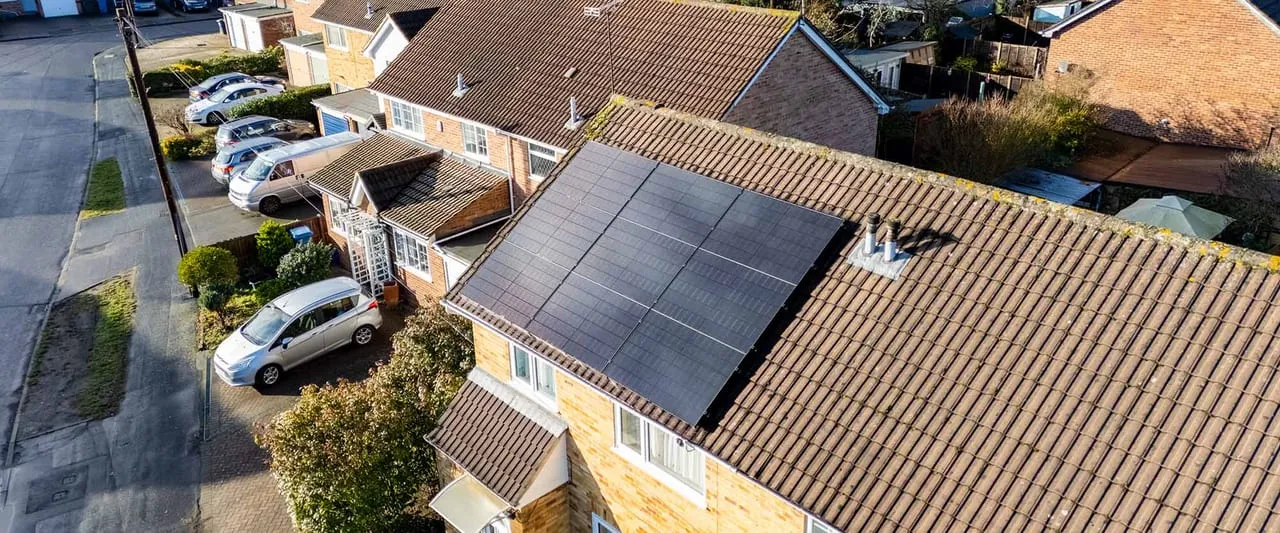
A detached house isn’t just a bigger version of a semi — it usually means a bigger roof, higher electricity usage, and often more valuable roof space to play with (multiple pitches, outbuildings, sometimes a garage or annexe roof too). That changes the maths on what to install and how fast it pays back. Here’s what a realistic 2026 quote looks like for a typical UK detached home, why 5-6kW tends to be the sweet spot rather than the ceiling, and where the bigger roof actually earns its keep.
Why detached houses need a different starting point
Semi-detached and terraced homes in the UK typically run a 3-4kW system because that’s roughly what a modest south-facing roof and a 2-3 bedroom household’s usage can absorb. Detached houses are a different proposition on both sides of that equation:
- More roof, often multiple usable pitches. A detached property frequently has a larger footprint, a double garage, or an outbuilding, giving installers more than one orientation to work with — useful when the “best” south-facing pitch is smaller than the total available area.
- Higher baseline electricity use. More rooms, more appliances, often a bigger boiler load or a second fridge-freezer, and — increasingly — an EV or a heat pump. Detached households in our experience commonly use 4,000-6,000+ kWh a year against the UK average of roughly 2,700-3,300 kWh for smaller homes.
- More capital available to deploy sensibly. Not always, but a bigger house often means a bigger appetite for a larger system plus a battery, rather than the smallest system that clears the payback bar.
Put those together and a 5-6kW system, rather than the 3-4kW that suits a terrace, becomes the realistic starting point — with plenty of detached homes justifying 8-10kW where roof space and usage support it.
What a 5-6kW system costs installed in 2026
For a well-oriented, unshaded roof with straightforward scaffolding access, expect:
| System size | Typical installed cost (2026) | Panels (approx.) |
|---|---|---|
| 4kW | £6,000 - £8,000 | 9-10 panels |
| 5kW | £7,500 - £9,500 | 11-13 panels |
| 6kW | £8,500 - £11,000 | 13-15 panels |
| 8kW | £10,500 - £14,000 | 18-20 panels |
| 10kW | £13,000 - £17,000 | 22-24 panels |
These are all-in figures — panels, inverter, mounting, scaffolding, wiring, MCS certification and VAT — for a domestic installation in Great Britain. Residential solar and battery storage are zero-rated for VAT until 31 March 2027, when the rate is scheduled to revert to 5%, so anyone weighing up timing has a genuine, dated reason to move sooner rather than later rather than a sales-driven “act now.”
Price per kWp falls as the system gets bigger — mainly because scaffolding, the inverter, and labour don’t scale linearly — which is one of the practical arguments for going a size up rather than undersizing a detached roof to match only the current bill.
Sizing it properly: usage first, roof second
The most common mistake on larger homes is sizing the system to the roof rather than to consumption. A few reference points:
- Modern panels degrade slowly and last a long time. Current N-type (TOPCon, HJT or ABC cell) panels typically degrade around 0.4% a year and are rated for 25-30+ years of useful output, so a system sized generously today isn’t overbuilding for a household that’s likely to add an EV or a heat pump within the panels’ lifetime.
- UK yield is geography-dependent. Expect roughly 850 kWh of annual generation per kWp installed on an average UK roof, rising to 1,000-1,050+ kWh/kWp on a well-oriented south-facing roof in the sunny south coast or south-east.
- A 6kW system on a good roof can therefore generate somewhere in the region of 5,100-6,300 kWh a year — comfortably covering a detached household’s higher baseline usage, with a meaningful surplus left for export or battery charging.
If you’re not sure where your own roof and usage numbers land, thecostofsolar’s solar panel calculator is a reasonable starting point before you get quotes, and our full cost of solar panels breakdown covers the smaller-system numbers if you’re comparing against a semi-detached quote too.
Should a detached house add a battery?
This is where detached homes diverge most from smaller properties. Higher daytime-plus-evening usage means more of the day’s generation would otherwise be exported at a low rate rather than used on-site. A battery lets you shift that self-generated power into the evening peak instead.
Typical 2026 battery pricing:
- Home batteries generally run £400-£700 per kWh installed, with a full system usually landing between £4,000 and £8,000 depending on capacity and installer.
- A Tesla Powerwall 3 (13.5kWh) typically costs in the region of £8,500-£10,500 fitted — a popular choice for larger households wanting near-total evening cover from daytime generation.
The decision comes down to your evening usage pattern: a detached household running an EV charger, a heat pump, or simply a lot of evening cooking and heating load will get more out of a battery than a smaller household that’s mostly out during the day. For a proper breakdown of battery costs against system size, see thecostofsolar’s battery storage cost guide.
Payback: what changes with a bigger system
Payback period is driven by three things: install cost, self-consumption rate, and export income — and a detached house tends to move all three in a favourable direction if it’s sized correctly.
With import electricity at roughly 25p/kWh under the current Ofgem price cap framework, and the Smart Export Guarantee paying anywhere from a few pence up to around 12-20p/kWh at the better end (rates vary significantly by supplier — there’s no fixed national rate), a well-sized 5-6kW system without a battery on a detached house with decent daytime usage typically pays back in 7-10 years. Add a battery and the payback period usually extends slightly in pure “cost of kit” terms but delivers more total lifetime saving, because it captures far more of the generated electricity rather than exporting it cheaply.
Our dedicated solar panel payback period guide walks through the underlying calculation in more detail if you want to model your own numbers against a specific quote.
Grants and support — what actually applies to a detached home
There’s no universal solar grant for owner-occupied homes in England. What’s genuinely available in 2026:
- ECO4 and the Warm Homes scheme — means-tested support for low-income households in low-EPC-rated homes, not a general solar subsidy.
- Home Energy Scotland offers an interest-free loan (with a grant element in some cases) for solar and battery installs north of the border.
- The Boiler Upgrade Scheme (£7,500) is for air source or ground source heat pumps only — it does not fund solar PV, a mix-up we still see in a lot of marketing.
- If your detached property sits within a farm or smallholding, the picture changes: England’s Improving Farm Productivity grant offers roughly 25% of eligible costs for agricultural solar (not the old FETF 40% figure some sites still quote), with different rates by nation.
For most detached homeowners the real financial lever isn’t a grant — it’s the 0% VAT window, correct system sizing, and getting more than one quote from an MCS-certified installer, since MCS certification is what makes you eligible for the Smart Export Guarantee in the first place.
Getting quotes: what to ask a regional installer
Because detached roofs vary so much in shape and orientation, a site survey matters more here than on a standard semi. When you’re speaking to installers, ask specifically how they’d split the array across multiple roof pitches if you have them, and what generation loss (if any) that split design implies versus a single south-facing array.
Regional installers who work detached housing stock regularly are worth talking to directly: in South Yorkshire, ElectriFusion Solutions handles detached and larger residential systems around Doncaster; in Central Scotland, Ecoaim covers Livingston and the surrounding area including battery pairing; in South Wales, FLD Electrical quotes both solar and the electrical upgrade work bigger systems sometimes need; and in Lincolnshire, Greenlinc Renewables is MCS-certified and used to sizing systems for rural and larger detached properties. If you’re in Hampshire or along the south coast where yield is highest, it’s worth getting a quote from Solent Solar or South Coast Solar Solutions specifically because the extra sun hours change the sizing maths in your favour.
Once a system’s installed, don’t ignore upkeep — string inverters typically last 10-15 years and cost £500-£1,000 to replace, and panel performance is worth checking periodically rather than assumed; Solar Maintenance Solutions covers ongoing O&M nationally if your installer doesn’t offer a monitoring package.
If the property has commercial-scale roof space
Some detached properties — a large rural house with barns, a smallholding, or a property run partly as a business (B&B, workshop, home office with staff) — actually sit closer to a small commercial install than a domestic one once you start using outbuilding roofs. If that’s your situation, it’s worth looking at the commercial side of the market rather than forcing a domestic quote onto a bigger job: Solar Panels for Farms covers agricultural-scale installs including outbuildings, Commercial Solar Panels Installation is a useful independent primer on how commercial-scale specification and finance differs from domestic, and if the property includes barns specifically, Solar Panels for Barns is worth a look for outbuilding-specific guidance. For anyone weighing finance structures rather than paying upfront, Commercial Solar Finance sets out the options for larger installs.
The bottom line for a detached house
Budget £7,500-£11,000 for a well-specified 5-6kW system on a detached roof in 2026, rising to £13,000-£17,000 if your usage and roof genuinely support 10kW. Get the sizing right against actual usage (not just the roof you happen to have), factor in a battery if your household uses meaningful power in the evenings, and use the 0% VAT window while it’s still in place rather than as a reason to rush a decision you haven’t properly sized. A detached house has more room to get this right than most — and more to lose from an undersized system that leaves both roof space and usage headroom on the table.