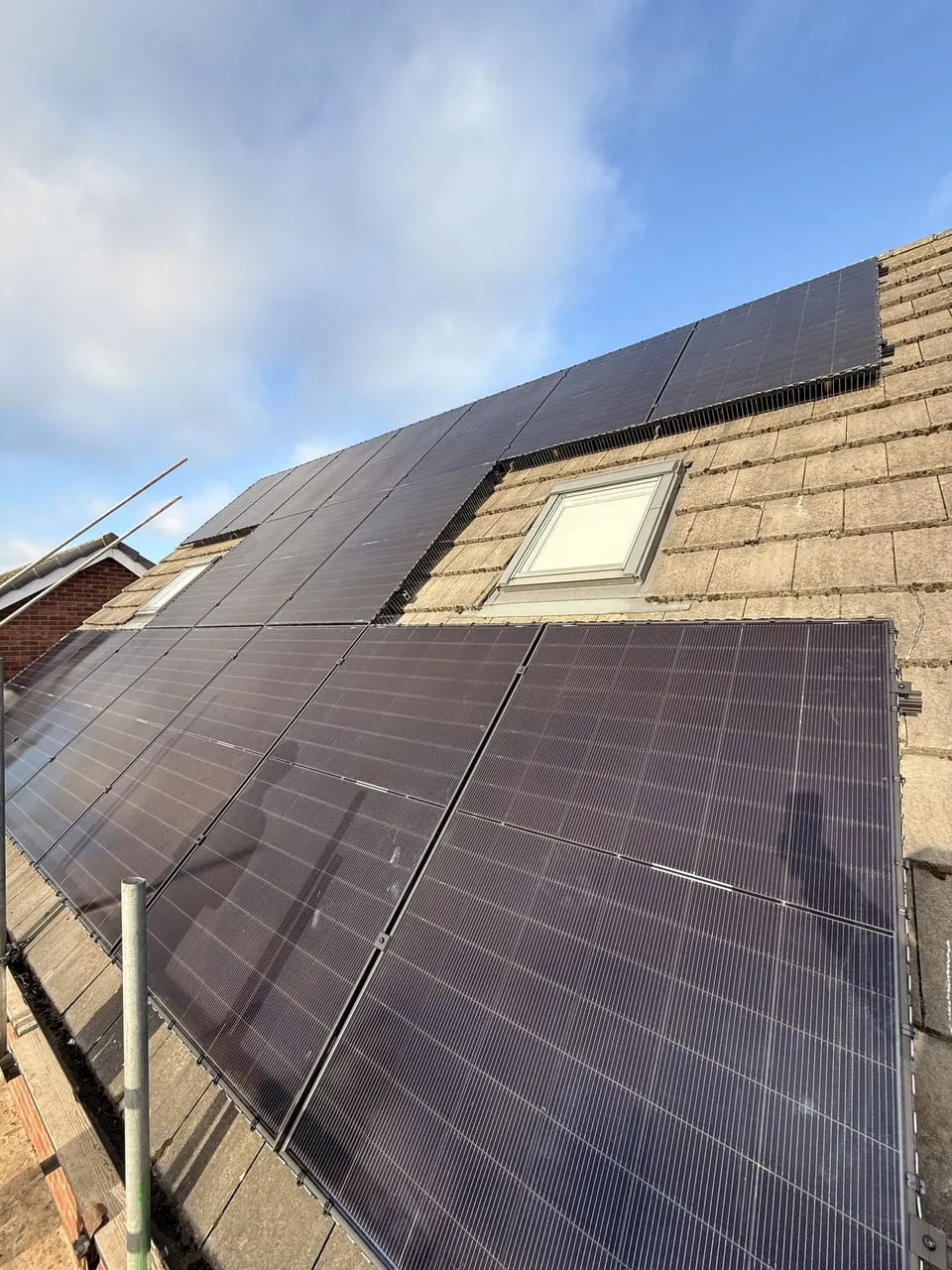
In-roof solar — where the panels sit flush within the roofline instead of on top of it — has moved from a niche architectural request to a genuine new-build standard. It costs more than a standard on-roof (in-roof) mounted system, sometimes considerably more, and the reasons why aren’t always explained clearly. This piece breaks down what an in-roof system actually is, what GSE-tray kits cost versus rail-mounted panels, why new-build economics change the maths completely, and why retrofitting in-roof onto an existing property carries a premium most homeowners aren’t warned about.
What “in-roof” actually means
Most UK solar installs are on-roof (sometimes called “in-roof” colloquially but more accurately “surface-mounted”): aluminium rails are bolted through the tiles or slates into the rafters, and the panels sit 60-100mm proud of the existing roof covering. The roof underneath stays intact and does the weatherproofing; the panels just sit on top of it.
In-roof (integrated) solar replaces a section of the roof covering entirely. Special waterproof mounting trays — most commonly GSE (Give Energy System / GSE Integration) trays, or equivalent systems from Viridian, EcoFasten-style UK importers, or panel manufacturers’ own kits — are fitted directly onto the roof timbers/battens, and the solar panels themselves become the weatherproof outer layer in that section. No tiles, no slates, no visible frame lip. The panels sit flush with the surrounding roof plane, which is why it’s often marketed as “seamless” or “aesthetic” solar.
The trade-off is upfront cost and installation complexity in exchange for a lower-profile look and, in new-build, a genuine materials offset.
GSE-tray systems: how the cost stacks up
GSE trays are the dominant integration system in the UK market — a flashed, interlocking aluminium tray sits on the batten structure, and panels clip into the tray rather than being rail-mounted. Rough 2026 pricing for a domestic retrofit:
| Item | On-roof (rail-mounted) | In-roof (GSE tray/integrated) |
|---|---|---|
| 4kW system, supply + install | £6,000–£8,000 | £8,500–£11,500 |
| Mounting hardware cost/panel | ~£15–£30 (rails, clamps, hooks) | ~£60–£120 (trays, flashing kit) |
| Labour (roofer + electrician days) | 1–2 days | 2–4 days (roof strip-back required) |
| Tile/slate removal & disposal | Not needed | Required across the array footprint |
| Waterproofing risk | Low (roof largely undisturbed) | Higher (new junction between tray and existing covering — flashing detail is critical) |
The premium is typically 35–50% over a comparable on-roof system on a retrofit job, driven almost entirely by three things: the tray hardware itself costs 3-4x a standard rail kit per panel, the roof has to be stripped back to battens across the array area (so you’re paying to remove tiles you’re not reusing, plus disposal), and the waterproofing detail at every tray-to-tile junction needs a skilled roofer, not just an MCS solar installer. Get the flashing wrong and you get a leak nobody notices until the plasterboard stains eighteen months later — so this isn’t a job to shop purely on price. For a general steer on what “normal” pricing looks like before you get quotes, our own cost breakdown by system size is a useful baseline to sanity-check any in-roof quote against.
Cost varies a fair bit by roof complexity too — a simple south-facing pitched roof with no hips, valleys or obstructions is far cheaper to integrate than a broken-up roofline with dormers and chimneys, where the tray has to be cut and flashed around every junction.
New-build economics: why the maths flips
On a retrofit, in-roof is close to pure cost premium for aesthetics. On a new build, the calculation is different, because the panels aren’t just generating electricity — they’re replacing a roof covering you were going to buy anyway.
A developer or self-builder speccing a roof has to buy tiles or slates for the whole roof regardless. If a section of that roof is going to carry solar panels integrated via GSE trays, that section doesn’t need tiles at all — the panels are the covering. So the true incremental cost of in-roof solar on a new build is:
(Cost of solar panels + trays + install) − (Cost of the tiles/slates and their fitting that you didn’t have to buy for that section)
Roofing tiles installed typically run £40–£90/m² depending on material (concrete vs clay vs natural slate) and roof complexity. A typical UK domestic roof pitch area for a 4kW array (around 16-20 panels’ worth, but usually the array covers 20-28m² depending on panel wattage and roof orientation) can offset £800–£2,000+ in tiling material and labour that simply isn’t needed. On premium natural slate roofs the offset is larger still, since slate can run £120-£180/m² installed.
That doesn’t make in-roof solar free on a new build — it’s still a specialist trade and the tray system costs more than rail — but it closes a meaningful chunk of the on-roof-vs-in-roof cost gap, and on some specs (particularly where the developer was already fitting a premium tile) it can bring the two options close to parity. This is precisely why in-roof solar has become the default spec on a lot of new housing developments rather than an expensive add-on: the roofer is on site either way, and the panel becomes a line-item substitution rather than a bolt-on extra. solarpanelsfornewbuilds.co.uk covers this new-build-specific economics in more depth, including how it interacts with Future Homes Standard compliance and developer procurement at scale — worth a look if you’re speccing a self-build or small development rather than retrofitting an existing house.
Two structural points worth flagging for anyone speccing a new build:
- 0% VAT applies to both routes. Residential solar and battery storage installs in Great Britain carry 0% VAT until 31 March 2027 (scheduled to revert to 5% after that), and this applies whether the system is on-roof or integrated — so the VAT saving doesn’t change the in-roof/on-roof decision, but it’s worth locking in installation before the deadline if you’re weighing up timing.
- In-roof still needs MCS certification for SEG eligibility. Some self-builders assume an integrated system is somehow “part of the building” rather than a certified installation — it isn’t. You need the same MCS-certified installer and paperwork to claim Smart Export Guarantee payments (rates vary by supplier, roughly 12-20p/kWh at the top end for the best tariffs) regardless of mounting method.
The retrofit premium: what you’re really paying for
If you already have a roof with tiles or slates in good condition, in-roof solar is a much harder sell financially, because you’re not offsetting a roof covering cost — you’re removing a perfectly good one and paying to dispose of it. The premium buys you three things, and it’s worth being honest about which of them actually matter to you:
- Aesthetics. Flush panels with no visible frame edge or rail shadow-lines read as more considered, particularly on period properties, conservation areas, or where the roof is highly visible from the street. This is overwhelmingly the reason homeowners choose in-roof on a retrofit — it’s an appearance decision, not a performance one.
- Wind loading in some cases. A flush-mounted panel can present slightly less wind uplift risk than a rail-mounted panel sitting proud of the roof, though modern rail systems are engineered and tested for UK wind zones and this is rarely the deciding factor in practice.
- No, it is not more efficient. A common myth worth killing directly: in-roof panels do not generate more electricity than on-roof panels of the same specification, orientation and pitch. If anything, on-roof systems get slightly better rear ventilation, which can marginally reduce panel operating temperature and therefore marginally improve output on hot days (panels lose efficiency as they heat up). The performance difference either way is small — a percent or two at most — and is dwarfed by orientation, shading, and panel quality. Don’t let a salesperson tell you in-roof pays for its premium through extra generation; it largely doesn’t. Typical UK yield sits around 850 kWh per kWp per year, rising to 1,050+ in the sunniest parts of the south, and that figure is driven by geography and roof aspect, not mounting method.
What in-roof does not buy you: easier future maintenance. If a panel fails or an inverter needs replacing under a GSE-tray system, access is more involved than simply unclipping a rail-mounted panel, because the tray forms part of the weatherproofing. Factor a modest ongoing-maintenance premium into your thinking, and use an installer who’s confident working on integrated systems specifically — not every MCS installer does tray work regularly. If your existing in-roof array needs servicing, solarmaintenancesolutions.com specialises in exactly this kind of post-install care across mounting types, which is worth knowing before you assume your original installer is still trading in five years.
Choosing between the two on a retrofit
For most retrofit homeowners, on-roof rail-mounted solar remains the sensible default: it’s £2,000-£4,000+ cheaper on a typical 4kW system, involves less disruption to a roof that’s already doing its job, and performs identically or marginally better. In-roof retrofit makes sense specifically when:
- You’re re-roofing anyway (re-tiling a section or the whole roof), in which case the incremental cost of integrating solar into that work drops sharply — you’re already paying for scaffolding, roofer time and disposal.
- Planning or conservation constraints push you toward a lower-visual-impact system.
- You simply value the flush aesthetic enough to pay for it and the numbers work for your budget.
If you’re weighing this up for a specific property, get quotes for both mounting methods from the same installer so you’re comparing labour and hardware on a like-for-like roof survey rather than two different companies’ assumptions. ECo Aim in Livingston and Green Linc Renewables — sorry, greenlincrenewables.co.uk — in Lincolnshire both quote on-roof and in-roof options as standard on domestic surveys, which is a reasonable way to get an honest side-by-side rather than being steered toward whichever system an installer happens to stock.
The bottom line
In-roof GSE-tray solar costs roughly 35-50% more than on-roof on a like-for-like retrofit, driven by tray hardware, roof strip-back labour and more demanding waterproofing detail — not by any generation advantage, because there isn’t one. On a new build, that gap narrows substantially because the panels displace a tile or slate covering you were buying regardless, sometimes offsetting £800-£2,000+ of roofing material and labour. The decision, in both cases, comes down to what the roof looks like afterwards and whether that’s worth paying for — not to output, which is governed by pitch, orientation and shading rather than mounting method. Whichever route you’re weighing, get itemised, mounting-method-specific quotes rather than a single lump-sum figure, so you can see exactly what the tray premium is actually buying you.
For a wider look at how mounting method fits into overall system pricing, our payback period guide walks through how to recalculate ROI once you’ve added a few thousand pounds of tray premium onto the upfront cost.
Still weighing up whether integrated panels suit your roof at all? The British Solar Blog has an independent comparison of in-roof vs on-roof solar panels covering looks, output and repairs.