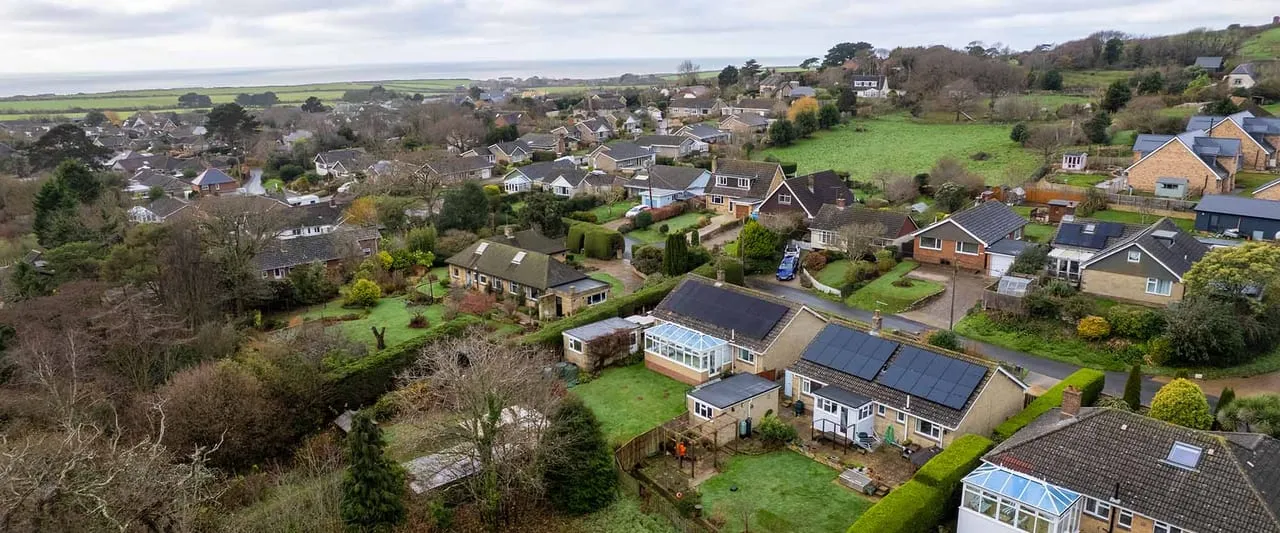
Solar panels are sold on a headline number: “£6,000 for a 4kW system” or “£13,000 for 10kW, fully installed.” Those figures are real, and with 0% VAT on residential solar and battery storage still in force in Great Britain until 31 March 2027, the quoted price is genuinely close to the final invoice for a straightforward roof. But “straightforward” is doing a lot of work in that sentence. Beneath the headline sit five or six cost categories that installers routinely leave off the first quote — not because they’re being dishonest, but because they only apply on some roofs, and nobody wants to frighten off a lead with a worst-case number.
This piece runs through the extras that catch people out: scaffolding, DNO approval, bird-proofing, inverter replacement, roof repairs, and insurance. None of these are exotic. Most systems hit at least one of them. Knowing which ones apply to your roof — and asking about them before you sign — is the difference between a quote that holds and a final bill that’s 15-20% higher than expected.
Why the “hidden” costs exist in the first place
Solar quoting in the UK is usually done from satellite imagery, an EPC record, and a phone call, with a site survey only happening once you’ve signed. That’s standard practice, not a red flag — but it means the quote you’re given before survey is a provisional price built on assumptions: your roof is in good condition, your consumer unit has spare capacity, your export capacity is available on request, and access is easy. Every one of those assumptions can be wrong, and each one maps to a specific extra cost below.
A good installer will flag likely extras during the initial call if you tell them your roof age, house type, and whether you’ve got a period or listed property. A quote that includes zero contingency for any of these, with no caveats, is one to read carefully — not necessarily to reject, but to ask direct questions about before you commit a deposit.
1. Scaffolding
Scaffolding is the most common “extra” and, oddly, the one installers are most likely to bury in a lump-sum “installation” line rather than breaking out separately. For a typical semi-detached house, scaffolding runs roughly £600-£1,500 depending on roof height, access, and how long it needs to stay up (some local authorities require party-wall notice or pavement licences if it encroaches on a public footway, which adds time and modest fees).
Where this bites: bungalows and single-storey extensions sometimes get away with tower scaffold or even ladder access at lower cost; three-storey Victorian terraces, steep roof pitches, or awkward rear access (no side passage for a scaffold lorry) push the price up, sometimes requiring specialist “birdcage” scaffold that can add several hundred pounds. Always ask whether the headline price includes scaffolding, and if it’s an allowance, whether it’s been priced against your actual roof height and access — not a generic assumption.
2. DNO approval and grid connection
Your Distributed Network Operator (DNO) — the regional electricity network company, not your supplier — has to approve any solar installation over a certain size before or shortly after connection. For most domestic systems under 3.68kW per phase this is a straightforward notification (G98), usually free and handled by your installer as part of the job. Larger domestic systems, anything with a big battery, or most commercial installations need prior approval (G99), which can take several weeks and occasionally requires network reinforcement work at your cost if the local substation is already heavily loaded.
This is a much bigger issue for commercial and larger installs than for the average home. If you’re a business fitting a sizeable rooftop array, get the DNO application submitted early — it’s a timeline risk as much as a cost risk, and in constrained grid areas (parts of the South East and South West in particular) reinforcement costs can run into five figures. Sites like commercialsolarpanelsinstallation.co.uk and solarpanelsforwarehouses.co.uk cover DNO timelines for larger roofs in more detail, and it’s worth reading before you fix a project completion date with a client or tenant.
3. Bird-proofing (mesh guards)
Pigeons and gulls love the warm, sheltered gap under a solar array, and once one nesting pair moves in, droppings, nesting material, and dead birds under the panels can void warranty terms with some manufacturers and definitely reduce output by blocking airflow and, in bad cases, panel cells. Bird mesh guards around the perimeter of the array cost roughly £4-£8 per linear metre fitted, so £150-£400 for a typical residential system — trivial in isolation, but rarely on the initial quote because it depends on whether birds are already active in the area.
If you’re in a semi-rural setting, near a coast, or you can already see pigeons roosting on your roofline, ask for mesh to be priced in from the outset. Retrofitting it later means paying for a second access visit (and sometimes a second small scaffold hire) on top of the mesh itself.
4. Roof repairs and reinforcement
This is the big one, and the one most likely to turn a £7,000 job into an £9,000-£10,000 one. Panels themselves are light — roughly 18-20kg each, spread across rails — but the roof underneath still needs to be structurally sound and the covering (slate, tile, felt) needs to have useful life left in it. A pre-installation survey should check for:
- Slipped, cracked, or spalling tiles/slates that need replacing before mounting brackets go in
- Roof timber condition, particularly on older properties or anywhere with historic damp
- Whether the existing felt/underlay is due for replacement anyway — because taking panels off in 8 years to re-felt a roof costs far more than doing it once, upfront
Reputable installers will flag this at survey stage rather than quote stage, and minor repairs (a handful of replacement tiles, re-pointing a ridge) might run £200-£500. Anything structural — rotten rafters, a roof that needs substantial reinforcement — can run into four figures and is a genuine reason to defer the installation until the roof work is done separately, ideally by a roofer, before panels go up. If your roof is over 20-25 years old, budget for at least a proper survey and assume some remedial work is likely. ECC Eco Energy and Premier Electrical Renewables both flag roof condition as a standard pre-install checklist item, which is the right approach — it should never be an afterthought.
5. Inverter replacement (the cost nobody budgets for at year 12)
This isn’t a hidden cost at installation — it’s a hidden cost in the lifetime cost-of-ownership sums that get left off most sales conversations. Modern panels are remarkably durable: N-type TOPCon and heterojunction (HJT) panels degrade at around 0.4% a year and are commonly warrantied for 25-30 years. String inverters are not built to the same timeline — expect 10-15 years of service life before replacement, at a cost of roughly £500-£1,000 for a typical domestic string inverter, more for hybrid inverters with integrated battery management.
If you’re comparing a 25-year payback calculation against a competing quote, check whether it has factored in one, possibly two, inverter swaps over that period. Leaving this out doesn’t affect the near-term return much, but it does mean the total lifetime cost is understated by up to £2,000 across a 25-year system life. Micro-inverters or optimiser-based systems shift this risk (failure is per-panel, not whole-system) but usually cost more upfront — worth discussing with your installer if long-term reliability matters more to you than the lowest headline price. Our solar payback period breakdown walks through how to build inverter replacement into a realistic 25-year return calculation rather than a rose-tinted one.
6. Insurance and warranty admin
Two separate things get conflated here, and both cost money:
Home insurance notification. Most UK insurers require you to notify them when you install solar panels, since it’s a permanent alteration to the building and adds replacement value. Some insurers charge a small additional premium (often £0-£30/year); a few will decline unless the installation was done by an MCS-certified installer, which is another reason MCS certification matters beyond just Smart Export Guarantee (SEG) eligibility. Skipping this step can void a claim later if a storm damages the roof and the array — not a cost today, but a real financial risk sitting unaddressed.
Installer warranty vs manufacturer warranty. Installer workmanship warranties (typically 2-10 years, sometimes insurance-backed) are separate from the panel manufacturer’s product/performance warranty (commonly 25-30 years on modern N-type panels) and the inverter manufacturer’s warranty (typically 5-12 years, sometimes extendable for a fee at purchase). If your installer goes out of business, an insurance-backed guarantee (a “warranty warranty,” in effect) protects you — an uninsured workmanship warranty from a small local firm does not survive that firm folding. It’s worth asking directly whether the workmanship warranty is insurance-backed, and factoring a modest cost (or opportunity cost) into your risk assessment if it isn’t.
Building a realistic total cost
Put together, on a typical domestic 4kW installation quoted at £6,000-£8,000, a sensible contingency for scaffolding, minor roof repairs, and bird mesh adds somewhere in the region of £800-£2,000 depending on your specific roof — call it 10-25% on top of the headline figure for a property with any of the risk factors above. For commercial rooftops, DNO reinforcement and structural surveys can be a much larger swing factor and should be scoped before a board or landlord signs off a budget; guidance for that scale of project is covered in more depth on solarpanelsforcommercialproperty.co.uk and solarpanelsforfactories.co.uk.
The practical fix is simple: insist on a physical roof survey before signing anything final, ask explicitly whether scaffolding, bird-proofing, and any known repairs are included in the quoted figure or itemised as allowances, and ask what inverter replacement is likely to cost across the system’s life. A quote that’s honest about these categories from the outset — even if the number is £1,000 higher than a rival’s — is usually the more trustworthy one. Installers who do this well include regional firms like Greenlinc Renewables in Lincolnshire and FLD Electrical in South Wales, both of whom scope roof condition and access as standard survey items rather than treating them as a discovery to be made mid-install.
The bottom line
None of the six items above make solar a bad investment — UK households and businesses installed a record 257,397 MCS-certified systems in 2025, and the underlying economics (0% VAT until March 2027, ~25p/kWh typical import prices, panels that last 25-30 years) remain sound. What changes is the comparison between quotes. A £6,500 quote with no scaffolding, no roof survey, and no mention of bird-proofing isn’t necessarily £1,500 cheaper than a £8,000 quote that includes all three — it may simply be an invoice waiting to grow. Ask the direct questions, get the roof surveyed before you commit, and price the whole job, not just the panels and inverter, before you compare two numbers side by side. For a full breakdown of what a compliant, all-in quote should look like, see our cost of solar panels in the UK guide and the accompanying solar panel calculator for working your own numbers before you get quotes in.