A 3-bedroom semi is the single most common property type asking for a solar quote in the UK right now, which is exactly why “how much will it cost me” deserves a straight answer rather than a marketing range. Below is what a typical 3-bed house actually needs, what it costs installed in 2026, and how long it takes to pay for itself.
Why 4kW is the benchmark for a 3-bed house
Most UK domestic solar quoting tools and installers default to a 4kW system for a 3-4 bedroom home, and there’s a reason it’s become the industry standard rather than an arbitrary number. A typical 3-bed household uses somewhere between 2,700 and 4,200 kWh of electricity a year (more if you’ve got an EV or a heat pump). A well-sited 4kW array in most of the UK will generate roughly 3,400 kWh a year — enough to meaningfully offset that usage without wildly overshooting the roof space available on a semi-detached or terraced house.
South-facing roofs in the sunny south of England (Hampshire, Kent, Cornwall) can push a 4kW system towards 4,000+ kWh/year, while a north Yorkshire or Scottish roof might sit closer to 3,000-3,200 kWh/year. That regional spread matters more than most quotes let on — it’s why an installer who actually surveys your roof pitch, orientation and shading beats a generic online calculator every time.
Panel count and roof space
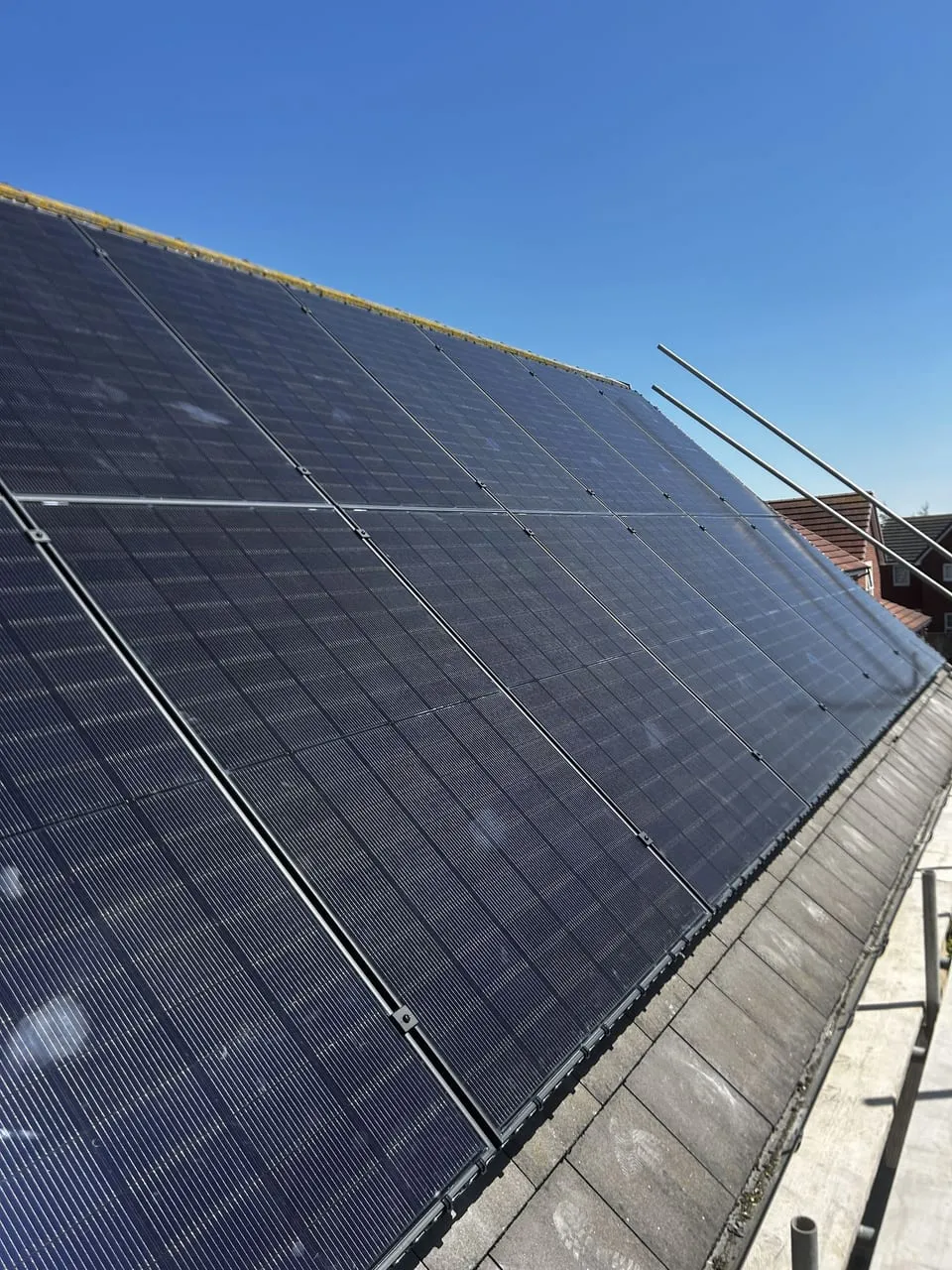
A 4kW system today typically means 9-10 panels, since most residential panels sold in 2026 are rated 400-440W. That’s roughly 16-20m² of roof space — comfortably inside the pitched roof area of a standard 3-bed semi, even accounting for a chimney stack, a Velux window or two, and the usual eaves/ridge setbacks an MCS installer has to leave.
If your roof is smaller, dormered, or partly shaded, you might land on a 3kW (7-8 panel) system instead; if you’ve got a bigger detached roof and higher usage (or you’re planning an EV or heat pump), some installers will push to 5-6kW using the same roof footprint but higher-wattage panels.
What it actually costs installed in 2026
For a straightforward 4kW system on a standard pitched, unshaded roof with easy scaffold access, expect a fully installed price of £6,000-£8,000. That figure includes panels, inverter, mounting/racking, scaffolding, electrical work, MCS certification and the DNO (electricity network) notification an installer handles on your behalf.
| System size | Typical installed cost 2026 | Approx. panel count | Best fit |
|---|---|---|---|
| 3kW | ~£5,000 | 7-8 panels | Smaller roof, lower usage, terraced house |
| 4kW | £6,000-£8,000 | 9-10 panels | Standard 3-bed semi/detached |
| 5-6kW | ~£8,000-£10,000 | 11-14 panels | Larger roof, EV owner, higher usage |
| 10kW | £13,000-£17,000 | 22-25 panels | Big detached, self-build, or prepping for a heat pump |
A few things move that £6,000-£8,000 range in either direction:
- Scaffold complexity. A simple two-storey pitched roof is cheap to access; a three-storey Victorian terrace, a steep pitch, or a roof needing tiled-to-slate transition scaffolding adds cost.
- Roof condition. If your roof needs re-felting or the tiles are old and brittle, that’s an extra job worth doing before panels go on, not after.
- Panel technology. Standard mono-PERC panels sit at the lower end of the range; premium N-type panels (TOPCon, HJT or back-contact/ABC cells) that degrade more slowly (around 0.4%/year, versus older panels’ ~0.5-0.8%) and often carry longer warranties cost somewhat more per kWp but pay back over the 25-30 year lifespan most manufacturers now guarantee.
- Inverter choice. A single string inverter is the cheapest option and typically lasts 10-15 years before a £500-£1,000 replacement; panel-level optimisers or microinverters cost more upfront but help if your roof has partial shading from a chimney or neighbouring tree.
- VAT. Crucially, residential solar and battery installations in Great Britain are at 0% VAT until 31 March 2027, after which the rate is scheduled to revert to 5%. That’s already reflected in installer quotes, but it’s worth locking in a quote before the deadline if you’re on the fence — waiting could add several hundred pounds to a typical job.
For the full national breakdown by system size, see our detailed cost of solar panels in the UK guide.
Should you add a battery?
A battery isn’t essential for a 4kW system to make financial sense, but it changes the economics substantially. Without one, you’ll typically self-consume 30-40% of what you generate (whatever you’re using in daylight hours) and export the rest via the Smart Export Guarantee. With a battery sized around 5kWh, self-consumption often rises to 60-80%, because you’re storing daytime generation to use in the evening instead of buying it back from the grid at ~25p/kWh.
Battery storage for a 3-bed house typically runs £4,000-£8,000 installed, depending on capacity and brand — working out to roughly £400-£700 per kWh of storage. A premium option like the Tesla Powerwall 3 (13.5kWh) sits higher, around £8,500-£10,500 installed, and is arguably oversized for most 3-bed households unless you’re also charging an EV or planning for a heat pump. For the full breakdown of battery pricing and sizing, our solar battery storage costs guide goes into more detail than we can here.
Payback: what the numbers actually look like
Here’s a realistic payback model for a 4kW system on a south-facing roof in the Midlands, generating around 3,400 kWh/year, with average self-consumption and no battery:
- Self-consumed electricity (avoiding ~25p/kWh import): roughly 1,200-1,400 kWh/year saved = £300-£350/year
- Exported electricity via the Smart Export Guarantee (rates vary by supplier, typically 12-20p/kWh for the better tariffs, not a fixed national rate): roughly 2,000-2,200 kWh/year = £250-£400/year depending on your supplier
- Total annual benefit: roughly £550-£750/year
Against a £7,000 installed cost, that’s a payback period of roughly 9-13 years — well within the panels’ 25-30 year working life, and the maths improves further if electricity prices rise, if you add a battery to lift self-consumption, or if you time high-usage habits (washing machine, dishwasher, EV charging) to daylight hours. Our solar panel payback period calculator guide walks through how to model your own roof and usage rather than relying on a generic average, and if you want to run actual numbers against your postcode and bill, the solar panel calculator is the quickest way to sanity-check a quote you’ve been given.
What about grants?
It’s worth being precise here because misinformation is rife. There is currently no universal grant for home solar in England — most homeowners buying solar for a standard 3-bed house are paying the full (0% VAT) cost themselves. The exceptions:
- ECO4 and the Warm Homes scheme offer support for low-income households in low-EPC-rated homes, but eligibility is means-tested and property-specific, not a general solar subsidy.
- Home Energy Scotland offers an interest-free loan (with a grant element in some cases) towards solar and battery costs for Scottish homeowners — genuinely useful if you’re north of the border.
- The Boiler Upgrade Scheme (£7,500) is often confused with a solar grant, but it only applies to air source or ground source heat pumps — it does not cover solar PV installation at all.
If you’re a farm or rural business rather than a household, England’s Improving Farm Productivity grant (roughly 25% of eligible costs, rates vary by UK nation) is the relevant scheme — not the old FETF figures still floating around some quote sites.
Finding the right installer
Get at least two or three MCS-certified quotes and ask each installer to survey your actual roof rather than relying on a satellite estimate — pitch, orientation, and shading from next door’s tree all move the output number meaningfully. MCS certification isn’t optional if you want Smart Export Guarantee eligibility, so check it before you sign anything.
If you’re in South Yorkshire, ElectriFusion Solutions in Doncaster and AMP Pro Electrical both quote residential 3-4kW systems regularly and can walk you through a site-specific survey rather than a desktop estimate. Homeowners in the Home Counties or Hertfordshire area might find Sola-UK a useful local comparison point, while anyone in West Kent weighing up solar alongside other electrical work could speak to Hazell Electrical, who handle both. In Scotland, Ecoaim near Livingston is a solid regional option given the Home Energy Scotland loan applies north of the border.
If your usage is closer to a small business than a household — an annexe, a home office with heavy equipment, or a semi-commercial unit — it’s worth a look at Solar Panels For Commercial Property or Commercial Solar Finance to understand how the economics shift once you’re outside pure domestic scale, since VAT treatment, grant eligibility and payback maths all change once a property is classified commercially rather than residential. And if maintenance and ongoing performance monitoring is more on your mind than the install itself, Solar Maintenance Solutions covers national O&M for existing systems.
The bottom line
For most 3-bed UK homes, a 4kW system installed for £6,000-£8,000 (at 0% VAT while it lasts) generating around 3,400 kWh/year is the sensible default — not because it’s the biggest system you could fit, but because it matches typical household usage without overspending on capacity you won’t use. Payback lands around 9-13 years without a battery, faster if you can shift usage into daylight hours or add storage. Get a proper on-site survey rather than a desktop quote, check MCS certification, and get your installation booked before the VAT rate changes at the end of March 2027 if you want to lock in the current price.