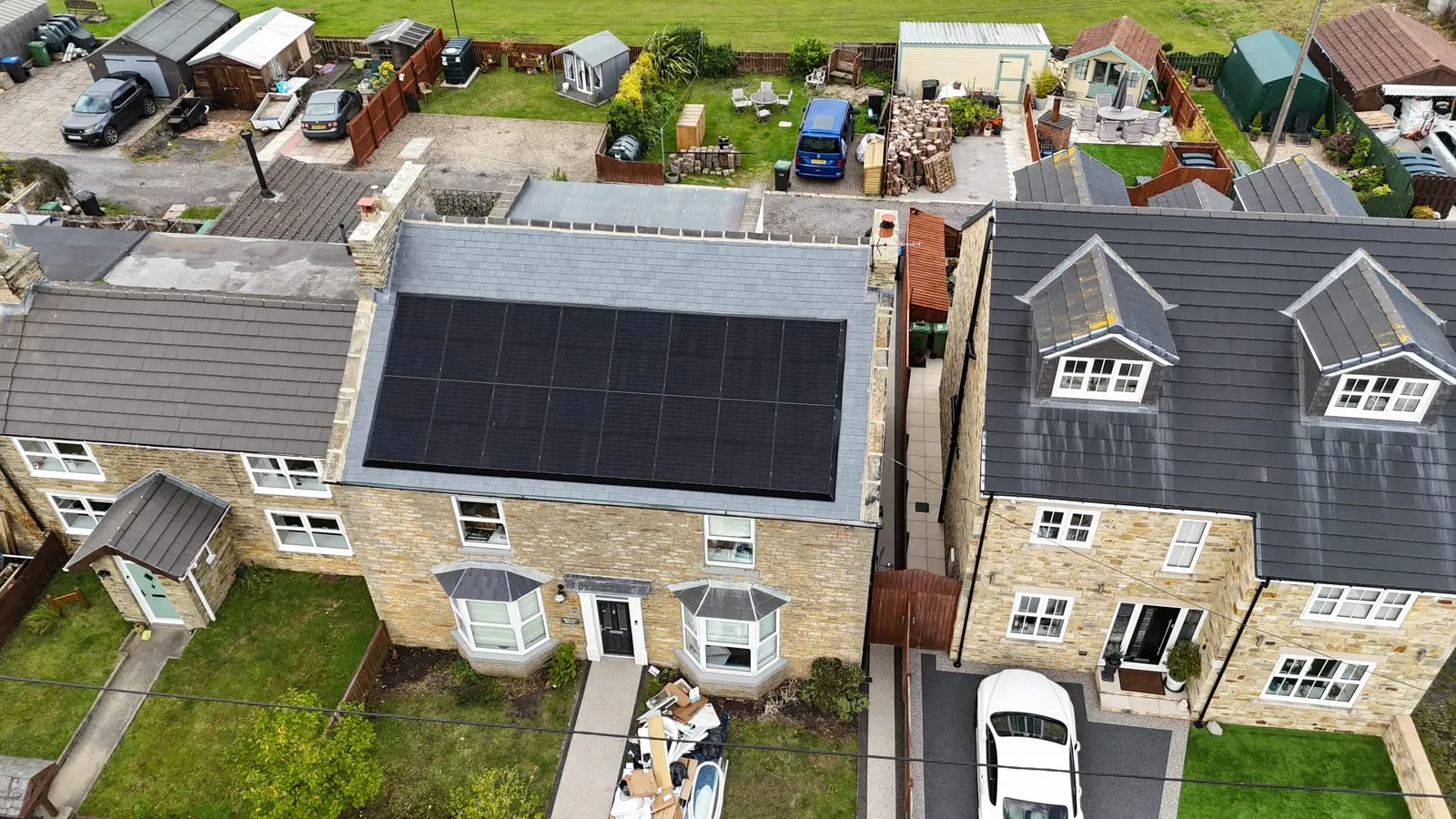
If you own a listed building, “can I fit solar panels” is really three separate questions: is it legal, is it sympathetic to the fabric, and does the sum still work once you’ve paid for consent and a heritage-grade installation. All three have workable answers in 2026 — but they change the maths compared with a standard retrofit, and this post sets out realistic numbers rather than the usual “just ask your council” hand-waving.
Why listed buildings are a different category, not just a harder version
A Grade I, II* or Grade II listed building has statutory protection that extends beyond the walls to features that “contribute to its special interest” — which can include roof pitches, chimney lines, sightlines from a conservation area, and sometimes rooflines visible from a churchyard or public footpath a quarter-mile away. Permitted development rights (which let most homeowners fit solar without planning permission at all) do not apply automatically. In practice you’re looking at needing Listed Building Consent (LBC), and depending on the local authority, sometimes planning permission alongside it if the property sits in a conservation area or National Park.
This is separate from VAT and grants, which behave normally: the 0% VAT rate on installed residential solar and battery storage in Great Britain (in place until 31 March 2027, after which it’s scheduled to revert to 5%) applies to a listed building exactly as it does to any other home. There’s no extra listed-building surcharge from HMRC — the extra cost sits entirely in consent, design and installation method.
Listed Building Consent: what it actually costs and how long it takes
LBC applications for solar are usually free to submit in England (the fee is typically waived for LBC-only applications, unlike a standard planning fee), but “free application” is not the same as “free process.” The real costs are:
- Heritage statement / Design and Access Statement: £400–£1,500 depending on complexity. Most conservation officers won’t process a solar LBC application without one — it needs to explain visual impact, materials, and why the proposed position minimises harm to the building’s special interest.
- Architect or heritage consultant fees: £600–£2,000 if you need scaled drawings, sightline studies, or photomontages showing the panels from the street/footpath.
- Structural survey: £300–£800, more likely to be required on older roof structures (timber trusses, stone slate, thatch) than on a standard tiled roof.
- Pre-application advice: many councils charge £100–£300 for an informal chat with the conservation officer before you submit — worth it, because it tells you whether a scheme is likely to be refused before you’ve paid for a full heritage statement.
- Determination time: statutory target is 8 weeks (13 for major applications), but conservation cases routinely run longer if the officer asks for revisions. Budget 3–6 months from pre-app to decision, and don’t sign an installer contract with a hard start date until consent is granted — installers we speak with report this is the single most common source of listed-building project delays.
Refusal risk is real and asymmetric: an unlisted extension roof and a Grade II farmhouse roof are not assessed by the same yardstick. A scheme on a rear elevation invisible from any public vantage point has a good chance; the same panels on a street-facing pitch of a town-centre listed terrace often don’t.
The conservation-slate and in-roof premium
Even once consent is likely, most conservation officers will steer you away from standard black-framed panels bolted on top of the existing roof covering (the typical “in-roof mounted on rails over slate” approach used on 90%+ of UK homes). Instead you’re usually looking at one of three routes, in roughly ascending cost order:
- Conservation/low-profile in-roof systems — panels sit flush with the roofline rather than proud of it, sometimes with matt or textured black glass and a slimmer frame to reduce glare and shadow lines. Expect a premium of roughly 15–30% over a standard in-roof kit.
- Solar tiles/slates — individual PV tiles or slates designed to interlock with (or closely mimic) natural slate, so the roof reads as slate from ground level. These cost considerably more per kWp than panel-based systems — commonly double a standard installed rate — and yields per tile are lower than a full-size panel, so you need more roof area for the same output.
- Rear/hidden elevation standard panels — if there’s a rear pitch, outbuilding, or detached garage roof invisible from any protected viewpoint, a conservation officer may accept a completely standard panel system there, with no premium at all. This is usually the cheapest route to “yes” if the roof geometry allows it.
Putting rough figures on a typical 4kW listed-building retrofit: where a standard installation might run £6,000–£8,000, factor in a heritage statement and consultant fees (£1,000–£2,500), a structural check if needed (£300–£800), and a conservation-grade or tile-based system (add 20–100%+ on the panel/install cost depending on route). All-in, a 4kW consented listed-building install commonly lands somewhere between £9,000 and £16,000+ — wider if solar tiles are mandated. Batteries, inverters and scaffolding cost the same regardless of listed status; a well-specified home battery still runs roughly £4,000–£8,000 installed, and that part of the quote shouldn’t move just because the roof is listed.
When it’s viable — and when it plainly isn’t
Viability tends to split along a few practical lines:
- South, east or west-facing rear roofs with no public sightline are the strongest candidates — you can often get a standard or near-standard system approved, keeping costs close to normal retrofit levels.
- Detached outbuildings, garages, or later (non-original, non-listed-curtilage) extensions on the same property are frequently the pragmatic answer — panels go on a structure that isn’t itself listed, sidestepping LBC for the array entirely (though check whether the outbuilding sits within the listed curtilage, which can still trigger consent).
- Ground-mounted arrays in a garden or paddock avoid the roof question altogether and are usually assessed under normal planning rules rather than LBC, provided they’re not prominent within the setting of the listed building.
- Street-facing principal elevations on Grade I or Grade II buildings* are the hardest sell — some conservation officers will simply not support panels here regardless of design, and pushing a scheme through appeal rarely makes financial sense on a domestic project.
- Churches and other listed places of worship sit in their own category, usually needing ecclesiastical exemption processes (faculty jurisdiction for C of E buildings) rather than standard LBC, with a different consultation body and timeline. If you’re advising on or researching a church roof rather than a private house, solarpanelsforchurches.co.uk covers the faculty/diocesan process in more depth than we can here, and it’s worth reading before a parochial church council commissions any survey.
Where a scheme is refused or clearly won’t get consent, the honest answer for a homeowner is often to look at other decarbonisation routes on the property (Boiler Upgrade Scheme funding of £7,500 covers an air source heat pump — it does not fund solar PV — plus fabric improvements like loft and wall insulation, which rarely trigger LBC at all) rather than fighting a heritage refusal.
What actually moves the numbers in your favour
A few things consistently improve either the consent odds or the payback:
- Get pre-application advice before commissioning full drawings. It’s the cheapest filter you have.
- Photograph and map every viewpoint a conservation officer might consider — public roads, footpaths, neighbouring gardens with a view in. Rule these out or minimise them in your design before submitting.
- Ask installers for conservation-project experience specifically, not just general MCS accreditation (MCS certification is still required for Smart Export Guarantee eligibility regardless of listed status, and export rates still vary by supplier — typically up to somewhere in the 12–20p/kWh range at the better end, not a fixed national figure). A firm that’s done listed roofs before will already know which conservation officers in your area favour which mounting systems.
- Model the yield conservatively. A shaded or partially obstructed listed roof, or a system forced onto a less-optimal rear elevation to satisfy planning, may sit below the typical UK range of roughly 850–1,050+ kWh per kWp per year — run the actual numbers for your pitch and orientation before committing, using a tool like the solar panel calculator to sanity-check the installer’s own yield estimate.
- Don’t assume grants apply. England has no universal home solar grant; support is largely means-tested (ECO4, Warm Homes) for low-income, low-EPC households, and a listed building doesn’t unlock anything extra. Scottish homeowners can access Home Energy Scotland’s interest-free loan, which is nation-wide rather than listed-status-specific.
If you want a wider read on how solar economics and payback periods work before adding the listed-building variables on top, our own payback period breakdown and cost of solar panels UK pages are a reasonable baseline to adjust from. For a consumer-friendly primer on how panels actually perform in UK weather once installed, do solar panels work in the UK is a useful companion read.
Finding the right installer for a heritage project
Not every MCS installer wants a listed-building job — the extra design time and consent uncertainty put some off entirely, which is one reason conservation-experienced firms can charge a premium and still be busy. If you’re in South Wales, fldelectrical.co.uk covers period and listed property retrofits alongside standard domestic solar in the Swansea area, and in Lincolnshire, greenlincrenewables.co.uk is MCS-certified and has handled rural and heritage roof stock across the county. For West Kent conservation areas specifically, hazellelectrical.co.uk has local knowledge of the borough’s listed-building process that’s genuinely useful when you’re choosing a mounting system.
Worth noting too: a listed farmhouse with adjoining agricultural buildings sometimes finds the barn or outbuilding roof is the more sensible install target rather than the main house — if that’s your situation, it’s worth reading how agricultural solar consent and structural assessment differs on solarpanelsforfarms.uk or the barn-specific guidance at solarpanelsforbarns.co.uk, since outbuildings often carry fewer restrictions than the listed dwelling itself.
The bottom line
Listed building solar is neither impossible nor a special case that ignores the normal rules of solar economics — it’s a standard installation with an extra layer of design, consultation and, usually, a materials premium bolted on the front. Budget realistically for a heritage statement, expect the timeline to run to several months rather than weeks, target rear or hidden roof pitches where possible, and get pre-application advice before you spend money on drawings. Done that way, the 0% VAT relief and a well-designed system still make the underlying economics work — you’re just paying for the privilege of doing it properly on a building that’s protected for good reason.