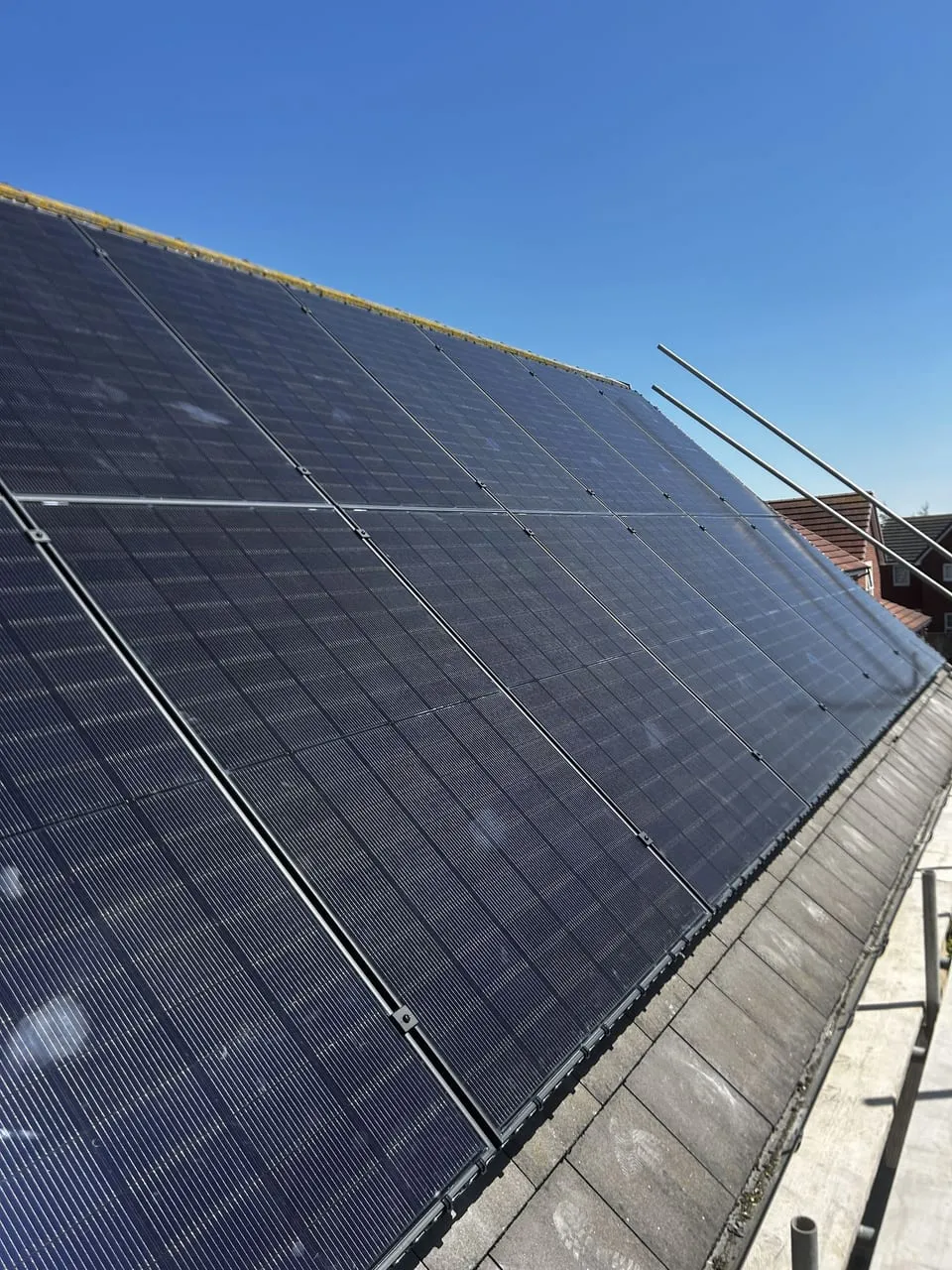
Ask three installers for a quote and you’ll sometimes hear a price “per square metre” before you hear a price per panel or per kilowatt. It sounds like a sensible way to compare a conservatory roof against a bungalow against a barn — but solar isn’t sold by the square metre, and pricing it that way hides more than it reveals. This guide converts roof area into the numbers that actually determine your quote: kWp (kilowatt-peak), panel count, and total installed cost — so you can see through a per-m² figure rather than be sold by one.
Why “per square metre” is the wrong unit in the first place
Solar panels are priced and specified by capacity (kWp), not by area. A kWp is a measure of how much electricity the panel can generate at standard test conditions — it’s the figure on your MCS certificate, the figure Ofgem and your DNO (distribution network operator) care about, and the figure that determines your Smart Export Guarantee payments. Roof area is just an input to that calculation, not the output.
Two roofs of identical size can carry very different systems depending on:
- Panel efficiency — a modern 440W panel and an older 330W panel can be the same physical size (roughly 1.7-1.9m²), so the same roof area yields a very different kWp depending on what’s fitted.
- Roof shape and obstructions — chimneys, roof windows, and hip ends eat into usable area without reducing the roof’s total m².
- Orientation and pitch — a south-facing roof at 30-40° pitch gets meaningfully more usable panels per m² of productive space than a shaded or steeply-angled one, even if total area is identical.
- String and inverter design — sometimes it makes more sense to under-fill a roof and add a second string later than to cram in every last panel.
This is exactly why reputable installers quote per panel and per kWp, and treat “£X per m²” as, at best, a rough back-of-envelope figure for early conversations. If you want the fuller reasoning on why panel count and system size are the real drivers of your quote, The Cost of Solar’s guide to UK solar panel costs breaks down the full price build from panels through to inverter and labour.
The m² → kWp → £ conversion, step by step
Here’s the chain that actually matters, using typical 2026 figures for monocrystalline panels in the 425-440W range (a good proxy for what most UK residential installers are now fitting as standard):
| Step | What it tells you | Typical 2026 figure |
|---|---|---|
| 1. Panel physical size | Area per panel | ~1.9m² per panel (residential 425-440W) |
| 2. Panel output | Capacity per panel | 0.425-0.44 kWp per panel |
| 3. Panels per kWp | How many panels for 1kWp | ~2.3 panels per kWp |
| 4. Roof area per kWp | Usable roof space needed | ~4.3-4.5m² per kWp |
| 5. Annual yield per kWp | Electricity generated per year | ~850 kWh/kWp (up to ~1,050+ kWh/kWp in the sunny south) |
So, roughly speaking: every 4.3-4.5m² of usable, unshaded, well-oriented roof carries about 1kWp of solar capacity, and every 1kWp of capacity generates somewhere between 850 and 1,050+ kWh a year depending on where in the UK you are and how the array is oriented. A south-facing roof in Cornwall or Kent will sit at the top of that range; a north Scotland roof with some shading will sit nearer the bottom.
Turning that into a roof-size-to-system-size table
| Usable roof area | Approx. system size | Approx. annual yield (850-1,050 kWh/kWp) | Typical installed cost, 2026* |
|---|---|---|---|
| 13-14m² | 3kWp | 2,550-3,150 kWh | ~£5,000 |
| 17-18m² | 4kWp | 3,400-4,200 kWh | £6,000-£8,000 |
| 26-27m² | 6kWp | 5,100-6,300 kWh | ~£8,500-£10,500 |
| 43-45m² | 10kWp | 8,500-10,500 kWh | £13,000-£17,000 |
*Residential installed prices including panels, inverter, mounting and labour, before any battery storage. Costs vary by installer, roof access/scaffolding, and inverter choice — always get a written, itemised quote. VAT on residential solar and battery storage is 0% in Great Britain until 31 March 2027, after which it’s scheduled to revert to 5%, so time-sensitive buyers should factor that into planning.
If you divide any of those installed costs by the roof area, you get a “per m²” figure somewhere in the £350-£470/m² range for domestic jobs — but notice how little that number actually tells you. A 4kWp system at £7,000 across 17.5m² is roughly £400/m². A 10kWp system at £15,000 across 44m² is roughly £340/m². The larger system is cheaper per square metre purely because fixed costs (scaffolding, inverter, labour mobilisation, electrical connection) are spread across more panels — nothing to do with the panels themselves being better value. This is the trap: a per-m² price makes bigger systems look artificially better and can mask an installer padding the small-job margin.
For commercial and industrial roofs the units shift again — quotes are usually expressed per kWp (roughly £900-£1,200/kWp installed for commercial-scale arrays in 2026), because flat industrial roofs, ballasted mounting, and higher-capacity inverters change the area-to-capacity ratio compared with a pitched residential roof. If you’re assessing a warehouse, factory or distribution shed, Solar Panels For Warehouses and Solar Panels For Industrial Units both cover how flat-roof layout, spacing for anti-glare/fire access, and ballast weight change the effective capacity you can fit per square metre of roof — often 30-40% less densely than a pitched domestic roof, because of mandatory walkways and row spacing to avoid inter-row shading.
Why per-panel (or per-kWp) quoting is more honest
A proper quote should let you check three things independently:
- Panel count and wattage — so you can verify the stated kWp yourself (panels × watts ÷ 1,000).
- Inverter spec — a string inverter typically lasts 10-15 years and costs £500-£1,000 to replace; an undersized inverter clipped against an oversized array is a common corner-cutting tactic that a per-m² price can hide entirely.
- Degradation and warranty — modern N-type panels (TOPCon, HJT, or back-contact/ABC cells) degrade at roughly 0.4% per year and are commonly warrantied for 25-30 years. That’s the number that determines your lifetime generation, not the size of the roof.
None of that is visible in a single £/m² figure. It’s a useful sanity check for a first conversation (“is £8,000 for 18m² in the right ballpark?”) but it should never be the basis on which you accept a quote. Ask for panel make, model, wattage, inverter make/model, and total kWp in writing, then work out your own £/kWp and £/panel from that — it’s the only way to compare two installers’ quotes on genuinely equal terms.
It’s also worth checking the installer is MCS-certified — this is required if you want to claim Smart Export Guarantee payments for the electricity you export, and it’s a reasonable proxy for basic installation competence and warranty backing. 2025 was a record year for MCS-certified installs across the UK — 257,397 installations, up 32% on the year before, taking cumulative UK solar capacity to roughly 21.6 GW and around 6.4% of the UK’s electricity.
Battery storage and the per-m² question
Batteries complicate the per-m² comparison further, because they don’t need roof space at all — most sit in a garage, utility room, or on an external wall. A domestic battery in 2026 typically runs £4,000-£8,000 installed (roughly £400-£700 per kWh of storage), with a Tesla Powerwall 3 (13.5kWh) landing around £8,500-£10,500 installed. None of that cost has any relationship to roof area, which is another reason a blended “per m²” figure for a solar-plus-battery system is close to meaningless — you’re combining a roof-area-linked cost with a completely area-independent one. For a full breakdown of how storage pricing works and what capacity actually suits your household usage, see The Cost of Solar’s battery storage cost guide.
Getting quotes based on the right numbers
Once you know roughly what capacity your roof can carry, the sensible next step is a site survey — roof pitch, orientation, shading from trees or neighbouring buildings, and structural condition all affect the real usable area, and no desk-based calculation replaces an installer physically checking your roof. Regional installers who carry out their own surveys and MCS-certified installations include ecoaim covering Central Scotland, FLD Electrical in Swansea and South Wales, Greenlinc Renewables across Lincolnshire, and ElectriFusion Solutions in Doncaster and South Yorkshire — each will give you a panel-count and kWp-based quote rather than a headline £/m² figure, which is what you should be pushing every installer towards regardless of who you use.
For businesses assessing a larger flat or pitched commercial roof, the area-to-capacity ratio is different enough from a house that it’s worth reading a sector-specific guide before you get quotes — Commercial Solar Panels Installation is a good general starting hub, while sector guides like Solar Panels For Farms or Solar Panels For Care Homes cover the specific roof types, grant eligibility, and layout constraints for those building types. Farms in England should note that the relevant grant is the Improving Farm Productivity scheme at around 25% of eligible cost, not the older FETF figure sometimes quoted online — rates differ across the UK’s nations, so check current eligibility before assuming a percentage.
The practical takeaway
Treat a £/m² figure as a rough opening estimate and nothing more. The numbers that should end up on your written quote are panel count, panel wattage, total kWp, inverter spec, and estimated annual yield in kWh — from those you can derive your own cost-per-kWp and sanity-check every installer against the same yardstick. A roof that carries 4kWp across roughly 17-18m² should cost somewhere in the £6,000-£8,000 range installed in 2026; if a quote is wildly outside that band, ask why, in writing, before you sign anything.