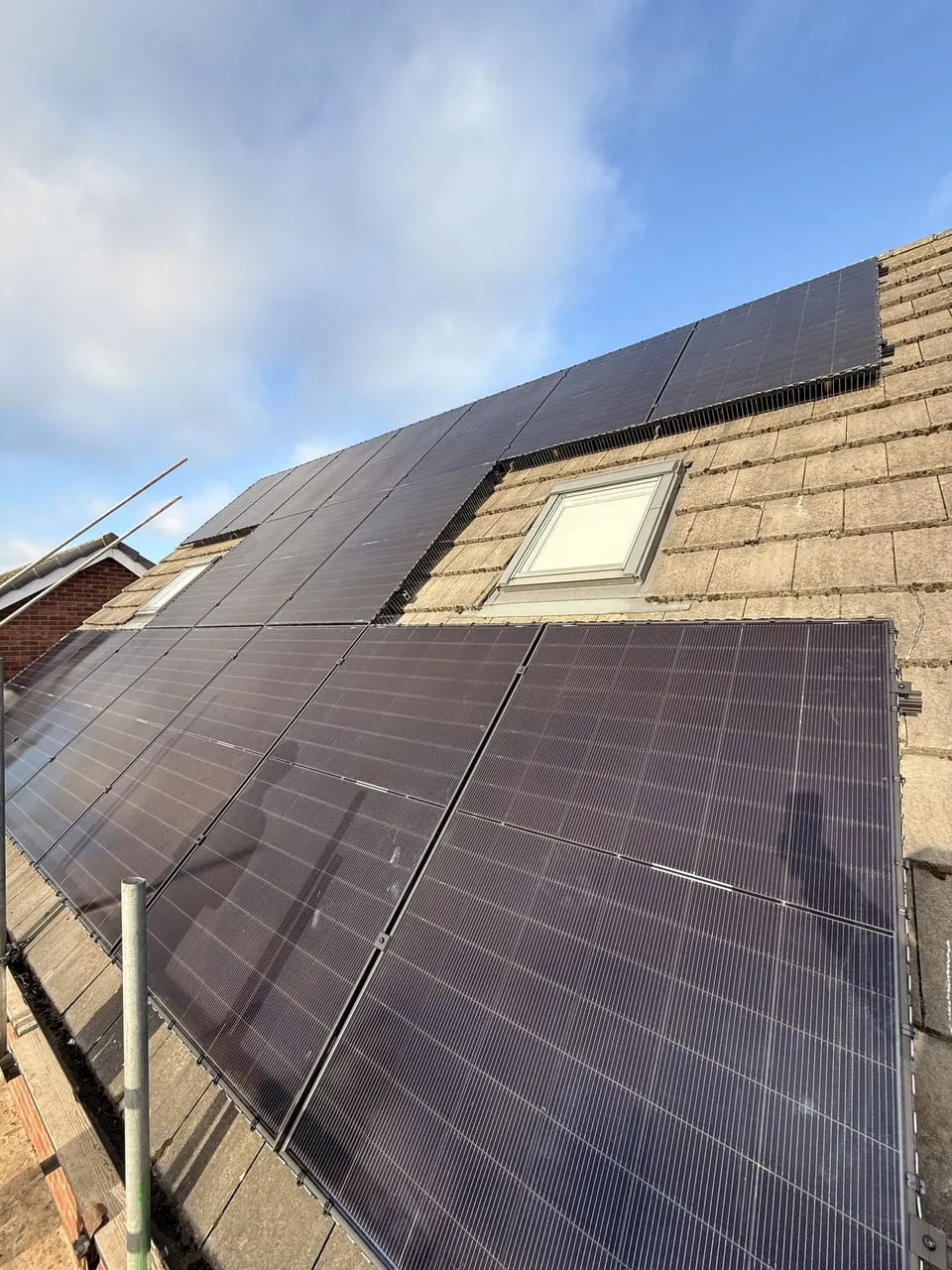
A professional solar panel clean in the UK typically costs £100-£200 for a standard domestic array, and depending on who you ask, that’s either sensible housekeeping or money down the drain. The honest answer sits between the two sales pitches you’ll find online — the cleaning firm telling you dirty panels are “haemorrhaging” your savings, and the installer forums telling you not to bother at all. Neither is quite right. Here’s the actual maths, so you can decide for yourself.
What a clean actually costs
Prices vary by region, roof access and system size, but the ranges are fairly consistent across the country:
| System size | Typical clean cost |
|---|---|
| Small domestic (3-4kW, ~10-12 panels) | £80-£130 |
| Standard domestic (5-6kW, ~14-18 panels) | £100-£180 |
| Large domestic / difficult access (steep roof, scaffolding needed) | £180-£300 |
| Small commercial rooftop | £250-£600+ |
| Large commercial / industrial roof | Quoted per job, often £1-£3 per panel at scale |
Most residential cleans use a water-fed pole system with purified water and a soft brush — the same kit window cleaners use for upper storeys — so no one needs to walk on the roof or the panels. That keeps costs down and, just as importantly, keeps the manufacturer’s warranty intact, since walking on panels or using anything abrasive can void it.
Some firms bundle an inspection into the price: a visual check for cracked cells, loose mounting, damaged cabling or signs of pest intrusion under the array. That’s worth having, because it’s arguably more valuable than the clean itself — more on that below.
The 1-3% gain — and why that’s the honest number
This is where most sales copy quietly inflates the case. The realistic, evidence-backed range for how much a clean recovers on a typical UK residential roof is 1-3% of annual output in most cases. Some cleaning companies advertise “up to 25% more power” or similar — that figure comes from extreme scenarios (heavy dust in arid climates, near-total organic buildup, or panels untouched for a decade) and isn’t representative of a UK roof rinsed regularly by rain.
The UK’s climate does a lot of the cleaning for you. Rain washes off general dust and airborne grime on most arrays, particularly ones tilted at a reasonable pitch (25-40°) where water sheets off rather than pooling. Independent field studies and installer monitoring data broadly agree that light-to-moderate soiling on a rained-on UK roof costs low single-digit percentages of output, not the double-digit figures used to sell contracts.
Run the numbers on a typical 4kW system generating roughly 850 kWh per kWp per year (a reasonable UK-wide average, higher in the sunny south, lower in parts of Scotland and the North) — that’s around 3,400 kWh annually. A 2% output loss from light soiling is about 68 kWh a year. At a typical import price of roughly 25p/kWh, avoided-import savings alone are worth about £17 a year, plus a small uplift in export income if you’re on a Smart Export Guarantee tariff (rates vary by supplier, broadly 12-20p/kWh at the better end). Even generously assuming 3% and a slightly larger system, you’re looking at £20-£35 a year in recovered value from a routine clean.
Against a £100-£200 bill, a once-off clean at that recovery rate doesn’t pay for itself within the year, and if you’re paying that every year, you’re very likely spending more than you get back. That’s the uncomfortable truth most cleaning-company websites don’t lead with.
So when does it actually make sense?
The honest case for professional cleaning isn’t “keep it spotless” — it’s specific scenarios where soiling genuinely departs from the UK norm.
A shallow roof pitch. Anything under about 10-15° won’t self-clean in the rain the way a steeply pitched roof does. Water sits, dust and grime accumulate, and you can get a visible haze or crust building up over a season or two — common on flat commercial roofs and some modern extensions with low-pitch arrays. This is genuinely one of the strongest cases for paying for a clean, and it recurs, so it’s worth budgeting for annually if your roof geometry is flat or near-flat.
Bird activity. Droppings are the single biggest offender for real output loss, because they don’t wash off like dust — they bake onto the glass and can create a localised “hot spot” that shades individual cells, which in some inverter and panel configurations can drag down the output of an entire string, not just the fouled cell. If you’ve got roosting gulls, pigeons, or a tree overhanging the array, this is worth checking every few months rather than waiting for an annual service, and it’s the scenario where a clean can plausibly deliver more than the 1-3% average.
Anything sticky. Sap from an overhanging tree, industrial residue near a factory or main road, or salt spray in coastal locations all behave differently to ordinary dust — they don’t rinse off and they attract further grime on top. If your roof sits under trees or near heavy traffic, inspect it visually a couple of times a year.
Long-term neglect. If a system hasn’t been checked in 5+ years, a clean-and-inspect combined visit is sensible housekeeping regardless of the output maths, because you’re also getting eyes on cracked cells, corroded connectors and loose mounting hardware that a homeowner can’t safely check themselves.
Commercial and industrial roofs change this calculation because the absolute kWh at stake is much larger. A 50kW+ commercial array losing even 2-3% to soiling represents meaningfully more lost generation in cash terms than a domestic roof, and many commercial roofs are low-pitch by design, which compounds the soiling problem. For sites like these, a scheduled maintenance contract that bundles cleaning with electrical and structural checks tends to make more commercial sense than a one-off wash. Firms operating in this space, like Solar Maintenance Solutions, specialise specifically in solar and battery upkeep rather than treating cleaning as a bolt-on to a general window-cleaning round — worth knowing if you’re managing a commercial array where downtime and degraded output actually show up on a P&L.
What you can do yourself, free
Before booking anyone, it’s worth doing a basic visual check from ground level (with binoculars if needed) rather than climbing up — walking on panels risks both your safety and your warranty. Look for obvious bird mess, leaf litter caught at the frame edges, or a visible dust haze after a dry spell. If your roof is steeply pitched and gets regular rain, and you can’t see anything obviously fouling the panels, you likely don’t need to spend anything at all.
If you do want to check for yourself whether soiling is actually costing you anything measurable, compare your generation figures (via your inverter’s app or in-home display) against expected output for the time of year — most decent monitoring systems will flag an unusual dip. That’s a far better trigger for booking a clean than a calendar reminder or a cold call from a cleaning firm.
Reading the maths against your own system
The 1-3% figure is a generalisation, and your own numbers depend on pitch, orientation, local weather, and what’s actually landing on the glass. If you want to work through your specific system’s output and payback assumptions properly rather than relying on rules of thumb, The Cost of Solar’s payback period guide walks through the maths, and our solar panel calculator will give you a size-specific output estimate to compare against your actual generation data. If cleaning costs are part of a wider question about whether the ongoing running costs of solar stack up, our battery storage cost breakdown covers the other big recurring-cost conversation people have about solar systems.
It’s also worth remembering that panel cleaning sits at the low-stakes end of solar maintenance. The bigger-ticket items — inverter replacement at 10-15 years (typically £500-£1,000), or checking mounting and cabling after storms — matter far more to a system’s 25-30 year lifespan than whether the glass is spotless. Do solar panels work in the UK’s often-grey climate? covers the wider output-in-real-weather picture if cleaning was your way into a bigger question about whether the whole thing is worth it, and our sister site has a dedicated look at solar panel maintenance in the UK that goes beyond cleaning into the full upkeep picture.
Getting a clean done properly
If you decide a clean is worth it — shallow pitch, bird problem, or just long overdue — get it done by someone who understands PV systems specifically, not a generic window cleaner who’s added “solar” to their price list. You want confirmation they’re using a soft-bristle, water-fed pole system (no pressure washers, no abrasive pads, no walking on the panels), and ideally someone who’ll flag anything electrical or structural they spot while they’re up there, since that’s arguably worth more than the clean itself.
Several of the installers in our network offer maintenance visits alongside new installations rather than treating servicing as an afterthought. In the South Yorkshire area, ElectriFusion Solutions covers both installation and ongoing electrical work; in the South West, CCS Heating & Renewables handles solar alongside renewable heating maintenance in Cornwall; and in the South East, Sola serves Hertfordshire and the Home Counties for both new installs and system checks. If your array is on a commercial roof rather than a house, it’s worth going to a specialist maintenance operator rather than a domestic cleaner — see the note on Solar Maintenance Solutions above, or if you’re weighing up a new commercial installation where long-term upkeep costs should factor into the business case from day one, Commercial Solar Panels Installation and Solar Panels for Warehouses both cover what ongoing costs — cleaning included — look like for larger commercial arrays.
The bottom line
For most UK homes with a reasonably pitched, rained-on roof, a professional clean at £100-£200 a year isn’t obviously worth it on the output maths alone — you’re likely recovering £20-£40 in avoided import and export income against a bill several times that size. It becomes worth paying for when your situation isn’t “most UK homes”: a shallow or flat roof that doesn’t self-clean, a genuine bird problem, sap or industrial residue, or a system that hasn’t had an inspection in years and could do with someone qualified taking a look while they’re up there anyway. Check visually first, trust your generation data over a salesperson’s percentage claim, and treat cleaning as occasional targeted maintenance rather than a subscription you renew on autopilot.