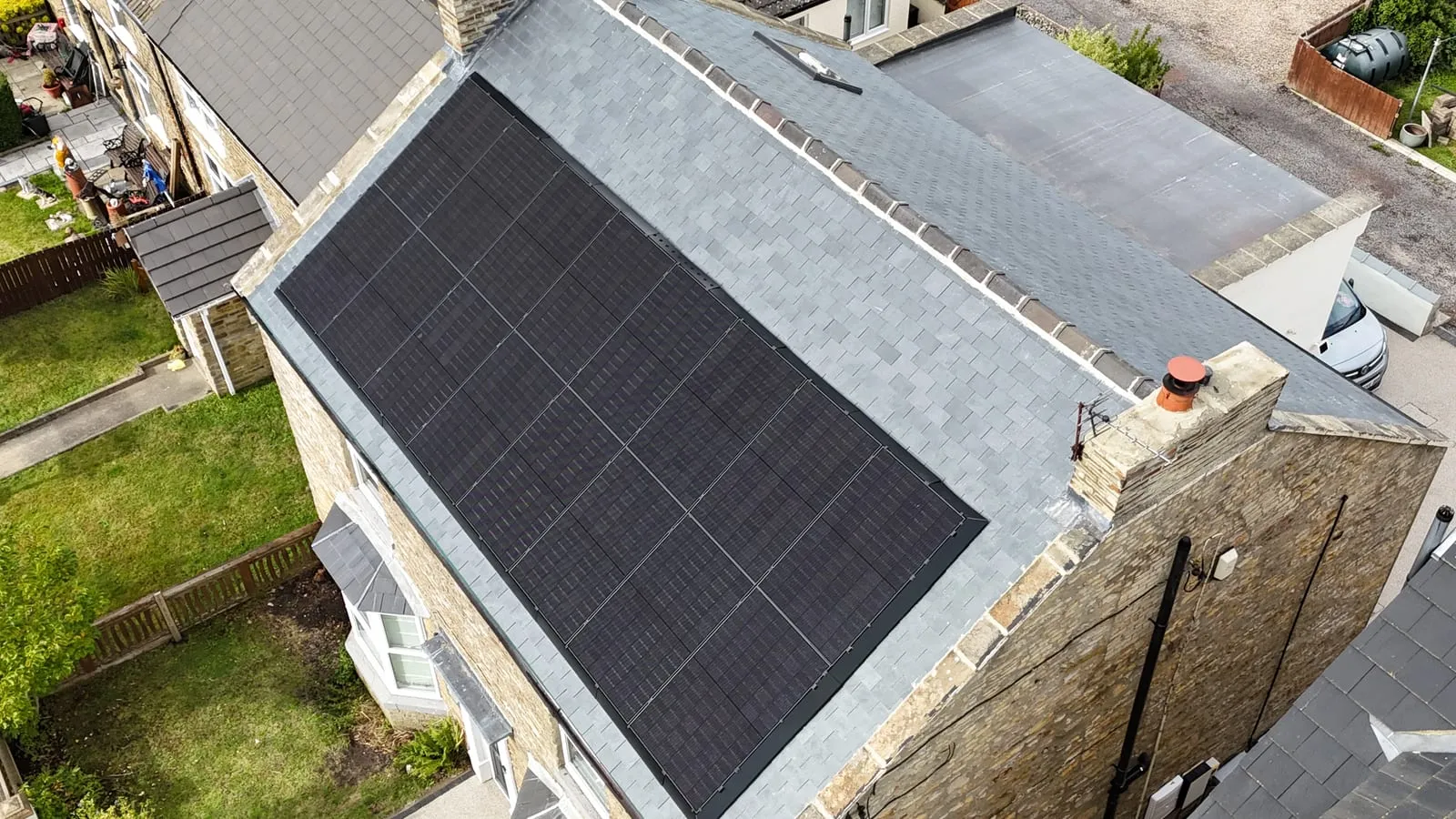
Ask most homeowners what a solar panel installation costs and they’ll quote a single number — “about seven grand for a 4kW system.” That figure is roughly right, but it hides the far more useful question: where does that money actually go? Understanding the cost waterfall — panels, inverter, mounting, scaffolding, labour, certification — tells you which line items are genuinely fixed by physics and safety law, and which ones move depending on who you hire and how your roof is shaped. That distinction is what separates a fair quote from an inflated one.
The headline number, and what sits inside it
For a typical UK domestic installation in 2026, all-in installed pricing (materials + labour + VAT) runs roughly:
| System size | Typical installed cost | Notes |
|---|---|---|
| 3kW | ~£5,000 | Small roof, limited household use |
| 4kW | £6,000–£8,000 | Most common domestic size |
| 10kW | £13,000–£17,000 | Larger homes / high daytime usage |
| Commercial (per kWp) | £900–£1,200 | Rooftop arrays on warehouses, farms, offices |
Residential solar and battery storage currently carries 0% VAT in Great Britain, a relief scheduled to run until 31 March 2027 before reverting to 5%. That’s already baked into the figures above — it isn’t a separate saving on top.
None of that number is arbitrary. It’s built from roughly six cost blocks, each behaving differently as system size, roof complexity and installer overhead change.
1. Panels — the biggest line item, and the one with the most genuine choice
Panels typically account for 30–40% of total project cost. In 2026 most reputable installers are fitting N-type panels — TOPCon, heterojunction (HJT) or back-contact (ABC) cell technology — which have largely displaced older P-type PERC panels at the budget end. The reason to care: N-type panels degrade at around 0.4% a year, against 0.5–0.7% for older PERC panels, and typically carry 25–30 year performance warranties rather than 20–25.
This is one area where cutting the spec genuinely costs you over the system’s life. A panel that’s 5% cheaper but degrades an extra 0.2%/yr will have given up that saving within a decade, then keeps losing. If you want to sanity-check where a specific quote’s panel spec sits against current market rates, The Cost of Solar’s panel cost breakdown is a useful independent benchmark, and thebritishsolarblog.co.uk’s rundown of which panels actually perform best in UK conditions is worth reading before you sign anything.
2. Inverter — smaller spend, bigger failure point
Inverters are usually 8–12% of project cost but they’re also the component most likely to need replacing before the panels do. String inverters last 10–15 years and cost £500–£1,000 to replace; hybrid inverters (needed if you’re adding a battery, or plan to later) cost more upfront but avoid a second labour callout down the line.
The false economy here is buying a “solar-ready” battery inverter combo that isn’t actually hybrid-capable, then discovering a retrofit battery needs a second inverter alongside it. If battery storage is even a maybe for you in the next 3–5 years, it’s worth pricing a hybrid inverter now — get a quote from an MCS-certified installer like Yorkshire’s YEERS, who fit solar, battery, heat pump and EV charging as a single specified system rather than bolt-on separately.
3. Mounting and racking — where roof type quietly changes the bill
Mounting hardware (rails, roof hooks, flashing kits, ballast for flat roofs) is typically 5–8% of cost, but the labour to fit it swings a lot more than that. A straightforward south-facing pitched roof with standard tile hangers is quick work. A flat roof needs ballasted tilt-frames and extra structural thought about wind uplift; a slate roof needs specialist hooks and more careful handling; anything with dormers, chimneys or multiple roof planes needs bespoke layout and more fixings per panel.
This is one reason two quotes for “the same” 4kW system can differ by £1,000+ without either installer being dishonest — they’re pricing different amounts of mounting labour because they’ve actually looked at your roof (or, in a lazier quote, haven’t).
4. Scaffolding — the cost nobody budgets for
Scaffolding is commonly the most underestimated line on a domestic quote, typically £600–£1,200 depending on property height and access, and it’s compulsory for most roof-mounted work under HSE working-at-height rules — no reputable installer should be doing a full re-roof-height installation off ladders alone. If a quote doesn’t mention scaffolding (or “access equipment”) as a separate line, ask why — either it’s folded silently into another line, or it’s been omitted and will appear as a nasty add-on later.
For bungalows or single-storey extensions, some installers use tower scaffolding or podium steps instead, which is cheaper — a legitimate reason for a lower quote, not a red flag by itself.
5. Labour and electrical work — the part that scales with complexity, not just size
Installation labour (mounting, wiring, DC isolators, cabling runs to the consumer unit, commissioning) generally makes up 20–25% of the total. This is the line most sensitive to your existing electrics: a modern consumer unit with spare ways is quick; an older board needing an upgrade or additional isolators adds real hours. Cable run length matters too — a loft-to-garage inverter location costs more in labour and cable than one metres from the roof.
It’s also where the difference between a specialist and a generalist shows up. Firms that install day in, day out — ElectriFusion Solutions in Doncaster and South Yorkshire, FLD Electrical in Swansea, or Hazell Electrical in West Kent — have refined their wiring routes and commissioning process to the point where labour hours are predictable, not padded. A generalist electrician doing solar as a sideline is more likely to over- or under-estimate this line because they haven’t done the reps.
6. MCS certification, G98/G99 grid notification, and paperwork
Often overlooked because it doesn’t look like a “cost,” MCS (Microgeneration Certification Scheme) accreditation and the associated grid notification (G98 for systems under 16A per phase, G99 above) are non-negotiable if you want to claim the Smart Export Guarantee. MCS certification cost is usually absorbed into the installer’s overhead rather than itemised, but it’s real: it covers design sign-off, commissioning checks, and the paperwork trail that lets your DNO (District Network Operator) and your chosen SEG supplier both approve the connection.
Skip MCS to save money and you lock yourself out of export payments entirely — current SEG rates vary by supplier, roughly 12–20p/kWh at the top end, which on a well-oriented system exporting a meaningful share of its output is not a rounding error over 25 years. It’s also the line most likely to be missing entirely from a “too good to be true” cash-in-hand quote, which is itself a warning sign.
What you can trim, and what you genuinely can’t
Safe to shop around on:
- Panel brand within the same technology tier (N-type TOPCon from a reputable Tier 1 manufacturer is broadly comparable regardless of badge)
- Monitoring app/dashboard extras
- Optional additions like EV charger bundling (worth comparing as a separate quote)
- Installer overhead and margin — genuinely varies 15–20% between firms for identical specifications
Not safe to trim:
- Scaffolding/access compliance (a legal requirement, not a nice-to-have)
- MCS certification (locks you out of SEG if skipped)
- Roof-appropriate mounting hardware (a cheap ballast kit on a windy flat roof is a warranty and safety issue)
- String inverter quality if you might add a battery later (false economy shows up as a second labour callout)
Payback math, briefly
At typical 2026 installed pricing and an import rate around 25p/kWh (Ofgem price cap, varies by tariff), a well-specified 4kW system in the UK’s sunnier south can generate close to 3,400–4,200 kWh/year (at ~850–1,050 kWh per kWp), with paybacks commonly landing in the 7–11 year range depending on how much of that generation you actually use versus export. For a fuller worked model including battery attach-rate scenarios, The Cost of Solar’s payback period calculator walks through the maths, and solarweekly.co.uk’s 2026 industry data roundup gives useful context on where installed pricing has moved as the market has matured — 2025 saw a UK record 257,397 MCS installations, so competition on quotes has genuinely sharpened.
For commercial and larger rooftop projects
Everything above scales differently once you’re past domestic size. Commercial rooftop arrays (£900–£1,200/kWp) shift the balance further towards scaffolding/access logistics (cherry pickers, extended access for large flat roofs) and structural survey costs, and MCS/G99 grid notification becomes a heavier compliance step at higher export capacities. If you’re speccing a warehouse, factory or office roof, Commercial Solar Panels Installation’s cost hub breaks down how the waterfall shifts at scale, and Solar Panels For Warehouses covers the specific access and structural considerations of large flat industrial roofs. For farm buildings and agricultural sheds, be aware England’s grant support is the Improving Farm Productivity grant at around 25% of eligible cost — not the older “FETF 40%” figure still circulating online — and Solar Panels For Farms has current, nation-specific rates. If finance rather than cash purchase is on the table for a larger project, Commercial Solar Finance and Solar Power Purchase Agreements are worth comparing against straight ownership before you commit to a spec.
The practical takeaway
A solar quote is really six separate quotes bundled into one number: panels, inverter, mounting, scaffolding, labour and certification. Ask any installer to itemise those six lines rather than hand you a single total — a firm confident in its pricing will do this without hesitation, and it’s the fastest way to spot where one quote is cutting a corner (usually scaffolding or mounting hardware) versus where it’s simply pricing a harder roof honestly. Get two or three itemised quotes from MCS-certified installers, compare line by line rather than bottom line, and you’ll know exactly what you’re paying for — and exactly what you’re not allowed to skip.