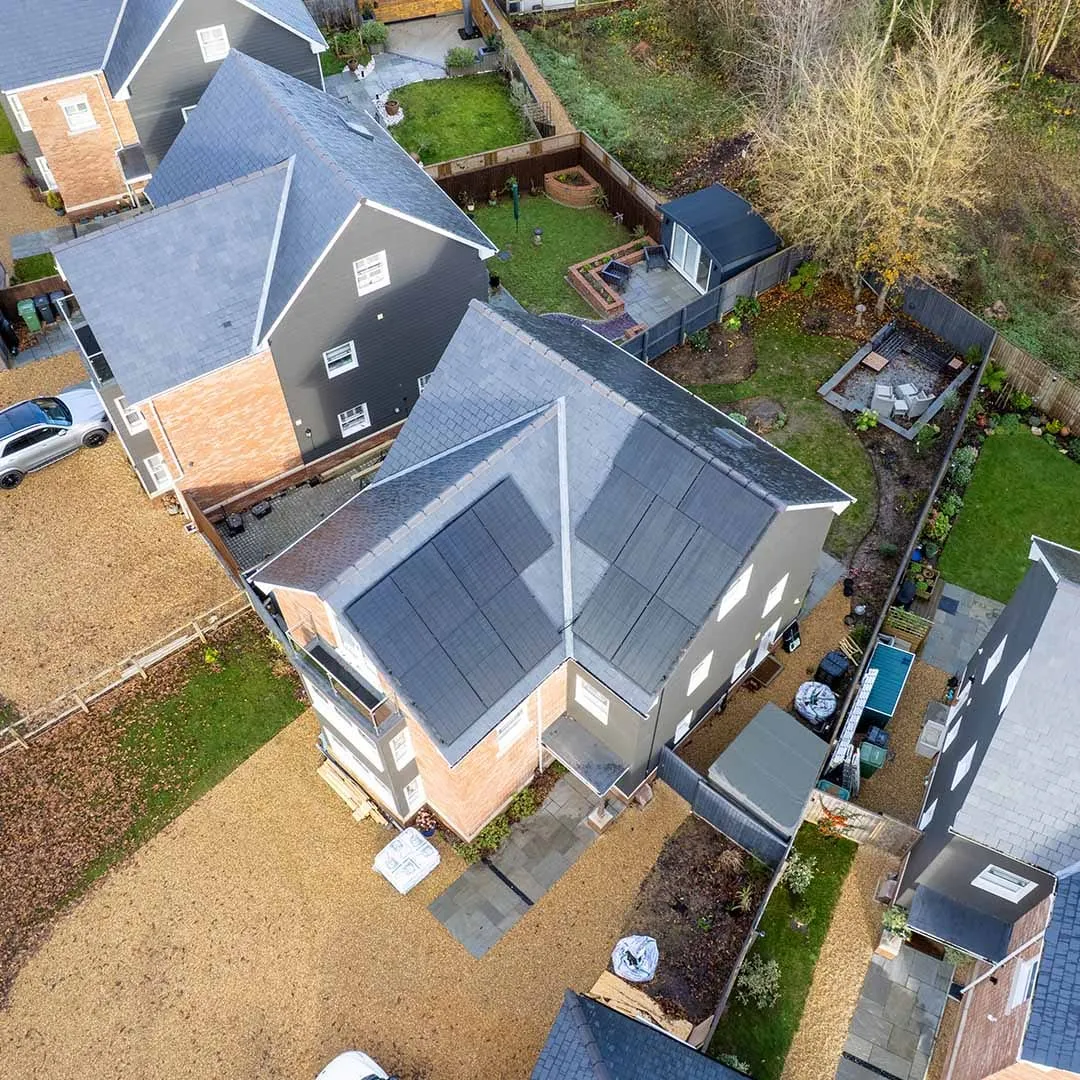
Solar panels are a fixed asset bolted to your roof, so it’s a fair question: does home insurance actually cover them, and will adding panels push your premium up? The short answer is that for most UK homeowners, cover comes as a straightforward extension of buildings insurance at little or no extra cost — but there are enough exceptions, exclusions and claims-process quirks that it’s worth twenty minutes checking your policy rather than assuming you’re covered. This guide works through home policies, when premiums genuinely move, what happens when you actually claim after a storm or fire, and how commercial solar insurance differs for businesses.
Are solar panels covered by standard home insurance?
In most cases, yes. Panels fixed to your roof are legally part of the building’s structure, so they typically fall under buildings insurance, not contents. Most mainstream UK insurers (Aviva, Direct Line, LV=, Admiral and the specialist panels of most price-comparison sites) will cover roof-mounted domestic solar arrays as standard, provided you tell them the panels exist.
That last point is the one people miss. Buildings insurance policies generally require you to notify your insurer of material changes to the property — and a 4kW solar array (typically costing £6,000–£8,000 installed in 2026, per current UK trade pricing) is a material change. Failing to declare it can, in the worst case, give an insurer grounds to reduce or refuse a claim, not just on the panels but on the roof itself if a related fault is found. It costs nothing to send a two-line email or make a five-minute call after your MCS-certified installer finishes the job — see thecostofsolar’s breakdown of typical 2026 installed prices if you want to sanity-check your installer’s quote first.
What’s usually covered as standard:
- Storm and wind damage to panels and mounting brackets
- Fire damage (from any cause, not just the panels themselves)
- Falling objects (branches, aerials, debris)
- Theft of accessible components, though roof-mounted panels are rarely stolen — inverters and battery units kept at ground level are the more common target
- Accidental damage — but only if you’ve paid for accidental damage cover as an add-on, which many standard buildings policies don’t include by default
What’s commonly excluded or capped:
- Wear and tear, including the gradual output decline every panel experiences (modern N-type panels degrade roughly 0.4% a year and are rated for 25–30+ years, which is a manufacturer performance warranty issue, not an insurance one)
- Manufacturing defects — again, this sits with the panel warranty, not your home insurer
- Damage during unrelated building work by a third party, unless that party’s own liability insurance covers it
- Some policies cap the “high-value additions” they’ll pay out on solar equipment specifically, particularly older or legacy policies written before rooftop solar was common
If you’re behind on this, an MCS-certified installer will normally include the exact panel spec, wiring diagram and inverter serial number in your handover pack — keep this. Insurers ask for it at claim stage, and without MCS certification you also lose Smart Export Guarantee eligibility, which is a separate but related reason to keep the paperwork tidy.
Batteries and inverters: same cover, different scrutiny
Home battery storage (typically £4,000–£8,000 installed, or roughly £400–£700 per kWh — a Tesla Powerwall 3 at 13.5kWh usually lands around £8,500–£10,500 fitted) is usually covered under the same buildings policy extension as the panels themselves, since it’s a fixed installation. But because lithium battery units are a comparatively newer risk category for UK insurers, some do ask specific questions at renewal: where is the battery mounted (garage vs. habitable space), is it wall-mounted per manufacturer instructions, and was it installed by a certified installer. Answer these honestly — a battery fire is a genuinely different risk profile to a roof panel fire, and misdeclaring the installation location is one of the few things that can void a claim outright.
Inverters (string inverters typically last 10–15 years and cost £500–£1,000 to replace) are covered as part of the system too, though because they’re the most failure-prone component, insurers will expect to see it was faulty/damaged by an insured event rather than simply worn out.
When does adding solar actually move your premium?
Here’s the more nuanced reality: for a typical domestic rooftop array, premium increases are usually small to negligible — often nothing at renewal, sometimes a few pounds a month. Underwriters price on rebuild cost and risk, and a well-installed MCS-certified system on a domestic roof doesn’t meaningfully change either for most insurers.
Premiums are more likely to move when:
- Rebuild cost rises. More equipment on the roof and a higher electrical spec can nudge up the sum insured for the buildings policy, which is what actually drives premium, not the panels’ market value.
- You add a large battery or multiple battery units, especially if declared as a higher-capacity commercial-style setup in what’s still a residential policy.
- You’re in a flood-risk or subsidence area where insurers are already pricing conservatively — solar isn’t the driver here, but it can be the item that prompts a fuller property reassessment at renewal.
- You switch to a specialist “green home” insurer — some genuinely price these systems more favourably, others simply market around it, so compare like-for-like rather than assuming a green-branded policy is automatically cheaper.
If your premium jumps sharply and unexpectedly after declaring solar, ask the insurer directly what changed the sum insured calculation — it’s a fair question and a well-run insurer should be able to answer it in plain terms.
What happens when you actually claim: storm and fire
Storm damage is the most common domestic solar claim. Process is usually:
- Photograph the damage before anything is moved or repaired, including wide shots of the roof and close-ups of the panels/mounts.
- Report to your insurer promptly — most policies have a “notify without unreasonable delay” clause, and delay can complicate a claim even when it doesn’t invalidate it.
- Get your original MCS installer (or another MCS-certified installer if the original firm has ceased trading) to provide a damage assessment and repair quote — insurers will often want this rather than relying on a generalist builder’s estimate for the electrical components.
- The insurer’s loss adjuster assesses; for straightforward storm damage to a small number of panels this is often resolved within a few weeks, though multi-property regional storm events can extend timelines simply due to claim volume.
Fire claims follow buildings insurance process generally, but with one added wrinkle: if the fire is suspected to originate from the solar installation itself (an inverter fault or DC isolator fault, for instance — both genuine, if rare, causes of UK domestic solar fires), the insurer may commission an independent electrical investigation before settling. This is standard practice, not an attempt to avoid paying out, and having MCS documentation and annual/periodic inspection records speeds it up considerably. If you’ve never had your system checked since installation, a maintenance and inspection specialist can produce exactly this kind of paperwork trail, which matters far more at claim time than most homeowners expect.
Commercial solar insurance is a different animal
For businesses — warehouses, factories, farms, care homes, schools — solar insurance sits inside a materially different framework to a domestic policy, for three reasons.
Scale changes the underwriting. A commercial rooftop array (installed cost typically £900–£1,200 per kWp) or a ground-mounted solar carport is usually insured either under the property’s existing commercial buildings policy as a specified item, or under a standalone renewable energy policy for larger installations. Insurers will often want an engineer’s report, O&M (operations and maintenance) schedule, and confirmation of DNO (Distribution Network Operator) grid connection compliance before quoting.
Business interruption becomes relevant. If a warehouse or distribution centre generates a meaningful share of its energy cost savings from solar, a serious fire or storm event that takes the array offline can be a business interruption issue as well as a straight property damage claim — worth discussing explicitly with a broker rather than assuming it’s automatically bundled. This is a live consideration for warehouse operators sizing up rooftop solar or factories weighing a larger industrial array, where the system is sized to offset a meaningful chunk of a much larger energy bill.
Ownership structure changes who insures what. If a system is financed through a Power Purchase Agreement (PPA) or asset finance arrangement rather than owned outright, the insurance obligation is usually specified in the contract — sometimes the finance provider insures the hardware and the host business insures the building, sometimes it’s bundled. Always get this in writing before signing; it’s a common source of disputes when a claim arises and neither party is sure who was supposed to hold cover. Businesses exploring solar PPAs or asset finance routes into a commercial array should ask the finance provider this question directly during due diligence, not after signing.
For a landlord or commercial property owner adding solar as part of MEES compliance work, it’s also worth checking whether your existing commercial buildings insurer needs formal notification before installation begins, since some require sign-off on structural loading calculations for larger rooftop arrays — a commercial property-focused installer will usually have handled this before and can flag it early rather than leaving it as a post-installation surprise.
VAT, grants and the insurance angle
None of the current 0% VAT relief on residential solar and battery installations (running until 31 March 2027 in Great Britain, before a scheduled return to 5%) or the England farm sector’s Improving Farm Productivity grant (around 25% of eligible cost — not the 40% FETF figure sometimes wrongly quoted, and rates differ by UK nation) affect your insurance position directly. But keep every invoice, grant confirmation letter and MCS certificate together in one folder regardless — it’s the same paperwork an insurer will ask for at claim time as proof of installation date, cost and certified fitting standard, so there’s no extra admin in doing it once, properly, at installation.
The practical checklist
- Tell your buildings insurer as soon as the system is fitted — don’t wait for renewal
- Keep MCS certification, the installer’s handover pack and all invoices in one place
- Check whether accidental damage is included or needs adding separately
- Ask explicitly how a battery unit is treated if you have one, and confirm its mounting location matches what’s declared
- For commercial systems, clarify PPA/finance insurance responsibility in writing before signing
- Photograph your installed system now, while it’s undamaged — it’s the single most useful thing to have ready if you ever need to claim
Solar panel insurance, in the end, mostly rewards good admin rather than a special policy. Declare the system, keep the paperwork, and for most UK homes the cover is already sitting inside the buildings policy you’re paying for anyway.