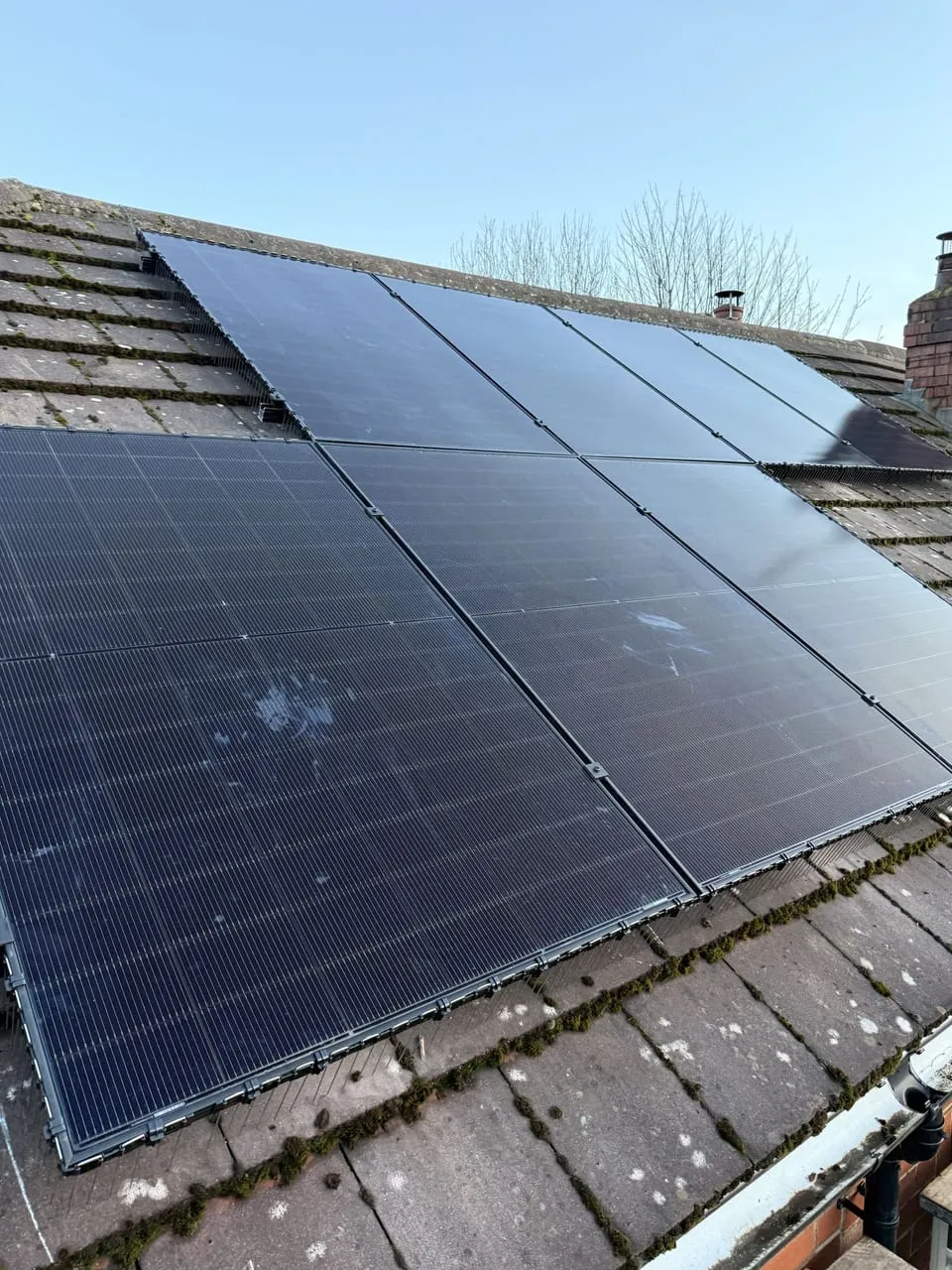
A blown isolator switch, a corroded MC4 connector, a single cracked panel after a storm — solar faults are rarely as expensive to put right as homeowners fear, but the invoicing around them is confusing. This guide breaks down what a UK repair callout actually costs in 2026, what the common faults are priced at, and when a “repair” is really a false economy compared with a proper re-do.
The callout fee: what you’re paying for before any parts
Most UK solar and electrical firms charge a standard callout of £100-£250 for a fault-finding visit. That figure typically buys you:
- Travel time and a qualified electrician or MCS-certified installer on site
- Diagnostic time — checking string voltages, inverter fault codes, isolator continuity, and DC/AC connections with a multimeter and (where needed) an IV curve tracer
- A written fault report, sometimes rolled into the first hour of labour
Anything beyond the initial diagnosis — a part swap, a rewire, a panel replacement — is quoted separately once the fault is confirmed. Some firms waive the callout fee if you go ahead with the repair; always ask upfront. If your system is still within its installer’s original workmanship warranty (commonly 2-10 years depending on the contract), the callout may be free — check your paperwork before booking an independent electrician, because a third party attending can sometimes affect a manufacturer or installer warranty on the original work.
For a system generating no power at all, a call-out is worth it fast: an idle 4kW array is losing roughly £3-£5 a day in avoided import costs at current tariffs, so a week of downtime can easily outweigh the diagnostic fee.
Common faults, priced
No two callouts are identical, but the faults below account for the large majority of UK residential repair jobs. Prices are labour + typical parts, fitted, and assume the callout fee above is separate (or already included, per your quote).
| Fault | Typical fix | Approx. cost (parts + labour) |
|---|---|---|
| DC isolator switch failure (a very common cause of nuisance shutdowns and a known fire-risk item on older installs) | Replace isolator | £150-£350 |
| AC isolator fault | Replace isolator | £120-£250 |
| Corroded/failed MC4 connector | Re-terminate or replace connector | £80-£200 per connector |
| Single panel underperforming or dead (blown bypass diode, delaminated cell, hotspot) | Diagnose + replace one panel | £300-£600 including panel |
| Cracked panel (hail, falling branch, foot traffic) | Replace panel | £350-£700 depending on wattage/availability |
| Inverter fault code / nuisance trip | Firmware reset, fan/capacitor replacement, or config fix | £100-£300 |
| Full string inverter failure (out of warranty) | Replace inverter | £500-£1,000+ for a typical domestic string inverter |
| Optimiser or micro-inverter failure (per unit) | Replace optimiser/micro | £150-£300 per unit |
| Rodent or bird damage to cabling under panels | Clear nest, re-run/repair cable, fit bird guard | £150-£400 |
| Roof mounting/flashing issue (leak, loose rail) | Re-seal flashing, tighten/replace mounting | £200-£500 |
| Monitoring/comms fault (no app data, dongle failure) | Replace Wi-Fi/comms dongle | £80-£180 |
A few things worth knowing about these numbers. First, connectors and isolators are disproportionately common faults precisely because they’re the parts most exposed to UV, thermal cycling and moisture ingress over 10-15 years outdoors — this isn’t a sign of a badly-installed system, it’s normal wear on hardware that lives on a roof. Second, panel replacement cost depends heavily on whether your original panel model is still in production; if it’s been discontinued, you may need a close-wattage substitute, which occasionally means minor rewiring to balance the string. Third, inverter replacement is the single biggest swing item — a string inverter typically lasts 10-15 years against a panel life of 25-30+, so if your system is past its first decade, budget for this as a “when” not “if” cost.
Repair vs. re-do: the judgement call
This is where most of the money gets wasted, in both directions — over-repairing systems that should be replaced, and over-replacing systems that just need a targeted fix.
Repair makes sense when:
- The fault is isolated to one component (a connector, an isolator, one panel) and the rest of the array tests healthy
- The system is under 10 years old and the inverter still has useful life left
- Replacement parts for your exact panel/inverter model are still available
- The repair cost is a small fraction (say under 15-20%) of what a full re-do would cost
A re-do (or partial re-do) starts to make more sense when:
- You’re facing your second or third inverter fault in a few years — a pattern, not a one-off
- Multiple panels are underperforming simultaneously, suggesting a batch/manufacturing issue rather than isolated damage
- The original install used now-obsolete panel wattages or connector standards, making like-for-like repair impossible
- You’re already having roof work done (re-roofing, extension) and it makes sense to re-rack and upgrade panels while the array is off anyway
- Your system predates modern DC isolator safety recommendations — some older installs (particularly pre-2015) have wiring or isolator configurations that no longer meet best practice, and a partial repair won’t fix that underlying risk
A genuinely useful sense check: get the repair quote and a fresh “what would a new system of this size cost today” quote side by side. If the repair is more than a third of the cost of replacing the affected section outright, ask the installer to justify why a repair — rather than a partial re-fit — is the right call. Reputable firms will tell you honestly when a re-do is the better spend; it’s a red flag if every fault diagnosis somehow ends in “you need a whole new system.”
Who to call, and why it matters
Fault-finding on a live solar array involves working with DC voltages that don’t behave like mains AC — DC arcs don’t self-extinguish the way AC ones do, which is exactly why isolator failures are treated seriously rather than as a minor inconvenience. This is not a job for a general handyman. You want either your original installer (fastest route if the fault is within warranty) or an MCS-certified installer/electrician competent in solar-specific fault-finding.
If your original installer has gone out of business or you’re simply not local to them, national maintenance specialist Solar Maintenance Solutions focuses specifically on solar and battery O&M — fault diagnosis, panel and inverter swaps, and ongoing maintenance contracts — rather than treating a repair as an add-on to a new-install business. For homeowners in South Yorkshire, ElectriFusion Solutions covers both the electrical and solar side of a callout, useful when a fault turns out to be a wiring or consumer-unit issue rather than the panels themselves. In Central Scotland, Ecoaim handles solar and battery fault-finding around Livingston, and in Lincolnshire, Greenlinc Renewables is MCS-certified for both new installs and remedial work. South Wales homeowners are covered by FLD Electrical in Swansea, while those in West Kent can reach Hazell Electrical for combined electrical and renewables callouts.
Commercial systems: different scale, same logic
The repair-vs-re-do maths shifts for commercial arrays, mostly because downtime costs more and access equipment (cherry pickers, scaffold) adds to every callout. A failed string inverter on a 50kWp warehouse roof isn’t a £500-£1,000 job — commercial inverters and the access needed to reach them push costs materially higher, and losing a whole string’s output for weeks matters more when you’re offsetting industrial energy bills rather than a household’s. If you’re weighing up the economics of a large-scale repair against a wider system upgrade, the sector hubs at Solar Panels for Warehouses and Solar Panels for Factories set out what full commercial installs cost by scale, which is a useful anchor point when a maintenance contractor’s repair quote needs a sanity check. If the fault-finding reveals the whole array is past its economic life rather than one bad string, Commercial Solar Finance covers how a re-fit can be funded without a large upfront capital outlay.
Avoiding repeat callouts
A handful of habits meaningfully cut how often you need a fault-finding visit at all:
- Monitor your generation. Most inverters have an app; a sudden unexplained drop is the cheapest possible early warning, catching a fault before it becomes total downtime.
- Get a visual check after any storm with hail or high winds, even if generation looks normal — cracked glass can sit for months before a cell fully fails.
- Keep gutters and roof valleys clear near the array; standing water and debris accelerate connector and flashing corrosion.
- Ask for an annual or biennial maintenance visit rather than waiting for a fault. A planned visit (checking torque on connections, cleaning where needed, verifying isolator function) is usually cheaper than an emergency callout and catches small issues — a slightly loose MC4, an isolator starting to pit — before they cause an outage.
If you’re still deciding whether your system needs repair at all versus whether the underlying install was ever right for your roof, it’s worth reading up on baseline running costs and expected output — our own guide to UK solar panel costs and the solar payback period give the context for what “normal” performance and spend look like, so you can spot when a fault is actually cutting into money you were relying on the system to save.
The bottom line
Most domestic solar faults are cheap to fix relative to the size of the original investment: a callout of £100-£250, and a repair typically in the low hundreds unless a full panel or inverter needs replacing. The expensive mistake isn’t the repair bill — it’s delaying it. A dead string sitting unrepaired for a season is a bigger loss than the £150 isolator that caused it, and a pattern of repeat faults is a signal to get a proper re-do quote rather than keep patching the same array.