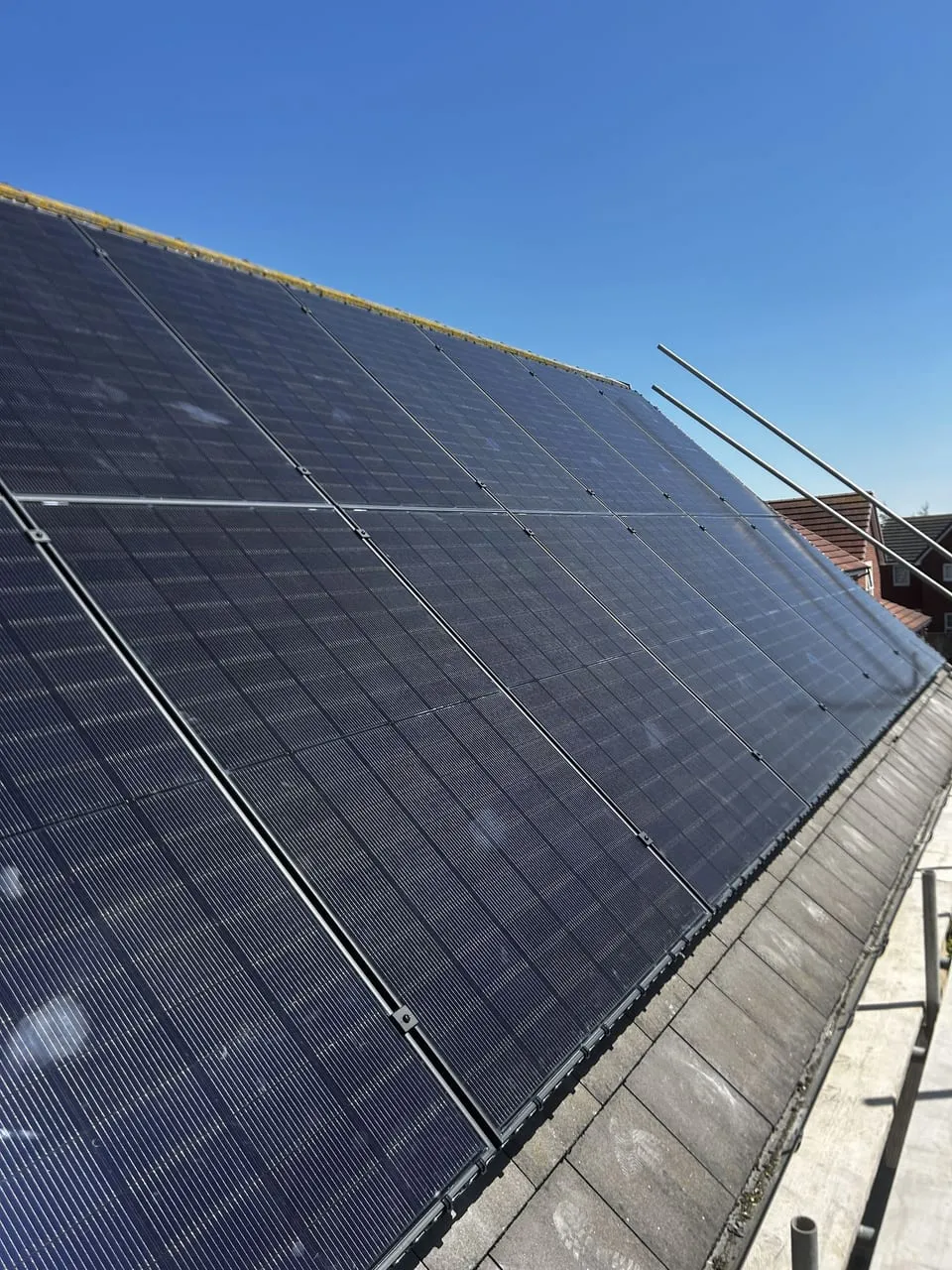
A shed roof or garden office is one of the cheapest places in the country to try solar — you’re not paying scaffolding rates, you’re not touching the main consumer unit, and in the simplest cases you’re not even involving an installer. But “shed solar” covers two completely different products at wildly different price points, and conflating them is where most people waste money. This guide separates the two, gives realistic 2026 budgets, and tells you honestly when a DIY kit is fine and when it isn’t.
Two different products, not one
“Solar for sheds” almost always means one of two things:
- A small off-grid kit — one or two panels, a charge controller, and a leisure battery, powering LED lighting, a phone charger, a radio or a low-draw fridge in a shed, summerhouse or allotment cabin that has no mains connection at all.
- A grid-tied array on a garden office or outbuilding roof — proper MCS-certified panels, a grid-tie inverter, and a connection back into the house consumer unit, sized to offset real daytime electricity use in a home office, gym or annexe.
These aren’t a small version and a big version of the same thing — they’re different electrical systems with different rules, different kit, and roughly a tenfold difference in cost. Get the categorisation right before you get a quote.
Off-grid shed kits: £300-£1,200
If the shed has no existing electrics and you just want lighting and low-power sockets, an off-grid kit is genuinely a sensible, low-risk purchase.
What’s in the box, typically:
- 1-4 monocrystalline or polycrystalline panels, usually 100W-400W each
- A PWM or MPPT charge controller (MPPT is 10-20% more efficient and worth the extra £30-£60 on anything over 200W)
- A 12V leisure/deep-cycle battery (lead-acid AGM ~£100-£180, or LiFePO4 ~£250-£450 for similar capacity but much longer cycle life and lighter weight)
- An inverter if you need 230V mains sockets rather than just 12V USB/lighting circuits
Realistic budgets:
| Setup | Typical cost | What it runs |
|---|---|---|
| Single 100-200W panel, PWM controller, small AGM battery | £150-£350 | LED lighting, phone/tool charging, a small fan |
| 2-panel 300-400W kit, MPPT controller, LiFePO4 battery | £500-£900 | Lighting, laptop, small power tools intermittently, a mini-fridge |
| 4-panel array (600-800W), larger LiFePO4 bank, pure sine inverter | £900-£1,500 | Light workshop use, longer runtime appliances, some heating (fan heaters are very battery-hungry — be realistic here) |
These are genuinely DIY-friendly. There’s no G98/G99 DNO notification because you’re not connecting to the grid, no MCS certification needed because you’re not claiming the Smart Export Guarantee, and no Part P notifiable work if you’re not touching fixed mains wiring. Most gardeners and shed-owners can mount the panel, wire the controller to the battery, and be running lights within an afternoon. The main things people get wrong: undersized cable gauge over longer runs (voltage drop kills performance), no fusing between battery and inverter, and expecting a 100W panel to run anything with a heating element.
Grid-tied garden offices: £1,200-£3,000+
The moment you want to power a proper home office, a garden gym with real equipment, or you want any exported surplus to actually earn money via the Smart Export Guarantee, you’re in different territory — and the shed/cabin roof needs to be treated like a small extension of the house electrical system.
What changes:
- Panels must be MCS-certified and installed by an MCS-certified installer if you want SEG eligibility — this isn’t optional if payments matter to you.
- You need a grid-tie inverter (string or micro-inverter), not a battery-charging setup, unless you’re adding battery storage too.
- The circuit back to the consumer unit is notifiable electrical work under Part P in England and Wales — this needs a qualified electrician (ideally one who is also the MCS installer) to sign it off.
- Your DNO (district network operator) needs a G98 notification for small systems (typically under 3.68kW single-phase) — your installer handles this, but it’s a legal step, not a formality you can skip.
Realistic budgets for a garden office/outbuilding grid-tied system:
- A small 1-2 panel (400-800W) grid-tie micro-inverter setup, professionally installed: roughly £1,200-£2,000
- A more substantial 1.5-2kW array on a larger garden building, enough to meaningfully offset a home office’s daytime draw (computer, monitors, heating/cooling, kettle): £2,000-£3,000+
- If you want a small battery alongside it for evening use, add £2,000-£4,000+ depending on capacity — this stops being a “shed project” cost bracket quickly.
Because these systems are grid-tied and residential in nature, they currently qualify for the same 0% VAT on installed residential solar and battery storage in Great Britain, in place until 31 March 2027 (scheduled to revert to 5% after). That’s a genuine saving on a professionally installed garden office array and worth confirming with your installer that it’s being applied.
Expected output is proportionate to panel count and orientation: at the UK’s typical yield of roughly 850 kWh per kWp per year (rising towards 1,050+ kWh/kWp in the sunniest southern counties with a good south-facing roof pitch), a 1kW garden office array might realistically generate 750-950 kWh annually — meaningful for a home office’s daytime consumption but not something to size a whole-house strategy around.
When DIY is genuinely fine — and when it isn’t
DIY is fine when:
- There’s no connection to the house consumer unit at all (pure off-grid, 12V system)
- You’re not claiming SEG payments
- The total system is low voltage (12V/24V) with appropriately rated cable and fusing
- You’re comfortable following the charge controller and battery manufacturer’s wiring instructions to the letter
Get a qualified electrician / MCS installer when:
- You want to connect the array back to the house grid supply, even at small scale
- You want SEG export payments (MCS certification is a hard requirement)
- The installation involves any Part P notifiable work
- You’re adding a battery that will be charged from the grid as well as solar (this is genuinely more complex wiring, with charge/discharge logic that’s easy to get wrong)
- The roof structure needs assessing for load — a summerhouse or timber-frame garden office roof isn’t always rated for the same loading as a house roof
If you’re at the point of wanting a properly specified, grid-tied garden building system rather than a leisure-battery kit, it’s worth getting it scoped by people who do outbuilding and small-structure solar specifically — solarpanelsforsheds.co.uk covers shed and outbuilding-specific installs, and solarpanelsforgardens.co.uk focuses on garden solar more broadly, including garden offices and summerhouses, where roof orientation and structural questions differ a lot from a standard house install.
A note on inverters and lifespan
Even at this small scale, the inverter is the component most likely to need replacing before the panels do. Modern N-type panels (TOPCon, HJT, or ABC cell designs, now common even on smaller residential-scale kits) degrade at roughly 0.4% a year and are routinely rated for 25-30+ years of service. String inverters, by contrast, typically last 10-15 years and cost £500-£1,000 to replace — a cost worth budgeting into any grid-tied garden office system from day one, even though it feels like a long way off at installation.
Getting a local quote for a grid-tied system
For anything beyond a plug-and-play off-grid kit, get at least two or three quotes from installers who’ll actually visit the site — garden building roofs vary hugely in pitch, shading and structure, and a desk-based quote is unreliable. If you’re in South Yorkshire, electrifusionsolutions.com covers Doncaster and the surrounding area for exactly this kind of smaller-scale residential and outbuilding work, and in Central Scotland, ecoaim.co.uk does solar and battery installs around Livingston, including smaller garden and outbuilding projects alongside full house arrays. If you’re further south, sola-uk.com serves Hertfordshire and the Home Counties, and would be a sensible call for a garden office array in that region.
Where a shed array fits in the bigger picture
A shed or garden office solar kit is never going to be the thing that meaningfully cuts your household electricity bill — even a decent 2kW grid-tied array is a fraction of a typical 4kW house system (installed for roughly £6,000-£8,000 today) that would actually offset most of a home’s daytime demand. If the real goal is household savings rather than powering a workshop or office in isolation, it’s worth reading our full breakdown of UK solar panel costs or running the numbers through a solar payback period calculator before deciding whether the money is better spent on a proper roof-mounted house system instead. For anyone weighing up a battery alongside either option, our battery storage cost guide covers the same 2026 price bands referenced here in more depth.
If your “shed” is actually a substantial outbuilding being used commercially — a workshop, small studio-for-hire, or anything drawing business rates — the rules and available support shift again; businesssolarcalculator.co.uk is a useful starting point for estimating ROI once a project moves from domestic garden scale into small commercial territory.
The bottom line
A £300-£500 off-grid kit is a sound, low-risk purchase for basic shed lighting and charging, and there’s no reason not to fit it yourself if you’re reasonably competent with 12V wiring. The moment you want SEG payments, meaningful daytime power for a garden office, or anything connected back to the house grid, budget £1,200-£3,000+, use an MCS-certified installer, and expect the DNO notification and Part P sign-off to be part of the job — not an optional extra. Match the spend to what you actually need the shed to do, and the numbers stay sensible either way.